
"VIGNETTES OF MY YEARS AS YOUTH ALIYAH CHAIRMAN"
ADDRESS BY MRS. CHARLES E. WYZANSKI, JR.
to
The National Youth Aliyah Committee of Hadassah
January 7, 1958
CHAIRMAN SCHOOLMAN'S INTRODUCTION: Those of us who were privileged to hear and to read the two sparkingly brilliant reports which were given, one last May 7th by Mrs. Edward Jacobs on the early history of Hadassah's association with Youth Aliyah, and one last month by Mrs. Greenberg on her five years of stewardship as Hadassah's first Youth Aliyah Chairman who fashioned the pattern for Youth Aliyah and helped establish it, felt very much rewarded and very much inspired, I am sure, by the saga of these impressive pioneering accomplishments in behalf of Youth Aliyah! It gave us a much broader horizon on what Youth Aliyah can be, has been, and will be in the years ahead.
Even these few days since we circulated Mrs. Greenberg's report, I have already heard from many of you who called to say how exciting her report was, and to express your appreciation of it.
Today we are going to be rewarded by hearing Gisela Wyzanski - who followed Mrs. Greenberg as Youth Aliyah Chairman - bring us some of the sad background which marked her earlier efforts with Youth Aliyah in Germany even before she came to us as Gisela Warburg, and before she brought to Youth Aliyah in the United States where she served as the second Chairman of Youth Aliyah - a world of new charm and dedication.
Gisela left Youth Aliyah only to get married and to become Mrs. Charles E. Wyzanski Jr., and to that we have had to agree. But in reality she didn't really leave Youth Aliyah at all, because in Boston where she has been living these many years, she has served in almost every capacity in behalf of Youth Aliyah.
I take special pleasure in presenting Gisela Wyzanski for what I know will be a moving report on her experiences.
MRS. CHARLES WYZANSKI: I want to begin the way Marian began. You forced me to reread and rethink the past and I can't tell you how much I enjoyed almost reliving everything that we went through.
Marian complained about a lack of material and if Marian complained I can only tell you, living in the sticks, I was in a much worse predicament. You said something about my youth. However, the Hadassah office made me feel as if I was a piece left from antiquity. They said about that period we have no files, implying it was ancient history. My files were desperately incomplete; so in despair I decided that there might be merit in not weighing you down with too many facts and figures. The fact that I don't remember them makes it likely that you would not remember them either; therefore I would rather share with you, in the form of vignettes, certain incidents that I shall never forget.
As Bertha has told you, I asked for permission not to speak about the years of my so-called formal chairmanship. By the way, I discovered to my astonishment that they stretched from 1940, far beyond my marriage in 1943, to 1950 when I was still registered as Vice-Chairman. This I would not have remembered at all. I was equally at a loss to remember when I stopped and when Lola began, because actually Lola and I worked so closely together before I "passed on" and for a while after I "passed out," that there was no division in these years.
On rereading the material and rethinking everything, there were two things that struck me most. First of all I realized that we should say every day a "Shehecheyanu."
I don't think we are gratefully and consciously enough aware of the tragedy and sufferings which we no longer face. First, in those years we perpetually came too late. Why too late? Because there were not sufficient certificates of immigration. Secondly, the story of each group in those years from the day they had to flee until they arrived in Palestine covered a minimum of two years but sometimes three or four years. There was war; there was persecution; there was Aliyah Bet (illegal immigration) and there was so much loss of life, so much suffering, that if you think of the groups that come in today and who can go straight to Israel because there is an Israel whose gates are wide open, then we should make a "shehecheyanu" every day for the existence of Israel and for having lived through these times and as far as the Jewish people are concerned, having reached a brighter horizon.
The second thing that struck me was an awareness of how profoundly Henrietta Szold's personality permeated and shaped Youth Aliyah. While some other spirit has been preserved in Youth Aliyah, something has gone which is irreplaceably lost. Perhaps for Henrietta Szold's sake it was good that she didn't live to a time when there were eighty-five thousand children in Youth Aliyah, because until her death she had a personal relationship with every Youth Aliyah child, not only to those in training but to the graduates too. She would have suffered had this grown into a movement where that degree of personal relationship would no longer have been possible.
I have always been blamed for speaking too impersonally and too unemotionally and I found to my horror that if I am to talk to you about these years of Youth Aliyah, it is almost going to be an autobiography. Because before I was married, the central guiding motive of my life was Youth Aliyah and therefore I can't help but really almost describe my life to you as I describe Youth Aliyah, and you might blame me today that I speak too personally.
I would like to begin with the first time I met Henrietta Szold, because it was through her that Youth Aliyah became the major content of my life.
I had heard of Youth Aliyah, of course, in Germany from 1934 on, and I had wanted to work with this movement. So I had gone to the only person whom I had known in Youth Aliyah at that time, Eva Michaelis Stern, who worked in the Arbeitsgemeinschaft for Youth Aliyah in Berlin and when I came to her and said I would like to help, she said, "That's wonderful - all you have to do is speak in public and raise funds."
I said I would rather be dead than open my mouth in public and that I was no good at raising funds. This I stuck to until Marian Greenberg got hold of me - many years later.
When I went to Palestine in 1935, I wanted to see Youth Aliyah in action. I knew Miss Szold was the head, I did not know her personally but my Aunt did, and with inborn chutzpah I marched myself into her office and I told her I would like to see Youth Aliyah. Henrietta Szold said, "Tomorrow morning I am meeting a group of children who are arriving in Haifa to go to Givat Brenner." (This was about the fifth or sixth group of Youth Aliyah children that came to Palestine.) She said: "You are more than welcome to come along. Be here at 7 o'clock for breakfast and then we'll go by bus."
I don't want you to think that a bus ride then was like a bus ride today. I have never been over such cobbled roads in my life. We arrived in Haifa only to find that it being too stormy for the boat to dock at Haifa, it had proceeded to Jaffa.
MRS. SCHOOLMAN: Henrietta Szold was seventy-eight years old then.
MRS. WYZANSKI: Henrietta Szold was very upset when she found out that we had missed the bus and were forced to hire a taxi. This was typical of her and her attitude toward spending public funds.
I had never gone with such a mad driver over such terrible roads. While I was making my will Miss Szold slept like a rock. I was exhausted by the time we reached Tel-Aviv. But from Tel-Aviv we got ourselves to Jaffa.
In those days it was very difficult to get into the port. The British Mandatory Power had to grant special permission. Henrietta Szold's permission was only good to enter the port of Haifa, not the one in Jaffa. So for two or three hours we stood in front of the barrier at the Jaffa port and by this time it was, I think, 3:30 and I was absolutely starved but I didn't dare to say anything. Finally Henrietta Szold remembered that we had not had any lunch. She called an urchin who was running around and asked him to buy us some sandwiches. So we ate our sandwiches standing at the barrier until we were admitted.
Henrietta Szold held a list containing the names of the children who were due to arrive. As you realize, in those days every child's certificate was made out to name. It was a personal visa. So for months she had been corresponding about the child with the German office, had made personally the application for the certificate to the High Commissioner, and the name was familiar to her long before she met the child.
So as the children came out, she read out the list of names and then all she had to do was to identify the face with the name—and after five minutes until the end of her life, she knew the name of that child forever. Thus she welcomed every group and each one of the thousands of children.
Then came the luggage and I think Marian Greenberg mentioned in her report that in the beginning there was an abundance of luggage because the German parents felt that this was their last chance to give the child a life-time trousseau and instead of the very strictly prescribed equipment which the children were to bring—just working clothes and for Shabbat not more than one or two sets of clothing—they brought everything.
I remember there was one suitcase that burst open and out of it fell Goethe and Schiller and Henrietta Szold bent down to pick up one of these books and said—and by the way she spoke the most beautiful and old fashioned, classical German, having studied Hermann and Dorothea with her father in early youth—"Please preserve that. This culture you should not forget."
It was too late that evening for the children to proceed to Givat Brenner where a great welcome celebration to which Chaim Weizmann had been invited was planned. And so it was decided that the children were to be taken to the immigrant's hostel and Miss Szold quickly arranged for refreshments and some little things to make it a festive evening. The children were taken to the hostel while Henrietta Szold called her pension where she stayed when she was in Tel Aviv and asked whether there would be two rooms available, and I shall never forget—she turned to me with rather an expression of dismay and said, "They have only one room—do you mind sharing a room with me?" You can imagine my reaction that she, the seventy-eight year old woman, should ask me whether I would mind.
Even then Henrietta Szold mentioned the need of a reception center because she felt that the most important day in the life of these children is the day of their welcome in Palestine; this should be a day that they would remember forever and she felt badly that this group should spend its first evening in this make-shift hostel.
There were touching speeches by the children. One spoke in Hebrew, others in German. Henrietta Szold spoke in German. Afterwards there was dancing of the Hora, and I can only assure you Henrietta Szold long out-danced me.
Then we went back to the pension and I don't know when she had last shared a room with someone. I remember we were like naughty children who talked after the light was out, and I learned a lot from her about Youth Aliyah.
The next morning at 5 o'clock I heard a weird noise. Henrietta Szold was up doing calisthenics. This she always did, and then she concentrated on her correspondence, mended some of her clothes and by seven o'clock when I got up, she had done a day's work.
She had to return to Jerusalem but she persuaded me to go with the group to Givat Brenner, to live through the first day with them and see how the children settled down. It was an unforgettable experience to see how the Kibbutz welcomed them and took these children into their hearts. Serini, the founder of Givat Brenner, was still alive and was the spirit of that party.
By the time I came back to Jerusalem I had decided I would stay in Palestine and work for Youth Aliyah. I cabled my parents accordingly but their answer somehow persuaded me to go back. However, I agreed with Henrietta Szold then and there that if I was going back it was only to work in the German Youth Aliyah.
The director of the German Youth Aliyah, or rather the Judische Jugendhilfe—that arm of the organization which dealt with the selection and preparation of the children—was then George Josepfthal. You have read about him very recently. He carried on the negotiations for a possible arms supply from Germany for Israel. He has been the Treasurer of the Jewish Agency for many years and is now the Secretary of the Labor Party.
The first month I spent at the preparation camp, which in those days was very much the heart of the Youth Aliyah work in Germany.
When a child registered with Youth Aliyah, Youth Aliyah became almost its parent. That is, it was we who tried to see to it that the child would do something useful - in view of its future in Palestine - between the enrollment and Aliyah, and the time between enrollment and Aliyah was sometimes very long.
Every child spent four weeks in the preparation camp where the routine was as much as possible adapted to its later Youth Aliyah life in Palestine: four hours physical work and four hours lessons and life in a community.
By the way, while this camp was going on, Henrietta Szold visited Berlin and I was the lucky girl who was assigned as her chauffeur. I spent much time with her in Berlin. Marian Greenberg in her report, mentioned a meeting which I shall never forget, where Henrietta Szold spoke to the parents whose children were now her charges and to prospective parents of Youth Aliyah children. The parents considered her the foster mother and every parent afterward came up and asked about his or her child and showed photos.
Henrietta Szold was deeply moved that night, especially by the unexpected introduction. Any refugee will understand why it meant so much to her.
She was introduced by Mr. Seeligsohn. Mr. Seeligsohn was then the head of the "Reichsvertretung der Deutschen Juden." He was later killed in a concentration camp. His wife lives today here in New York.
I would like to read to you what she wrote to her sister about that introduction:
"The speaker, a Mr. Seeligsohn began by saying that fifty-three (I think it is fifty-three) years ago the Philadelphia community had arranged a commemoration service in honor of Moses Mendelssohn's hundredth birthday, and could find no one better to deliver the address than the Rabbi of the Oheb Shalom Congregation of Baltimore. The speaker then proceeded to analyze the address our father delivered; and he used it to demonstrate the love of the Jew for German literature, the German language, the German people and his identification with them. He continued to quote from our father's sermons striking passages, many of which I remembered. The inference was that in this way I was prepared to take up work for the German immigrants, especially German youth.
"Can you imagine my consternation and embarrassment and pride? Or doesn't the incident affect you as it did me? Perhaps my fortunes make a difference. You have remained more or less in your milieu. You have no need to legitimize yourself. Your background is known and recognized. Ever since I have been living in Palestine, I have had the feeling that I hadn't the protection of the rock from which I was hewn. And here suddenly the rock was the important feature. I confess I felt solemn and touched."
My mind is filled with emergency pressures and fears of these years from 1935-38 in Berlin. I remember one of the many times when there was fear that immigration to Palestine would be stopped. Our last precious hundred certificates were only valid for three weeks. It meant getting a hundred children ready to leave Germany within three weeks - desperately short weeks. A precious passport would only be issued after receipt of payment of flight tax had been obtained, and after an exit visa had been procured - a very difficult thing to get - then only could transit and a Palestinian visa be received. Transportation had to be arranged; the medical certificates had to be supplied. I remember on the wall in the office in Berlin was a day by day schedule of what parts of this intricate plan had to be checked off every day. I spent hours with Nazi officials, consuls, to obtain the necessary papers and on the long distance telephone with parents all over Germany to assemble missing papers.
But the day finally came when the hundred children were ready to leave. Grete Kitzinger, then the Director of Youth Aliyah who has in the meantime died, accompanied the children to the border as there had been no time to mail their papers back to them. She had one suitcase full of precious passports and the many papers needed in addition and she handed them back to the children as they boarded the train at various stations.
The farewell scenes in Berlin I shall never forget, especially not this one because it was at the same time both the saddest and the happiest experience that any human being could live through. On the one hand the families, mothers, brothers and sisters, fathers, if they had not disappeared, and friends seeing these children off with a very fair premonition that they would never see them again; and on the other hand the happiness, the yelling of Shalom and L'Hitraot with a sort of hope against hope that you would see them again in Palestine and that at least these children were starting out on a better future.
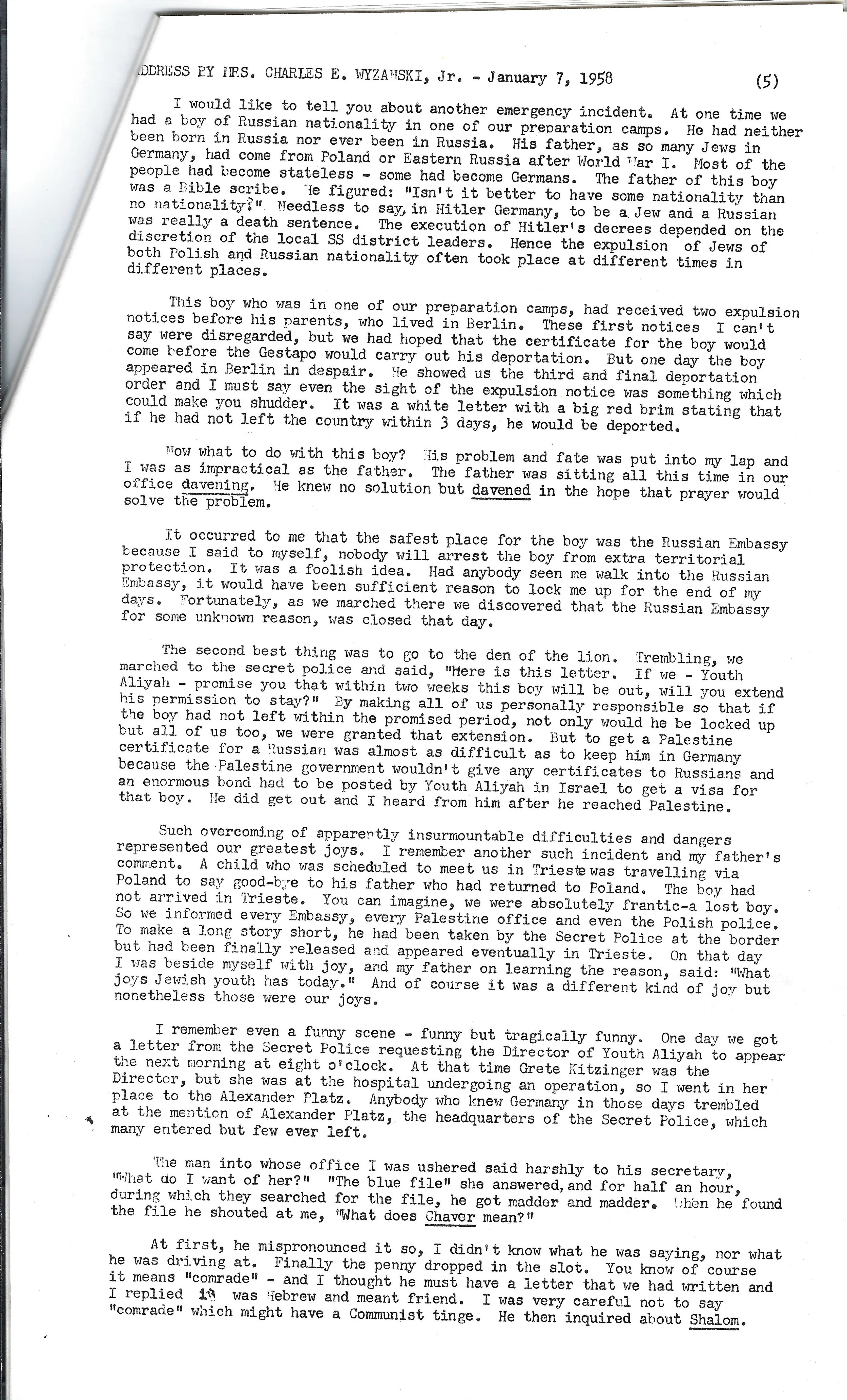
I would like to tell you about another emergency incident. At one time we had a boy of Russian nationality in one of our preparation camps. He had neither been born in Russia nor ever been in Russia. His father, as so many Jews in Germany, had come from Poland or Eastern Russia after World War I. Most of the people had become stateless - some had become Germans. The father of this boy was a Bible scribe. He figured: "Isn't it better to have some nationality than no nationality?" Needless to say, in Hitler Germany, to be a Jew and a Russian was really a death sentence. The execution of Hitler's decrees depended on the discretion of the local SS district leaders. Hence the expulsion of Jews of both Polish and Russian nationality often took place at different times in different places.
This boy who was in one of our preparation camps, had received two expulsion notices before his parents, who lived in Berlin. These first notices I can't say were disregarded, but we had hoped that the certificate for the boy would come before the Gestapo would carry out his deportation. But one day the boy appeared in Berlin in despair. He showed us the third and final deportation order and I must say even the sight of the expulsion notice was something which could make you shudder. It was a white letter with a big red brim stating that if he had not left the country within 3 days, he would be deported.
Now what to do with this boy? His problem and fate was put into my lap and I was as impractical as the father. The father was sitting all this time in our office davening. He knew no solution but davened in the hope that prayer would solve the problem.
It occurred to me that the safest place for the boy was the Russian Embassy because I said to myself, nobody will arrest the boy from extra territorial protection. It was a foolish idea. Had anybody seen me walk into the Russian Embassy, it would have been sufficient reason to lock me up for the end of my days. Fortunately, as we marched there we discovered that the Russian Embassy for some unknown reason, was closed that day.
The second best thing was to go to the den of the lion. Trembling, we marched to the secret police and said, "Here is this letter. If we - Youth Aliyah - promise you that within two weeks this boy will be out, will you extend his permission to stay?" By making all of us personally responsible so that if the boy had not left within the promised period, not only would he be locked up but all of us too, we were granted that extension. But to get a Palestine certificate for a Russian was almost as difficult as to keep him in Germany because the Palestine government wouldn't give any certificates to Russians and an enormous bond had to be posted by Youth Aliyah in Israel to get a visa for that boy. He did get out and I heard from him after he reached Palestine.
Such overcoming of apparently insurmountable difficulties and dangers represented our greatest joys. I remember another such incident and my father's comment. A child who was scheduled to meet us in Trieste was travelling via Poland to say good-bye to his father who had returned to Poland. The boy had not arrived in Trieste. You can imagine, we were absolutely frantic - a lost boy. So we informed every Embassy, every Palestine office and even the Polish police. To make a long story short, he had been taken by the Secret Police at the border but had been finally released and appeared eventually in Trieste. On that day I was beside myself with joy, and my father on learning the reason, said: "What joys Jewish youth has today." And of course it was a different kind of joy but nonetheless those were our joys.
I remember even a funny scene - funny but tragically funny. One day we got a letter from the Secret Police requesting the Director of Youth Aliyah to appear the next morning at eight o'clock. At that time Grete Ritzinger was the Director, but she was at the hospital undergoing an operation, so I went in her place to the Alexander Platz. Anybody who knew Germany in those days trembled at the mention of Alexander Platz, the headquarters of the Secret Police, which many entered but few ever left.
The man into whose office I was ushered said harshly to his secretary, "What do I want of her?" "The blue file" she answered, and for half an hour, during which they searched for the file, he got madder and madder. When he found the file he shouted at me, "What does Chaver mean?"
At first, he mispronounced it so, I didn't know what he was saying, nor what he was driving at. Finally the penny dropped in the slot. You know of course it means "comrade" - and I thought he must have a letter that we had written and I replied it was Hebrew and meant friend. I was very careful not to say "comrade" which might have a Communist tinge. He then inquired about Shalom.
Finally he showed me our circular letter and shouted, "To whom did you send this letter?" This letter had been addressed to children who had been in the preparation camp. We had at that time no certificates. It was a letter of consolation to these children asking them to make good use of their time until they could go to Aliyah. We asked them to tell us whether they were learning Hebrew. This letter, to our horror, had gone by mistake to an SS District Leader.
You can imagine what names he called me. If we didn't stop this kind of practical joke he would close our organization, and anyhow he wanted exact figures of how many people we were getting out per week, per month, because if we didn't get enough people out they were not interested in allowing us to exist.
When I got out of that place alive, I had a hysterical fit of laughter - it was a kind of reaction of relief; the thought of the SS leader being asked whether he was learning Hebrew certainly was some practical joke!
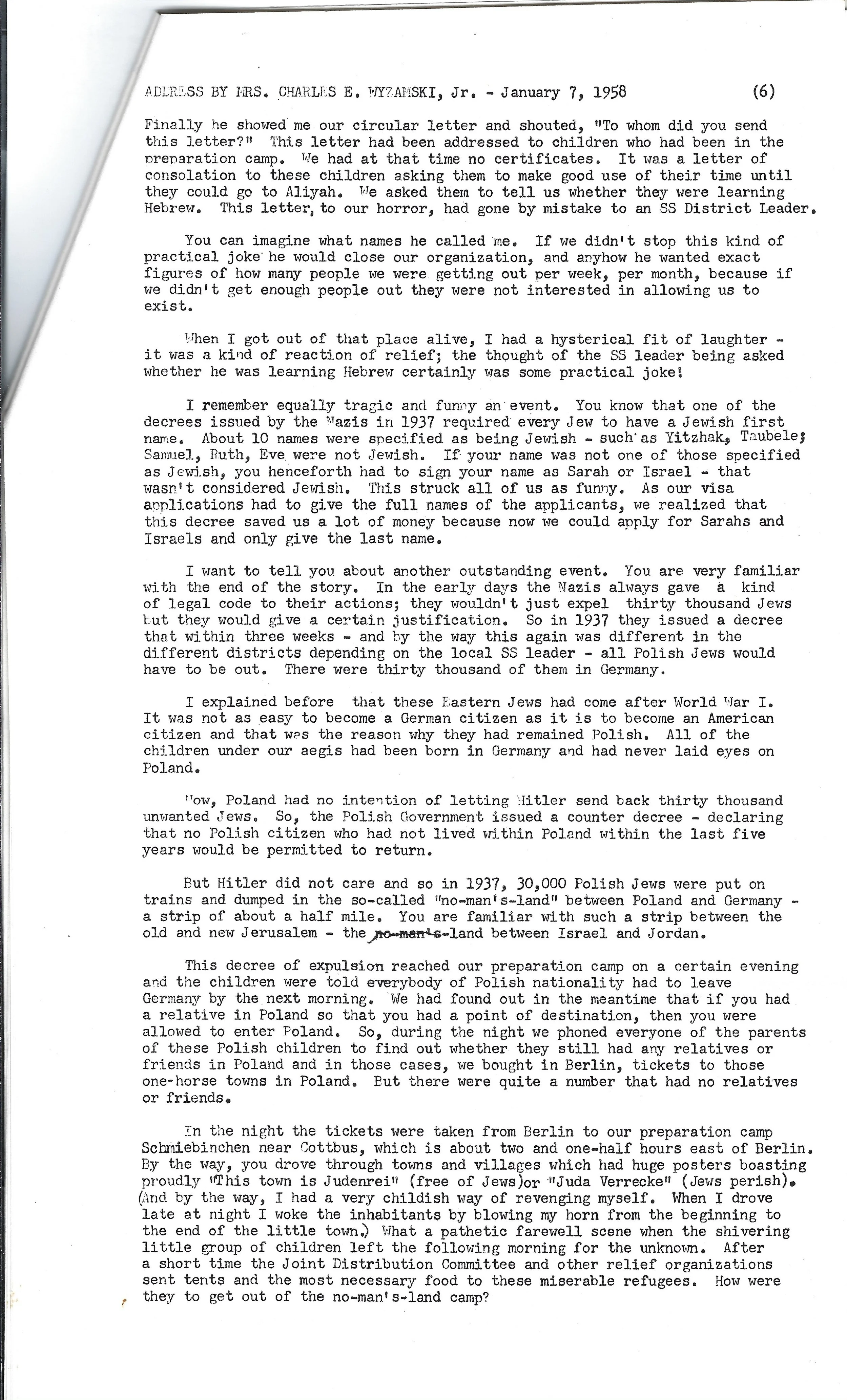
I remember equally tragic and funny an event. You know that one of the decrees issued by the Nazis in 1937 required every Jew to have a Jewish first name. About 10 names were specified as being Jewish - such as Yitzhak, Taubele; Samuel, Ruth, Eve were not Jewish. If your name was not one of those specified as Jewish, you henceforth had to sign your name as Sarah or Israel - that wasn't considered Jewish. This struck all of us as funny. As our visa applications had to give the full names of the applicants, we realized that this decree saved us a lot of money because now we could apply for Sarahs and Israelis and only give the last name.
I want to tell you about another outstanding event. You are very familiar with the end of the story. In the early days the Nazis always gave a kind of legal code to their actions; they wouldn't just expel thirty thousand Jews but they would give a certain justification. So in 1937 they issued a decree that within three weeks - and by the way this again was different in the different districts depending on the local SS leader - all Polish Jews would have to be out. There were thirty thousand of them in Germany.
I explained before that these Eastern Jews had come after World War I. It was not as easy to become a German citizen as it is to become an American citizen and that was the reason why they had remained Polish. All of the children under our aegis had been born in Germany and had never laid eyes on Poland.
Now, Poland had no intention of letting Hitler send back thirty thousand unwanted Jews. So, the Polish Government issued a counter decree - declaring that no Polish citizen who had not lived within Poland within the last five years would be permitted to return.
But Hitler did not care and so in 1937, 30,000 Polish Jews were put on trains and dumped in the so-called "no-man's-land" between Poland and Germany - a strip of about a half mile. You are familiar with such a strip between the old and new Jerusalem - the no-man's-land between Israel and Jordan.
This decree of expulsion reached our preparation camp on a certain evening and the children were told everybody of Polish nationality had to leave Germany by the next morning. We had found out in the meantime that if you had a relative in Poland so that you had a point of destination, then you were allowed to enter Poland. So, during the night we phoned everyone of the parents of these Polish children to find out whether they still had any relatives or friends in Poland and in those cases, we bought in Berlin, tickets to those one-horse towns in Poland. But there were quite a number that had no relatives or friends.
In the night the tickets were taken from Berlin to our preparation camp Schneibichen near Cottbus, which is about two and one-half hours east of Berlin. By the way, you drove through towns and villages which had huge posters boasting proudly "This town is Judenrei" (free of Jews) or "Juda Verrecke" (Jews perish). (And by the way, I had a very childish way of revenging myself. When I drove late at night I woke the inhabitants by blowing my horn from the beginning to the end of the little town.) What a pathetic farewell scene when the shivering little group of children left the following morning for the unknown. After a short time the Joint Distribution Committee and other relief organizations sent tents and the most necessary food to these miserable refugees. How were they to get out of the no-man's-land camp?
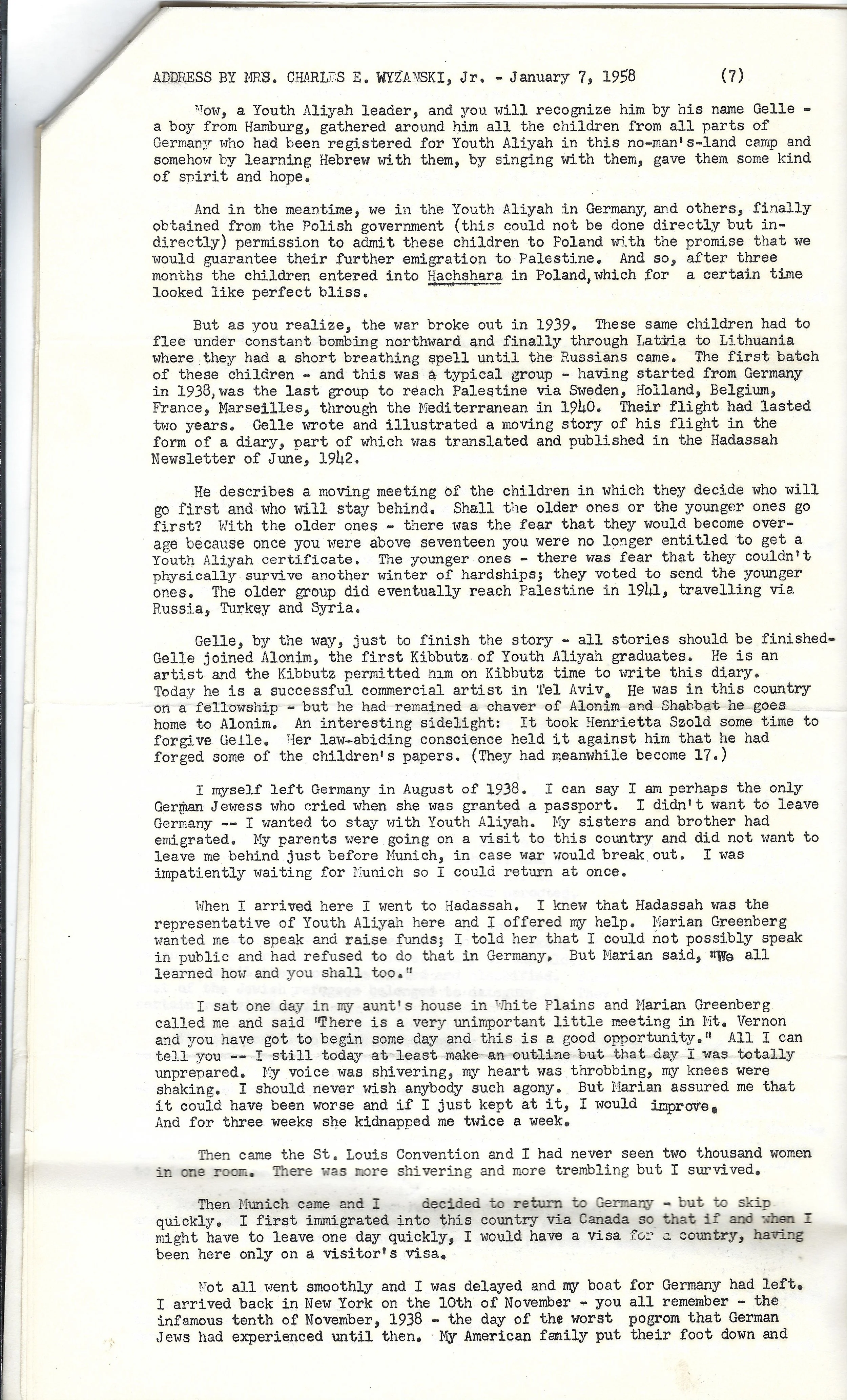
Now, a Youth Aliyah leader, and you will recognize him by his name Gelle - a boy from Hamburg, gathered around him all the children from all parts of Germany who had been registered for Youth Aliyah in this no-man's-land camp and somehow by learning Hebrew with them, by singing with them, gave them some kind of spirit and hope.
And in the meantime, we in the Youth Aliyah in Germany, and others, finally obtained from the Polish government (this could not be done directly but indirectly) permission to admit these children to Poland with the promise that we would guarantee their further emigration to Palestine. And so, after three months the children entered into Hachshara in Poland, which for a certain time looked like perfect bliss.
But as you realize, the war broke out in 1939. These same children had to flee under constant bombing northward and finally through Latvia to Lithuania where they had a short breathing spell until the Russians came. The first batch of these children - and this was a typical group - having started from Germany in 1938, was the last group to reach Palestine via Sweden, Holland, Belgium, France, Marseilles, through the Mediterranean in 1940. Their flight had lasted two years. Gelle wrote and illustrated a moving story of his flight in the form of a diary, part of which was translated and published in the Hadassah Newsletter of June, 1942.
He describes a moving meeting of the children in which they decide who will go first and who will stay behind. Shall the older ones or the younger ones go first? With the older ones - there was the fear that they would become over-age because once you were above seventeen you were no longer entitled to get a Youth Aliyah certificate. The younger ones - there was fear that they couldn't physically survive another winter of hardships; they voted to send the younger ones. The older group did eventually reach Palestine in 1941, travelling via Russia, Turkey and Syria.
Gelle, by the way, just to finish the story - all stories should be finished. Gelle joined Alonim, the first Kibbutz of Youth Aliyah graduates. He is an artist and the Kibbutz permitted him on Kibbutz time to write this diary. Today he is a successful commercial artist in Tel Aviv. He was in this country on a fellowship - but he had remained a chaver of Alonim and Shabbat he goes home to Alonim. An interesting sidelight: It took Henrietta Szold some time to forgive Gelle. Her law-abiding conscience held it against him that he had forged some of the children's papers. (They had meanwhile become 17.)
I myself left Germany in August of 1938. I can say I am perhaps the only German Jewess who cried when she was granted a passport. I didn't want to leave Germany -- I wanted to stay with Youth Aliyah. My sisters and brother had emigrated. My parents were going on a visit to this country and did not want to leave me behind just before Munich, in case war would break out. I was impatiently waiting for Munich so I could return at once.
When I arrived here I went to Hadassah. I knew that Hadassah was the representative of Youth Aliyah here and I offered my help. Marian Greenberg wanted me to speak and raise funds; I told her that I could not possibly speak in public and had refused to do that in Germany. But Marian said, "We all learned how and you shall too."
I sat one day in my aunt's house in White Plains and Marian Greenberg called me and said "There is a very unimportant little meeting in Mt. Vernon and you have got to begin some day and this is a good opportunity." All I can tell you -- I still today at least make an outline but that day I was totally unprepared. My voice was shivering, my heart was throbbing, my knees were shaking. I should never wish anybody such agony. But Marian assured me that it could have been worse and if I just kept at it, I would improve. And for three weeks she kidnapped me twice a week.
Then came the St. Louis Convention and I had never seen two thousand women in one room. There was more shivering and more trembling but I survived.
Then Munich came and I decided to return to Germany - but to skip quickly. I first immigrated into this country via Canada so that if and when I might have to leave one day quickly, I would have a visa for a country, having been here only on a visitor's visa.
Not all went smoothly and I was delayed and my boat for Germany had left. I arrived back in New York on the 10th of November - you all remember - the infamous tenth of November, 1938 - the day of the worst pogrom that German Jews had experienced until then. My American family put their foot down and didn't allow me to go back.
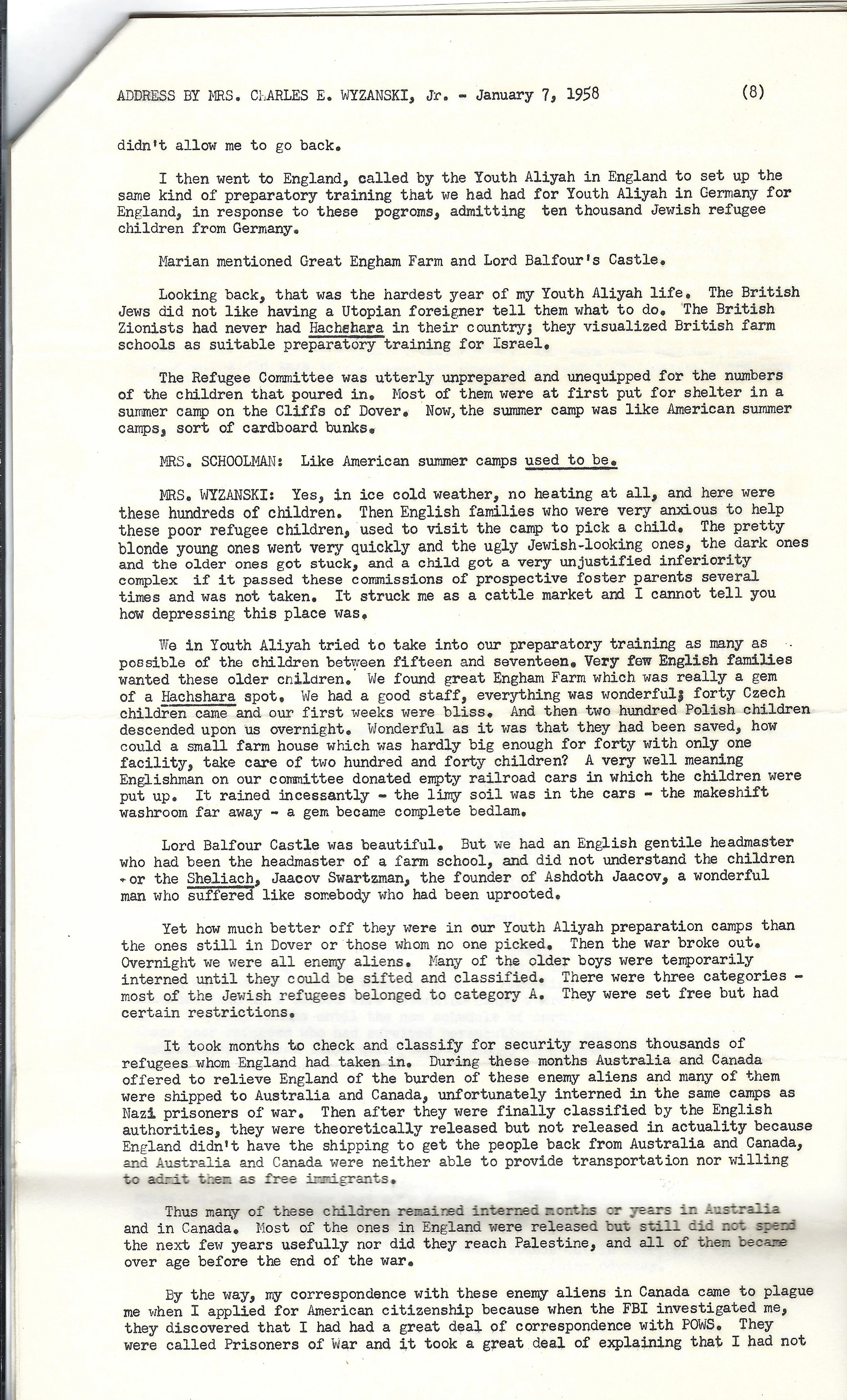
I then went to England, called by the Youth Aliyah in England to set up the same kind of preparatory training that we had had for Youth Aliyah in Germany for England, in response to these pogroms, admitting ten thousand Jewish refugee children from Germany.
Marian mentioned Great Engham Farm and Lord Balfour's Castle.
Looking back, that was the hardest year of my Youth Aliyah life. The British Jews did not like having a Utopian foreigner tell them what to do. The British Zionists had never had Hachshara in their country; they visualized British farm schools as suitable preparatory training for Israel.
The Refugee Committee was utterly unprepared and unequipped for the numbers of the children that poured in. Most of them were at first put for shelter in a summer camp on the Cliffs of Dover. Now, the summer camp was like American summer camps, sort of cardboard bunks.
MRS. SCHOOLMAN: Like American summer camps used to be.
MRS. WYZANSKI: Yes, in ice cold weather, no heating at all, and here were these hundreds of children. Then English families who were very anxious to help these poor refugee children, used to visit the camp to pick a child. The pretty blonde young ones went very quickly and the ugly Jewish-looking ones, the dark ones and the older ones got stuck, and a child got a very unjustified inferiority complex if it passed these commissions of prospective foster parents several times and was not taken. It struck me as a cattle market and I cannot tell you how depressing this place was.
We in Youth Aliyah tried to take into our preparatory training as many as possible of the children between fifteen and seventeen. Very few English families wanted these older children. We found great Engham Farm which was really a gem of a Hachshara spot. We had a good staff, everything was wonderful; forty Czech children came and our first weeks were bliss. And then two hundred Polish children descended upon us overnight. Wonderful as it was that they had been saved, how could a small farm house which was hardly big enough for forty with only one facility, take care of two hundred and forty children? A very well meaning Englishman on our committee donated empty railroad cars in which the children were put up. It rained incessantly - the limy soil was in the cars - the makeshift washroom far away - a gem became complete bedlam.
Lord Balfour Castle was beautiful. But we had an English gentile headmaster who had been the headmaster of a farm school, and did not understand the children - or the Sheliach, Jaacov Swartzman, the founder of Ashdoto Jaacov, a wonderful man who suffered like somebody who had been uprooted.
Yet how much better off they were in our Youth Aliyah preparation camps than the ones still in Dover or those whom no one picked. Then the war broke out. Overnight we were all enemy aliens. Many of the older boys were temporarily interned until they could be sifted and classified. There were three categories - most of the Jewish refugees belonged to category A. They were set free but had certain restrictions.
It took months to check and classify for security reasons thousands of refugees whom England had taken in. During these months Australia and Canada offered to relieve England of the burden of these enemy aliens and many of them were shipped to Australia and Canada, unfortunately interned in the same camps as Nazi prisoners of war. Then after they were finally classified by the English authorities, they were theoretically released but not released in actuality because England didn't have the shipping to get the people back from Australia and Canada, and Australia and Canada were neither able to provide transportation nor willing to admit them as free immigrants.
Thus many of these children remained interned months or years in Australia and in Canada. Most of the ones in England were released but still did not spend the next few years usefully nor did they reach Palestine, and all of them became over age before the end of the war.
By the way, my correspondence with these enemy aliens in Canada came to plague me when I applied for American citizenship because when the FBI investigated me, they discovered that I had had a great deal of correspondence with POWs. They were called Prisoners of War and it took a great deal of explaining that I had not been corresponding with Nazis but with Jewish children who had been interned.
I shall jump quickly now. The war had broken out in August, 1939. By October 1939 I had to return here because my re-entry permit to the United States would have expired. I had come only on a visitor's visa to England and I caught one of the last boats arriving here in October, 1939. I came again to Hadassah, but by then, knowing what my fate would be, I was catapulted on a speaking trip which got me as far as California. I must say I am very grateful to Hadassah. They sent me through forty-six states, a record which by far beats my American born husband's.
In recalling the events of my chairmanship - I could only remember the fate of certain Youth Aliyah groups in that period. Our work here was but a natural response. I did talk to you about the Gelle story which was certainly the most exciting group in the years of '40 and '41.
In 1942 Henrietta Szold sent a Youth Aliyah graduate over here by plane. I mention him because Henrietta Szold's concern for him at the time, thought and funds she devoted to him, was so typical of the way she took each child's problem to heart. The boy had almost completely lost his eyesight within a few weeks and Henrietta Szold ascertained that only a neurological operation might save his eyesight. The Hadassah hospital had no neurosurgeon at that time. Miss Szold insisted that the boy be flown to the United States to be operated here. We made all the arrangements. I spent a good deal of time with Aaron who had hoped that his eyesight would either be completely restored or that he would not survive the operation. But of course what happened was neither white nor black but grey. He remained in the United States because he didn't want to become a burden on Palestine.
Marian Greenberg mentioned in her report the Patria. This was but one of the many tragedies of Aliyah Beth. Despair and suffering, lack of immigration certificates, no place to go, drove thousands of refugees to risk their lives on unseaworthy, overcrowded ships with only a faint hope for survival and illegal landing somewhere on the shores of Palestine.
The Struma, perhaps one of the most tragic boats, got to Turkey in desperate need of repair. The Turkish authorities would not allow the Struma into port because none of the people on board had visas for any place and Turkey was unwilling to risk giving them temporary asylum. So they forced the boat without repairs to continue on its trip.
Henrietta Szold had heard that on this boat, among its seven hundred and sixty passengers in Turkish territorial waters, there were seventy children. So she went to the High Commissioner and pleaded with the High Commissioner that at least these children, if and when the boat would reach Palestine, be granted special certificates. But before the negotiations were even completed, the Struma struck a mine and everybody was drowned.
Henrietta Szold like everyone else was grief struck but she felt that she had to do something to make up for this tragedy. In those days illegal immigrants were caught as they tried to land in Palestine and the Mandatory Power interned them in a barbed wire detention camp, where these people had to wait often for many months until the new schedule of certificates was released. So these poor refugees who had survived persecution, war and flight, the ghastly hardships of illegal immigration, were interned in a barbed wire camp when they reached the land of their hope.
After the Struma tragedy, shortly before Pesach, Henrietta Szold went to the High Commissioner and pleaded with him to release thirty children from the SS Darlen detained in Atlit, so that they would be able to celebrate Seder in freedom. This permission was granted. She rushed to Atlit to make the arrangements and was overwhelmed and touched to find the children fasting. Why were they fasting? Because of the victims of the Struma. Nobody could feel like these children for those that were drowned. Nobody understood the meaning of Seder as they who had experienced its modern version.
The group familiar to all of you which stands out in everyone's memory, are the Teheran children. Theirs was the most gripping odyssey.
After Poland was divided there were a great many Polish Jews who found themselves within Russia or the Russian part of Poland. Many of them were then deported to Siberia because they were Polish. A group of 14,000 Polish refugees, Jews and non Jews alike, made their way gradually south through the Ukraine until they finally came to Teheran in Persia. The Polish Christians were finally brought to Kenya and to India. The whole Jewish world tried to get permission to get the Jewish refugees into Palestine. A group of eight hundred thirty-five (eventually one thousand) children reached Palestine. They could have reached it much earlier if it had not been for the fact that Iraq would not allow them transit visas. Consequently, these children had to go from Persia to Karachi, then India, today Pakistan, and from there through the Red Sea via Suez they came to Palestine.
Of the eight hundred children in the first transport, only one hundred seventy-seven had parents. Two hundred of these children were under six, forty were under two, and it had taken them altogether three years to reach Palestine.
By the way, there was a touching scene when these children passed through the Red Sea. A contingent of Jewish soldiers who served with the British Army gave the first kind of Israeli welcome to these children as they came through. For a whole night the soldiers had stuffed little bags with candy, chocolate, of anything they had to give, for each one of these children, with a little letter saying "Blessed be the one who comes - no longer will you be called a refugee; from now on you are going to be a citizen of Palestine."
The Yishuv, the Jewish community of Israel, went into an excitement over this Teheran group, never experienced before. For them they were, so to say, the symbol and the embodiment of the remnant of Israel. The concentration camp survivors had not yet come. Here were a thousand people on whom they could shower their longing for those whom they had forever lost and those who were still to be saved.
For Henrietta Szold the Teheran group was both a great joy and a superhuman strain. Overnight eleven reception centers had to be established in which these children were first put up; and it seemed as if the whole Yishuv came to call on these children - some to ask perhaps whether they had heard from or seen a relative who was at such-and-such a time in such a place, some just to hear their story, thinking that perhaps they could thus lead to their relatives, some really because they were actually related or hoped to discover a relative or a friend.
The religious question became the thorniest and most aggravating problem for Henrietta Szold. This was the first time that children came in large groups where there were no relatives, where there were no parents, where nothing of their previous religious background was known and the Agudath and other orthodox elements insisted that these children be brought up orthodox. They spread rumors and accused Henrietta Szold, who fought like a lion, having approached this difficult question with a deep sense of responsibility from the very beginning of Youth Aliyah.
It took every ounce of her strength to cope with the problems of this group, especially in the face of these unjustified accusations.
The Teheran group arrived in 1943, the same year in which the battle in the Warsaw Ghetto took place, but very little of it was known to us at that time.
To Henrietta Szold there were two events in these years which lifted her faith and her hope. One was a group of refugee children from Denmark. You remember after 1938, when we could get but a trickle into Palestine, we sent many children for temporary shelter to European democracies before they too were overrun by Hitler's armies. We had sent a group of two hundred children to individual farmers in Denmark. They had a Madrich, a leader who met daily with these children while they lived with Danish families, and when these children arrived in Palestine, Henrietta Szold was gratefully aware how different these children were who had experienced humanity at its best.
And the establishment of Children to Palestine lifted Henrietta Szold's spirit and faith in humanity. She wrote to Mr. Eliot, "It strengthens faith and consecrates hope that there is a group like you."
I would like to make mention of one more group, after the Teheran children which, too, is so typical of this period.
Henrietta Szold was already in the hospital. It was the Transnistria group who had been in a concentration camp in Rumania, representing almost all kinds of refugees, who had come from Yugoslavia, Czechoslovakia, Bulgaria, Hungary and even some still from Austria and Germany, and who had gone through incredible hardships. In one group of one hundred nineteen children there were seventy-eight orphans; twenty-one half orphans; only ten had parents; ten didn't know whether their parents were still alive.
In the annual report of that year I remember that I tabulated the children, stating their country of origin and enumerating the countries of transmigration - alas what a long list.
Henrietta Szold saw pictures drawn by one boy who came from Transnistria. You remember the artist. He had drawn his own father before he was taken to the gas chambers. Incredible! Henrietta Szold asked to meet the boy. The boy came to see her at the hospital and she saw to it that he was given a scholarship to become a painter and in the meantime he has become a very well known artist.
We now come to the year 1945, the year in which Henrietta Szold died, and in which Youth Aliyah entered a new phase. It was only then that the concentration camps were opened and that a new out-pouring of children began. I shall let Lola begin here although there were still several years in which we worked together.
When I took over Youth Aliyah our sky looked very dark. Any realistic human being would have had little hope for the immediate future of Youth Aliyah. Transportation next to impossible, Europe war-ridden, certificates almost non-existent. Yet the pressure, the suffering, the knowledge of the suffering, especially in Palestine and among all those who had escaped, brought about a determination and a tenacity which overcame unsurmountable obstacles. Youth Aliyah not only continued, it grew. While between 1931 and 1939 six thousand children had been absorbed, nine thousand were taken in between 1939 and 1945. To the everlasting credit of the American Jewish community they also didn't believe in what seemed realistic obstacles, and in the years from 1935 to 1945 they increased their donations to Youth Aliyah from seven hundred thousand to one million three hundred forty thousand dollars.
And now my closing and personal word. I never had a chance to express to Youth Aliyah my gratitude. My life was directed, filled and made rich by Youth Aliyah. The reasons why in the first years I was, strange as that may seem, homesick for Germany, was because I missed the unique sense of comradeship with the people with whom I worked there. I never again experienced this kind of front-line spirit and relationship which tied us together. They will forever - only a few of them survived - remain my friends.
I am grateful for what I have found in you, my friends, in Hadassah. I might very easily have been a lonely refugee but you took the cause and me to your hearts as I never would have thought possible. Thanks to you, I got to know and feel at home in America.
Above all - had it not been for Youth Aliyah, I would never have met Henrietta Szold and without her I might never have become so intimately part of Youth Aliyah. Youth Aliyah has given me my intimate friendship with Lola and she is my proud contribution to Hadassah.
And last and certainly not least, I owe my husband to Youth Aliyah, because if I had not gone to Boston to speak for Youth Aliyah, I might never have met him. (Applause)
MRS. SCHOOLMAN: Thank you, Gisela, for coming to us and opening that very revealing story of your experience. I am glad that we can share it with the old-timers and the younger ones.
I can only say, Gisela, you really did close a period in Youth Aliyah. Mrs. Jacobs, Marian and you were privileged to work with Henrietta Szold. Some day, when that book of Henrietta Szold will be written, much will be found to strengthen our hearts. Lola, you worked a little bit with Miss Szold but that was at the close of a period. But I think the greatness of Youth Aliyah and the greatness of Henrietta Szold was that, despite the fact that she closed the page at that point in February, 1945, the work was able to go on - not in the same way. Those who came later didn't have that blessing and that spiritual experience of working directly with Henrietta Szold, although all of us have the privilege of having her principles and her ideals and the ideals and the spirit which she has implanted in those who have worked with her. All of us have the privilege of carrying those with us in carrying on our tasks with youth.
Youth Aliyah is facing different problems. In those days we used to cry for certificates. Now we don't need certificates. It is up to us to help the children - altogether different problems but not easier ones. There are tremendous problems and those of you who will read this little story which I asked you to take with you today, will recognize in it one of the major problems which we face in Youth Aliyah today.