
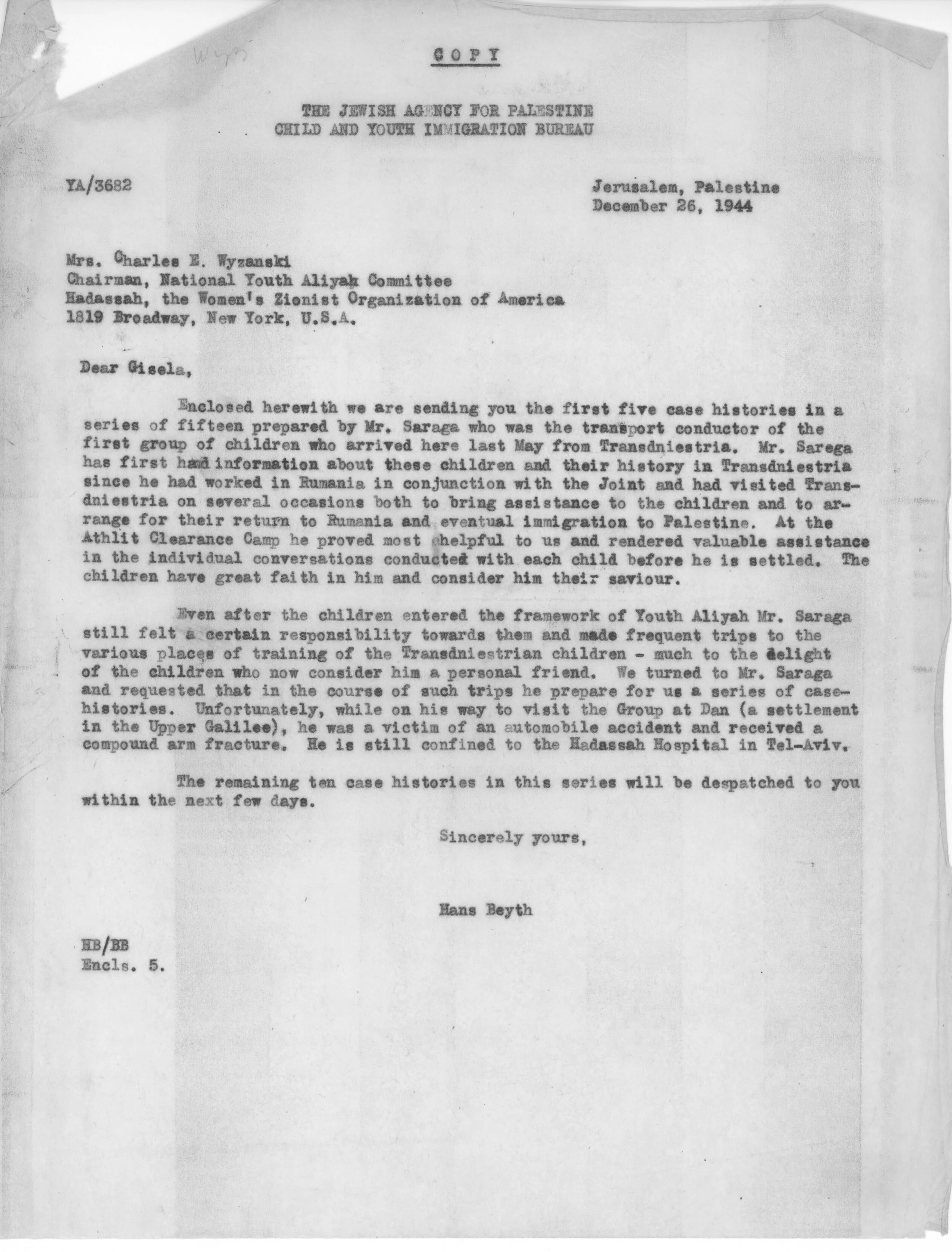
THE JEWISH AGENCY FOR PALESTINE CHILD AND YOUTH IMMIGRATION BUREAU
YA/3682
Jerusalem, Palestine December 26, 1944
Mrs. Charles E. Wyzanski Chairman, National Youth Aliyah Committee Hadassah, the Women's Zionist Organization of America 1819 Broadway, New York, U.S.A.
Dear Gisela,
Enclosed herewith we are sending you the first five case histories in a series of fifteen prepared by Mr. Saraga who was the transport conductor of the first group of children who arrived here last May from Transdniestria. Mr. Sarega has first hand information about these children and their history in Transdniestria since he had worked in Rumania in conjunction with the Joint and had visited Transdniestria on several occasions both to bring assistance to the children and to arrange for their return to Rumania and eventual immigration to Palestine. At the Atlit Clearance Camp he proved most helpful to us and rendered valuable assistance in the individual conversations conducted with each child before he is settled. The children have great faith in him and consider him their saviour.
Even after the children entered the framework of Youth Aliyah Mr. Saraga still felt a certain responsibility towards them and made frequent trips to the various places of training of the Transdniestrian children - much to the delight of the children who now consider him a personal friend. We turned to Mr. Saraga and requested that in the course of such trips he prepare for us a series of case-histories. Unfortunately, while on his way to visit the Group at Dan (a settlement in the Upper Galilee), he was a victim of an automobile accident and received a compound arm fracture. He is still confined to the Hadassah Hospital in Tel-Aviv.
The remaining ten case histories in this series will be despatched to you within the next few days.
Sincerely yours,
Hans Beyth
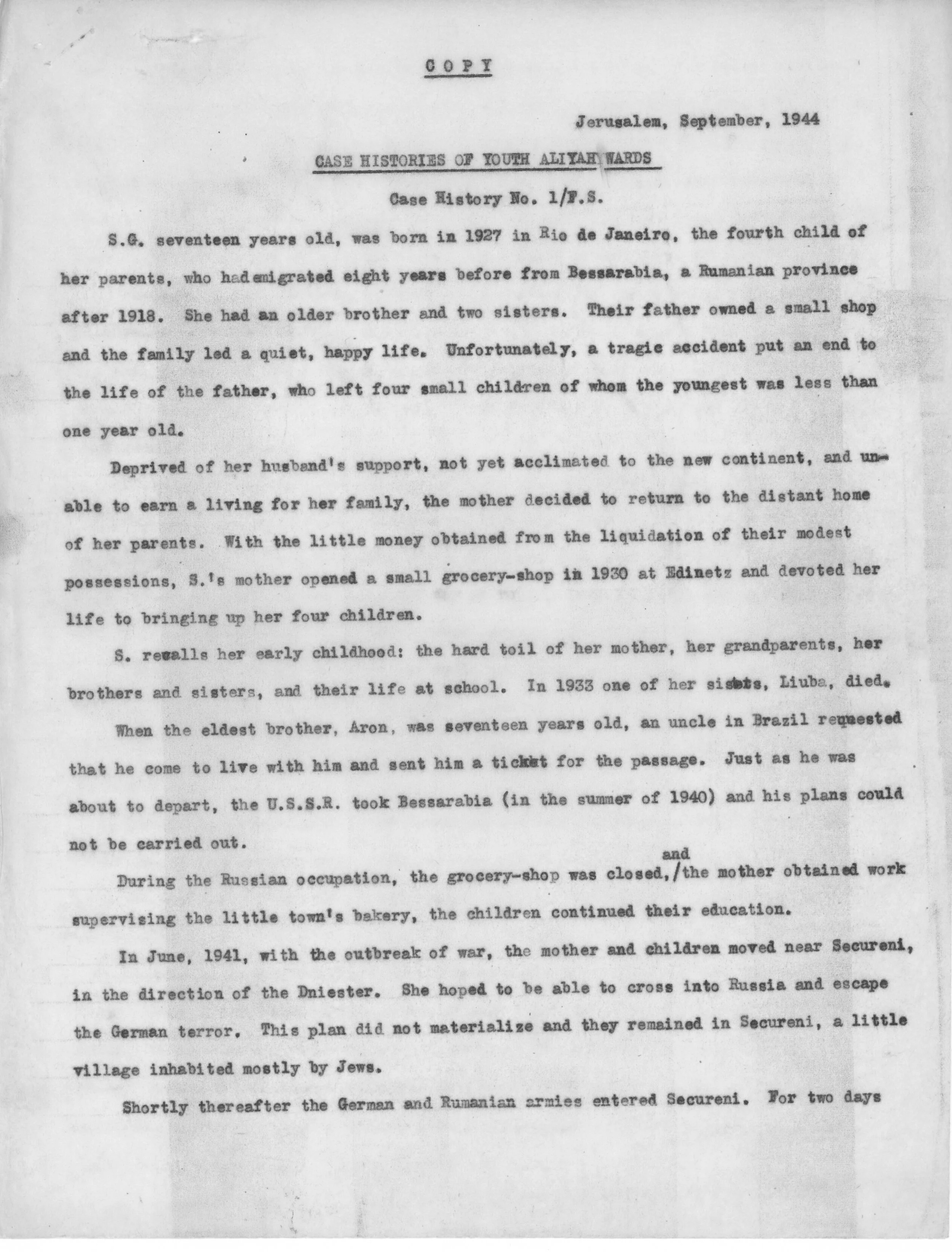
Jerusalem, September, 1944
CASE HISTORIES OF YOUTH ALIYAH WARDS
Case History No. 1/F.S.
S.G. seventeen years old, was born in 1927 in Rio de Janeiro, the fourth child of her parents, who had emigrated eight years before from Bessarabia, a Rumanian province after 1918. She had an older brother and two sisters. Their father owned a small shop and the family led a quiet, happy life. Unfortunately, a tragic accident put an end to the life of the father, who left four small children of whom the youngest was less than one year old.
Deprived of her husband's support, not yet acclimated to the new continent, and unable to earn a living for her family, the mother decided to return to the distant home of her parents. With the little money obtained from the liquidation of their modest possessions, S.'s mother opened a small grocery-shop in 1930 at Edinetz and devoted her life to bringing up her four children.
S. recalls her early childhood: the hard toil of her mother, her grandparents, her brothers and sisters, and their life at school. In 1933 one of her sisters, Liuba, died.
When the eldest brother, Aron, was seventeen years old, an uncle in Brazil requested that he come to live with him and sent him a ticket for the passage. Just as he was about to depart, the U.S.S.R. took Bessarabia (in the summer of 1940) and his plans could not be carried out.
During the Russian occupation, the grocery-shop was closed, and the mother obtained work supervising the little town's bakery, the children continued their education.
In June, 1941, with the outbreak of war, the mother and children moved near Secureni, in the direction of the Dniester. She hoped to be able to cross into Russia and escape the German terror. This plan did not materialize and they remained in Secureni, a little village inhabited mostly by Jews.
Shortly thereafter the German and Rumanian armies entered Secureni. For two days
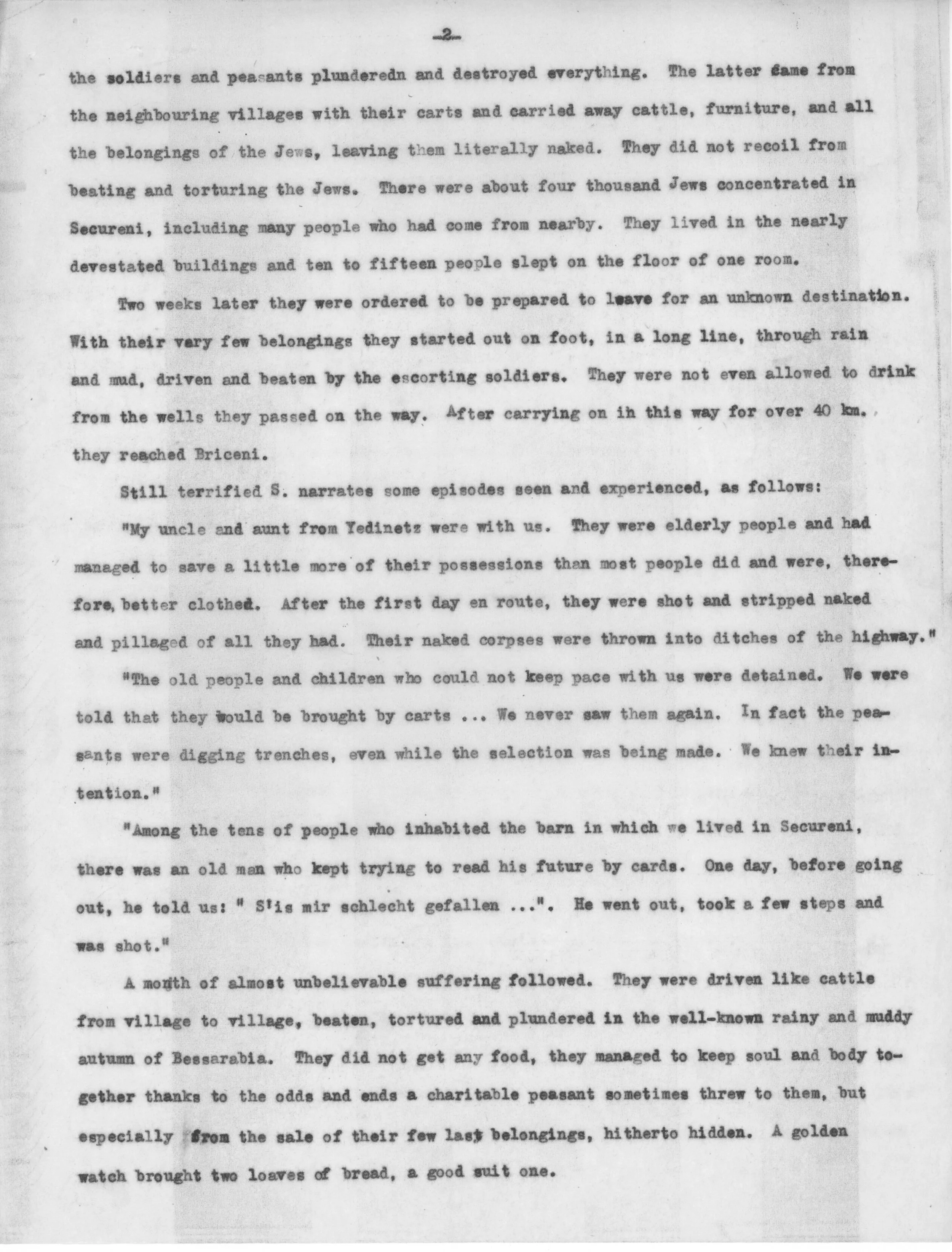
the soldiers and peasants plundered and destroyed everything. The latter came from the neighbouring villages with their carts and carried away cattle, furniture, and all the belongings of the Jews, leaving them literally naked. They did not recoil from beating and torturing the Jews. There were about four thousand Jews concentrated in Secureni, including many people who had come from nearby. They lived in the nearly devastated buildings and ten to fifteen people slept on the floor of one room.
Two weeks later they were ordered to be prepared to leave for an unknown destination. With their very few belongings they started out on foot, in a long line, through rain and mud, driven and beaten by the escorting soldiers. They were not even allowed to drink from the wells they passed on the way. After carrying on in this way for over 40 km, they reached Briceni.
Still terrified S. narrates some episodes seen and experienced, as follows:
"My uncle and aunt from Yedinetz were with us. They were elderly people and had managed to save a little more of their possessions than most people did and were, therefore, better clothed. After the first day en route, they were shot and stripped naked and pillaged of all they had. Their naked corpses were thrown into ditches of the highway."
"The old people and children who could not keep pace with us were detained. We were told that they would be brought by carts ... We never saw them again. In fact the peasants were digging trenches, even while the selection was being made. We knew their intention."
"Among the tens of people who inhabited the barn in which we lived in Secureni, there was an old man who kept trying to read his future by cards. One day, before going out, he told us: 'S'is mir schlecht gefallen ...'. He went out, took a few steps and was shot."
A month of almost unbelievable suffering followed. They were driven like cattle from village to village, beaten, tortured and plundered in the well-known rainy and muddy autumn of Bessarabia. They did not get any food, they managed to keep soul and body together thanks to the odds and ends a charitable peasant sometimes threw to them, but especially from the sale of their few last belongings, hitherto hidden. A golden watch brought two loaves of bread, a good suit one.
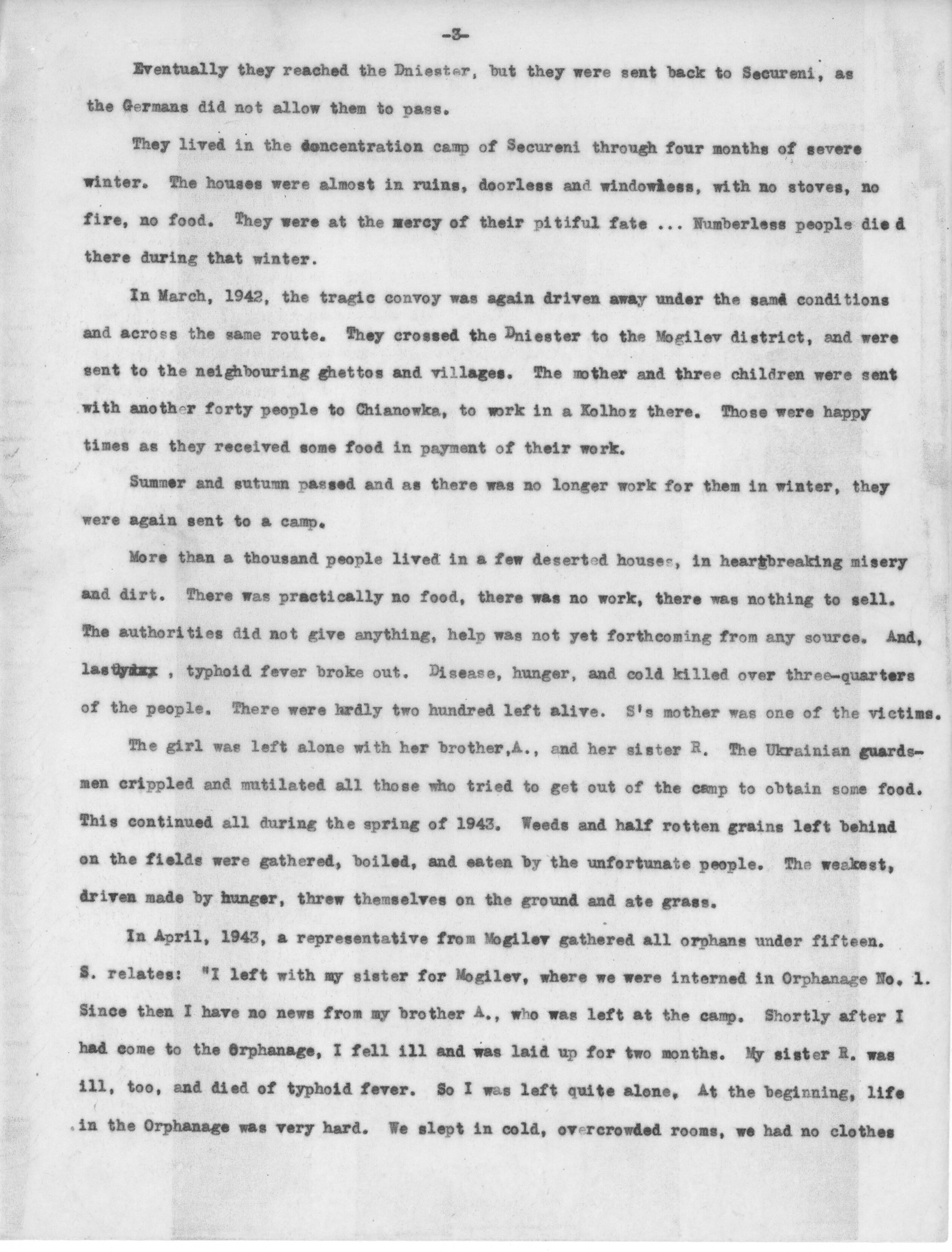
Eventually they reached the Dniester, but they were sent back to Secureni, as the Germans did not allow them to pass.
They lived in the concentration camp of Secureni through four months of severe winter. The houses were almost in ruins, doorless and windowless, with no stoves, no fire, no food. They were at the mercy of their pitiful fate ... Numberless people died there during that winter.
In March, 1942, the tragic convoy was again driven away under the same conditions and across the same route. They crossed the Dniester to the Mogilev district, and were sent to the neighbouring ghettos and villages. The mother and three children were sent with another forty people to Chianowka, to work in a Kolhoz there. Those were happy times as they received some food in payment of their work.
Summer and autumn passed and as there was no longer work for them in winter, they were again sent to a camp.
More than a thousand people lived in a few deserted houses, in heartbreaking misery and dirt. There was practically no food, there was no work, there was nothing to sell. The authorities did not give anything, help was not yet forthcoming from any source. And, lastly, typhoid fever broke out. Disease, hunger, and cold killed over three-quarters of the people. There were hardly two hundred left alive. S's mother was one of the victims.
The girl was left alone with her brother A., and her sister R. The Ukrainian guardsmen crippled and mutilated all those who tried to get out of the camp to obtain some food. This continued all during the spring of 1943. Weeds and half rotten grains left behind on the fields were gathered, boiled, and eaten by the unfortunate people. The weakest, driven made by hunger, threw themselves on the ground and ate grass.
In April, 1943, a representative from Mogilev gathered all orphans under fifteen. S. relates: "I left with my sister for Mogilev, where we were interned in Orphanage No. 1. Since then I have no news from my brother A., who was left at the camp. Shortly after I had come to the Orphanage, I fell ill and was laid up for two months. My sister R. was ill, too, and died of typhoid fever. So I was left quite alone. At the beginning, life in the Orphanage was very hard. We slept in cold, overcrowded rooms, we had no clothes
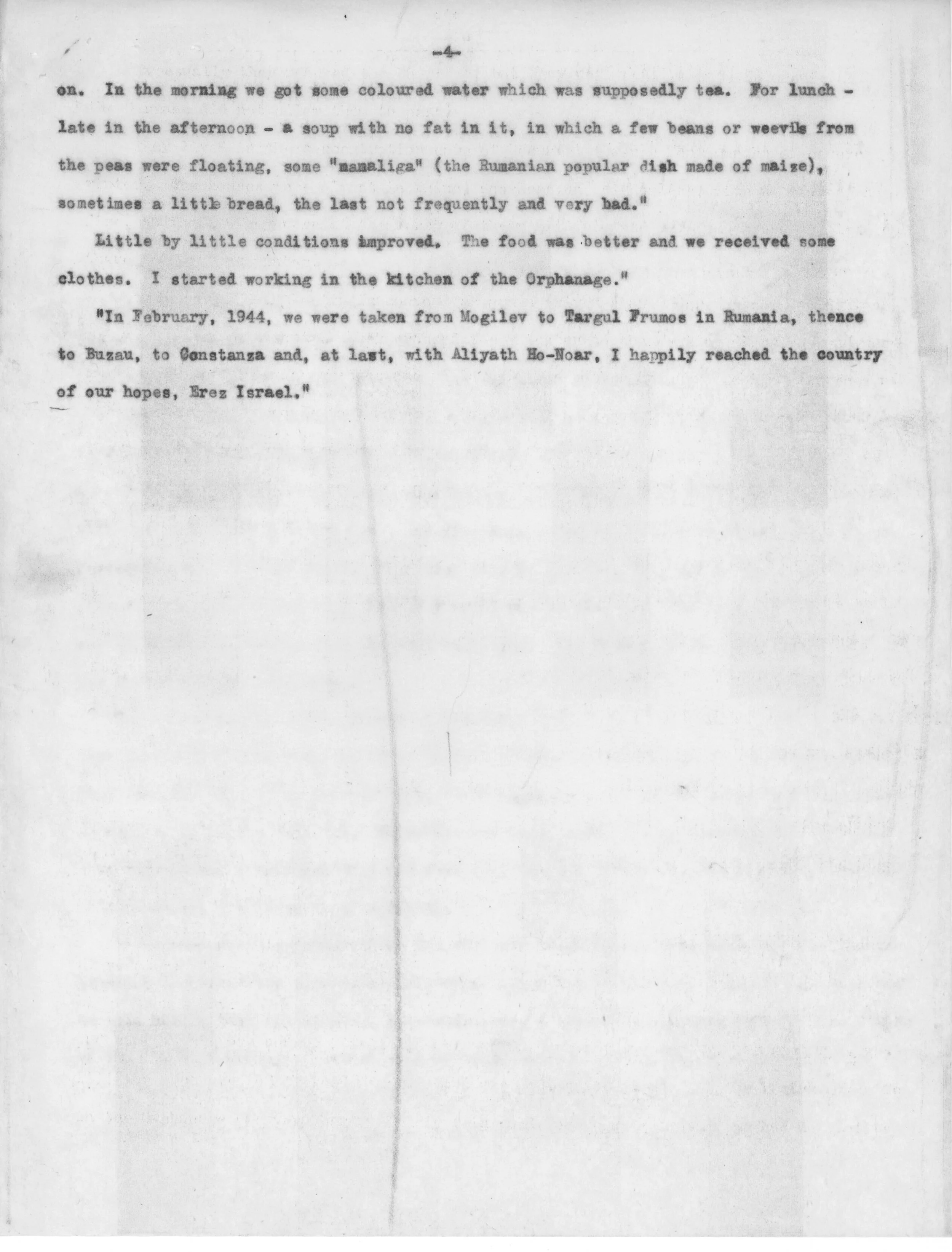
on. In the morning we got some coloured water which was supposedly tea. For lunch - late in the afternoon - a soup with no fat in it, in which a few beans or weevils from the peas were floating, some "mamaliga" (the Rumanian popular dish made of maize), sometimes a little bread, the last not frequently and very bad."
Little by little conditions improved. The food was better and we received some clothes. I started working in the kitchen of the Orphanage."
"In February, 1944, we were taken from Mogilev to Targul Frumos in Rumania, thence to Buzau, to Constantza and, at last, with Aliyath Ho-Noar, I happily reached the country of our hopes, Erez Israel."
Jerusalem, September 1944
CASE HISTORIES OF YOUTH ALIYAH WARDS
Case History No. 2/F.S.
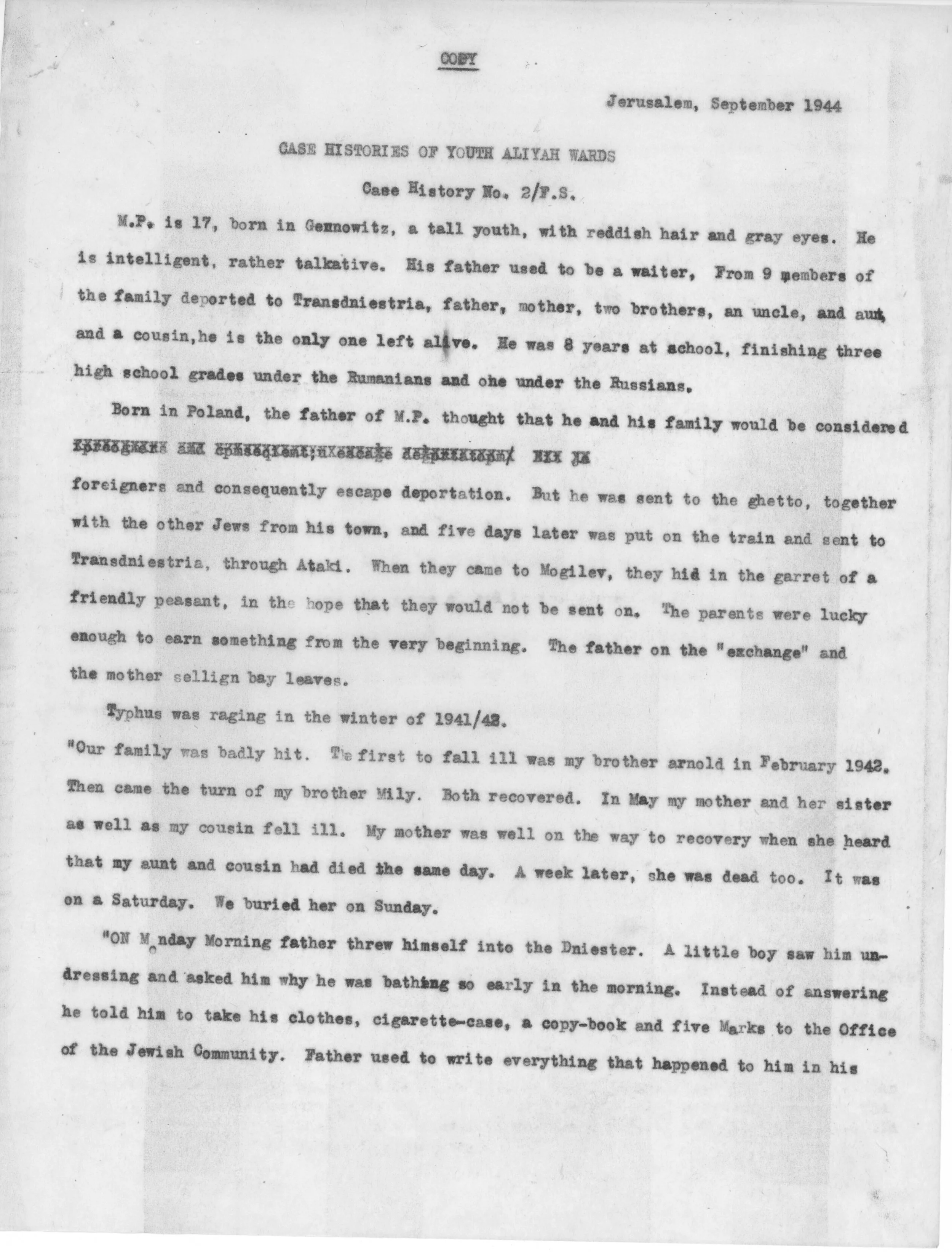
M.P. is 17, born in Gemnowitz, a tall youth, with reddish hair and gray eyes. He is intelligent, rather talkative. His father used to be a waiter. From 9 members of the family deported to Transdniestria, father, mother, two brothers, an uncle, and aunt, and a cousin, he is the only one left alive. He was 8 years at school, finishing three high school grades under the Rumanians and one under the Russians.
Born in Poland, the father of M.P. thought that he and his family would be considered foreigners and consequently escape deportation. But he was sent to the ghetto, together with the other Jews from his town, and five days later was put on the train and sent to Transdniestria, through Ataki. When they came to Mogilev, they hid in the garret of a friendly peasant, in the hope that they would not be sent on. The parents were lucky enough to earn something from the very beginning. The father on the "exchange" and the mother sellign bay leaves.
Typhus was raging in the winter of 1941/42.
"Our family was badly hit. The first to fall ill was my brother Arnold in February 1942. Then came the turn of my brother Mily. Both recovered. In May my mother and her sister as well as my cousin fell ill. My mother was well on the way to recovery when she heard that my aunt and cousin had died the same day. A week later, she was dead too. It was on a Saturday. We buried her on Sunday.
"ON Monday Morning father threw himself into the Dniester. A little boy saw him undressing and asked him why he was bathing so early in the morning. Instead of answering he told him to take his clothes, cigarette-case, a copy-book and five Marks to the Office of the Jewish Community. Father used to write everything that happened to him in his copy-book. We did not get it; the authorities kept it. But we found out from a policeman, who had read the last note that he was not able to live without mother, and that anyhow life had no value. His body was found the next day.
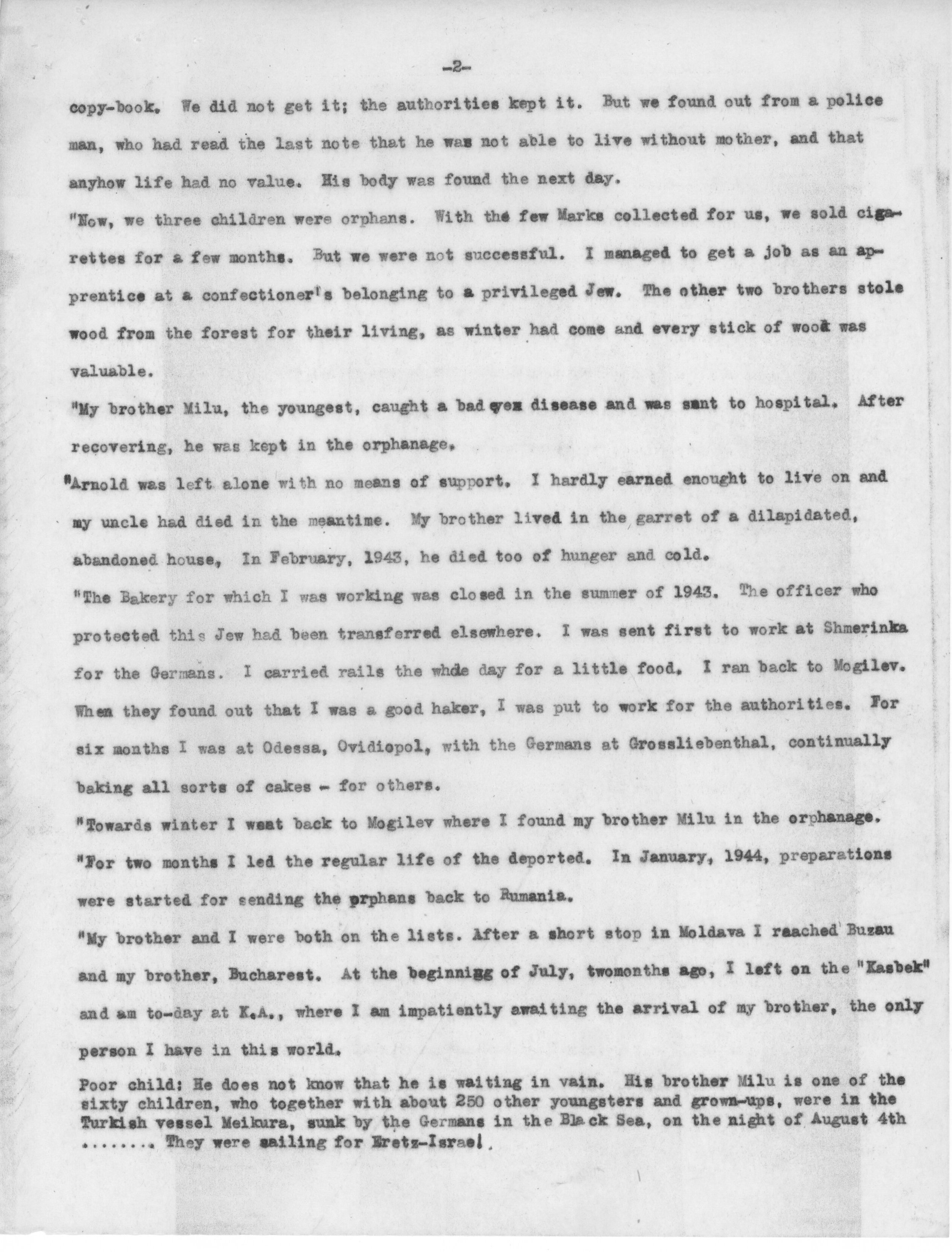
"Now, we three children were orphans. With the few Marks collected for us, we sold cigarettes for a few months. But we were not successful. I managed to get a job as an apprentice at a confectioner's belonging to a privileged Jew. The other two brothers stole wood from the forest for their living, as winter had come and every stick of wood was valuable.
"My brother Milu, the youngest, caught a bad disease and was sent to hospital. After recovering, he was kept in the orphanage.
"Arnold was left alone with no means of support. I hardly earned enough to live on and my uncle had died in the meantime. My brother lived in the garret of a dilapidated, abandoned house. In February, 1943, he died too of hunger and cold.
"The Bakery for which I was working was closed in the summer of 1943. The officer who protected this Jew had been transferred elsewhere. I was sent first to work at Shmerinka for the Germans. I carried rails the whole day for a little food. I ran back to Mogilev. When they found out that I was a good haker, I was put to work for the authorities. For six months I was at Odessa, Ovidiopol, with the Germans at Grossliebenthal, continually baking all sorts of cakes - for others.
"Towards winter I went back to Mogilev where I found my brother Milu in the orphanage.
"For two months I led the regular life of the deported. In January, 1944, preparations were started for sending the orphans back to Rumania.
"My brother and I were both on the lists. After a short stop in Moldava I reached Buzau and my brother, Bucharest. At the beginning of July, two months ago, I left on the "Kasbek" and am today at K.A., where I am impatiently awaiting the arrival of my brother, the only person I have in this world.
Poor child: He does not know that he is waiting in vain. His brother Milu is one of the sixty children, who together with about 250 other youngsters and grown-ups, were in the Turkish vessel Meikura, sunk by the Germans in the Black Sea, on the night of August 4th ....... They were sailing for Eretz-Israel.
Jerusalem, September 1944
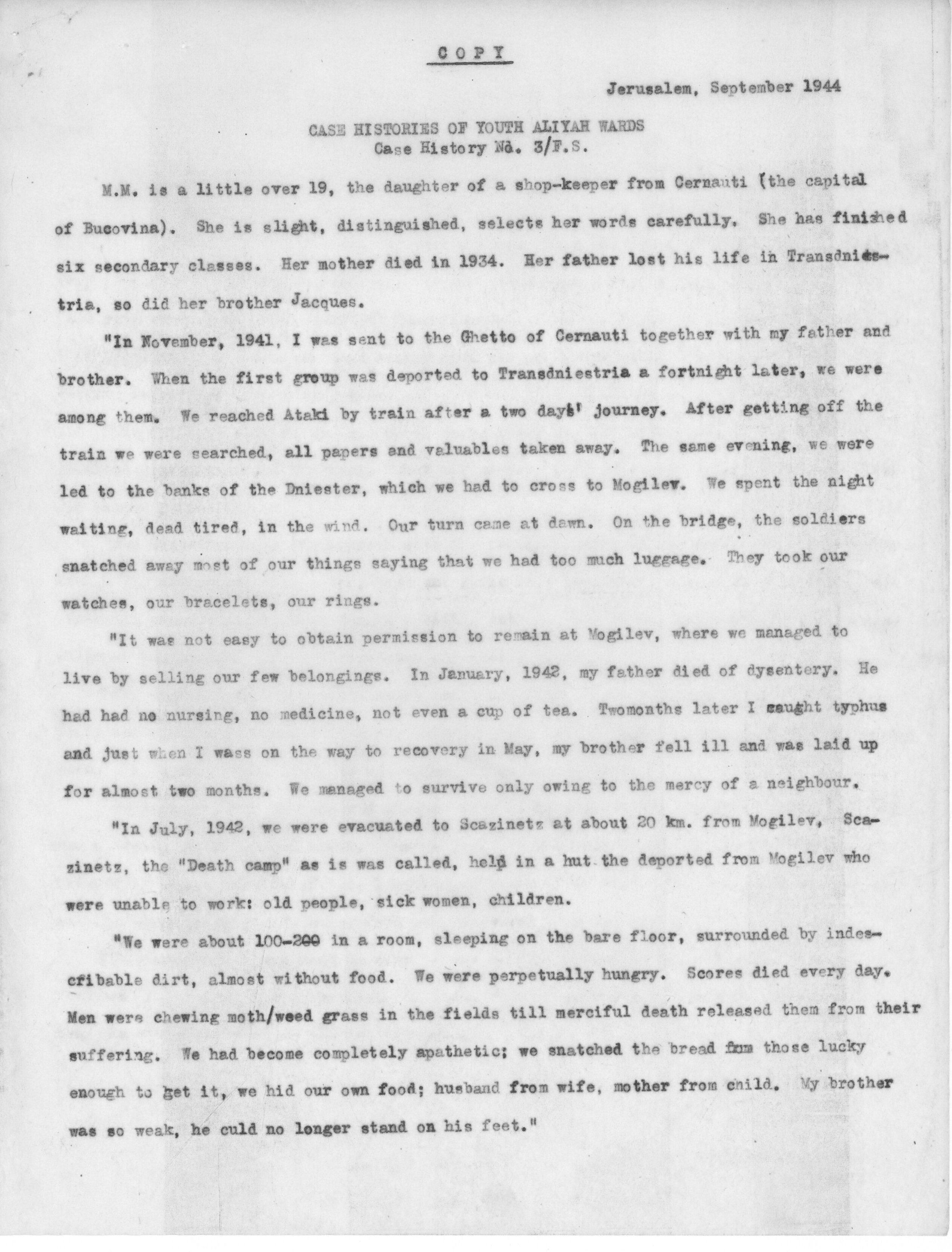
CASE HISTORIES OF YOUTH ALIYAH WARDS Case History No. 3/F.S.
M.M. is a little over 19, the daughter of a shop-keeper from Cernauti (the capital of Bucovina). She is slight, distinguished, selects her words carefully. She has finished six secondary classes. Her mother died in 1934. Her father lost his life in Transnistria, so did her brother Jacques.
"In November, 1941, I was sent to the Ghetto of Cernauti together with my father and brother. When the first group was deported to Transnistria a fortnight later, we were among them. We reached Ataki by train after a two day's journey. After getting off the train we were searched, all papers and valuables taken away. The same evening, we were led to the banks of the Dniester, which we had to cross to Mogilev. We spent the night waiting, dead tired, in the wind. Our turn came at dawn. On the bridge, the soldiers snatched away most of our things saying that we had too much luggage. They took our watches, our bracelets, our rings.
"It was not easy to obtain permission to remain at Mogilev, where we managed to live by selling our few belongings. In January, 1942, my father died of dysentery. He had had no nursing, no medicine, not even a cup of tea. Two months later I caught typhus and just when I was on the way to recovery in May, my brother fell ill and was laid up for almost two months. We managed to survive only owing to the mercy of a neighbour.
"In July, 1942, we were evacuated to Scazinetz at about 20 km. from Mogilev. Scazinetz, the "Death camp" as it was called, held in a hut the deported from Mogilev who were unable to work: old people, sick women, children.
"We were about 100-200 in a room, sleeping on the bare floor, surrounded by indescribable dirt, almost without food. We were perpetually hungry. Scores died every day. Men were chewing moth/weed grass in the fields till merciful death released them from their suffering. We had become completely apathetic; we snatched the bread from those lucky enough to get it, we hid our own food; husband from wife, mother from child. My brother was so weak, he could no longer stand on his feet."
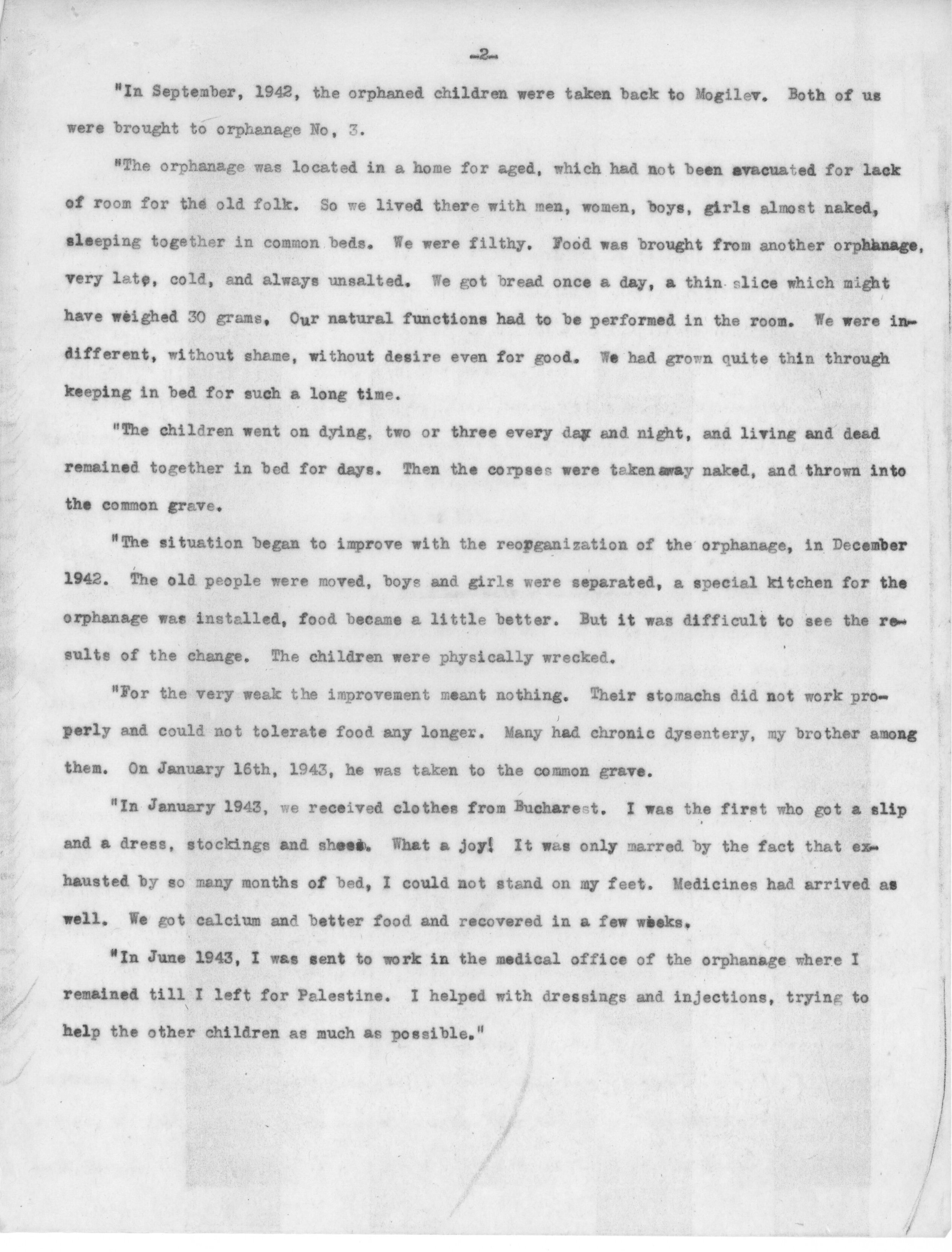
"In September, 1942, the orphaned children were taken back to Mogilev. Both of us were brought to orphanage No. 3.
"The orphanage was located in a home for aged, which had not been evacuated for lack of room for the old folk. So we lived there with men, women, boys, girls almost naked, sleeping together in common beds. We were filthy. Food was brought from another orphanage, very late, cold, and always unsalted. We got bread once a day, a thin slice which might have weighed 30 grams. Our natural functions had to be performed in the room. We were indifferent, without shame, without desire even for good. We had grown quite thin through keeping in bed for such a long time.
"The children went on dying, two or three every day and night, and living and dead remained together in bed for days. Then the corpses were taken away naked, and thrown into the common grave.
"The situation began to improve with the reorganization of the orphanage, in December 1942. The old people were moved, boys and girls were separated, a special kitchen for the orphanage was installed, food became a little better. But it was difficult to see the results of the change. The children were physically wrecked.
"For the very weak the improvement meant nothing. Their stomachs did not work properly and could not tolerate food any longer. Many had chronic dysentery, my brother among them. On January 16th, 1943, he was taken to the common grave.
"In January 1943, we received clothes from Bucharest. I was the first who got a slip and a dress, stockings and sheets. What a joy! It was only marred by the fact that exhausted by so many months of bed, I could not stand on my feet. Medicines had arrived as well. We got calcium and better food and recovered in a few weeks.
"In June 1943, I was sent to work in the medical office of the orphanage where I remained till I left for Palestine. I helped with dressings and injections, trying to help the other children as much as possible."
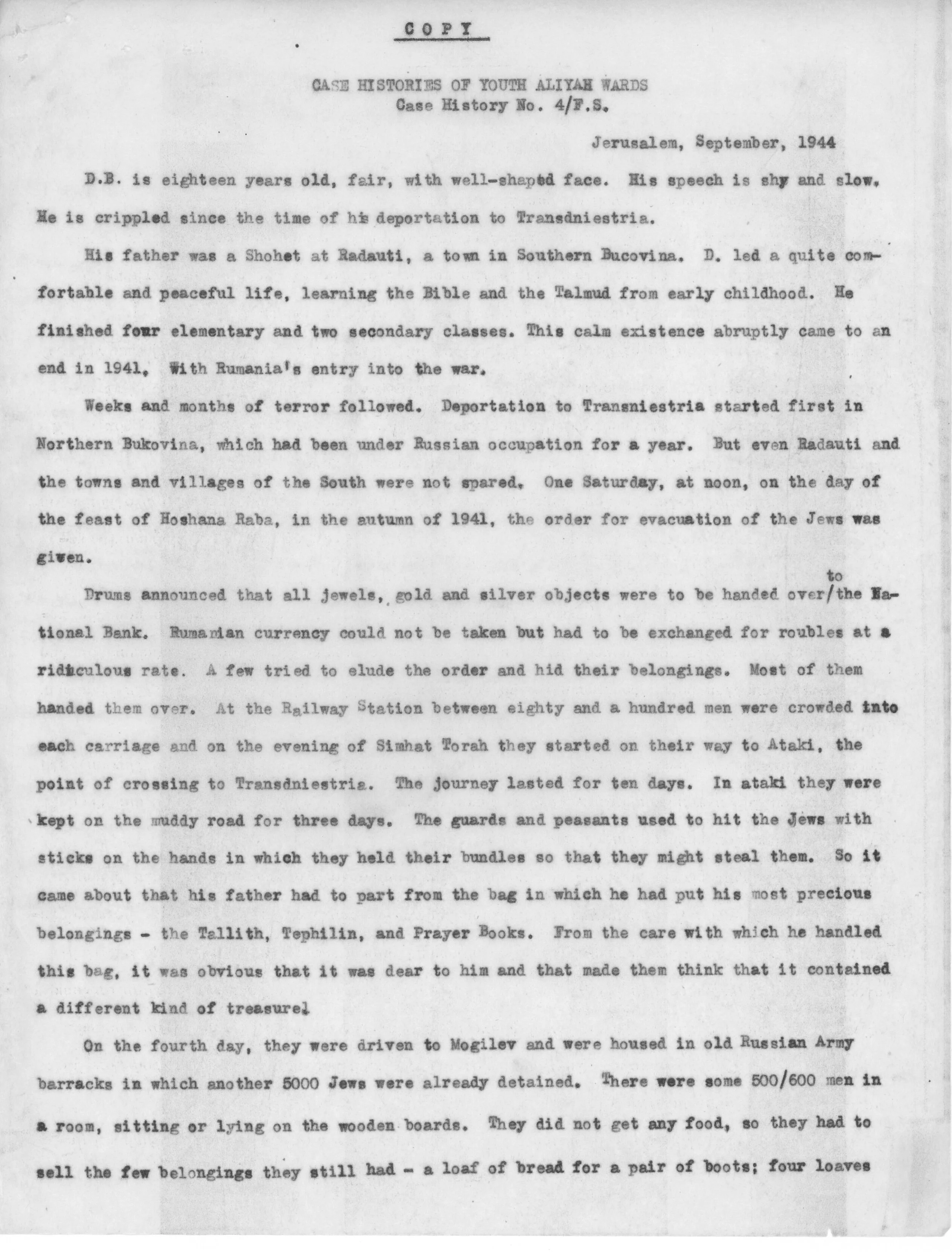
CASE HISTORIES OF YOUTH ALIYAH WARDS Case History No. 4/F.S.
Jerusalem, September, 1944
D.B. is eighteen years old, fair, with well-shaped face. His speech is shy and slow. He is crippled since the time of his deportation to Transdniestria.
His father was a Shohef at Radauti, a town in Southern Bucovina. D. led a quite comfortable and peaceful life, learning the Bible and the Talmud from early childhood. He finished four elementary and two secondary classes. This calm existence abruptly came to an end in 1941. With Rumania's entry into the war.
Weeks and months of terror followed. Deportation to Transnistria started first in Northern Bukovina, which had been under Russian occupation for a year. But even Radauti and the towns and villages of the South were not spared. One Saturday, at noon, on the day of the feast of Hoshana Raba, in the autumn of 1941, the order for evacuation of the Jews was given.
Drums announced that all jewels, gold and silver objects were to be handed over to the National Bank. Rumanian currency could not be taken but had to be exchanged for roubles at a ridiculous rate. A few tried to elude the order and hid their belongings. Most of them handed them over. At the Railway Station between eighty and a hundred men were crowded into each carriage and on the evening of Simhat Torah they started on their way to Ataki, the point of crossing to Transnistria. The journey lasted for ten days. In Ataki they were kept on the muddy road for three days. The guards and peasants used to hit the Jews with sticks on the hands in which they held their bundles so that they might steal them. So it came about that his father had to part from the bag in which he had put his most precious belongings - the Tallith, Tephilin, and Prayer Books. From the care with which he handled this bag, it was obvious that it was dear to him and that made them think that it contained a different kind of treasure!
On the fourth day, they were driven to Mogilev and were housed in old Russian Army barracks in which another 5000 Jews were already detained. There were some 500/600 men in a room, sitting or lying on the wooden boards. They did not get any food, so they had to sell the few belongings they still had - a loaf of bread for a pair of boots; four loaves or 60 roubles for a winter coat.
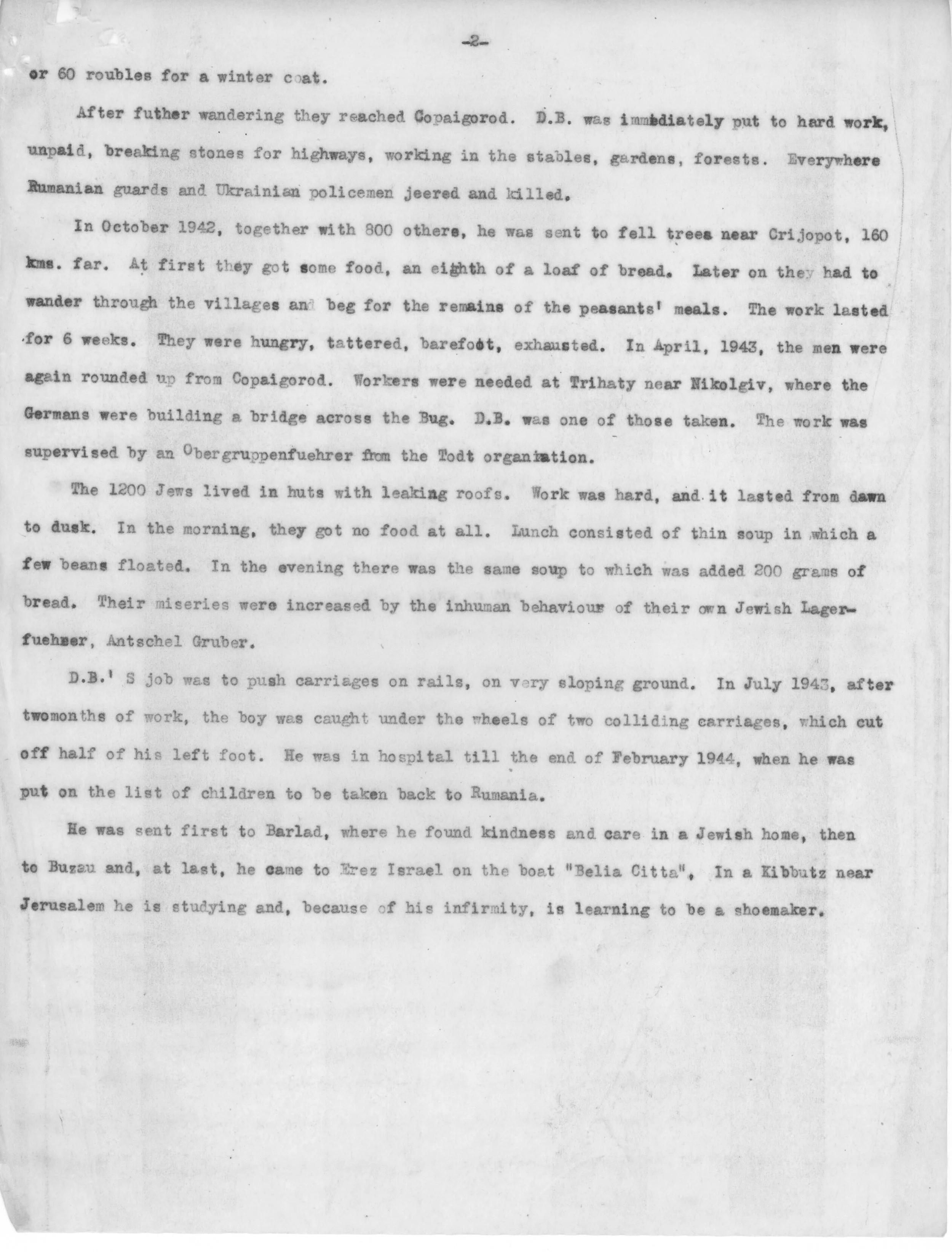
After further wandering they reached Copaigorod. D.B. was immediately put to hard work, unpaid, breaking stones for highways, working in the stables, gardens, forests. Everywhere Romanian guards and Ukrainian policemen jeered and killed.
In October 1942, together with 800 others, he was sent to fell trees near Crijopot, 160 kms. far. At first they got some food, an eighth of a loaf of bread. Later on they had to wander through the villages and beg for the remains of the peasants' meals. The work lasted for 6 weeks. They were hungry, tattered, barefoot, exhausted. In April, 1943, the men were again rounded up from Copaigorod. Workers were needed at Trihaty near Nikolgiv, where the Germans were building a bridge across the Bug. D.B. was one of those taken. The work was supervised by an Obergruppenfuehrer from the Todt organization.
The 1200 Jews lived in huts with leaking roofs. Work was hard, and it lasted from dawn to dusk. In the morning, they got no food at all. Lunch consisted of thin soup in which a few beans floated. In the evening there was the same soup to which was added 200 grams of bread. Their miseries were increased by the inhuman behaviour of their own Jewish Lagerfuehrer, Antschel Gruber.
D.B.'s job was to push carriages on rails, on very sloping ground. In July 1943, after two months of work, the boy was caught under the wheels of two colliding carriages, which cut off half of his left foot. He was in hospital till the end of February 1944, when he was put on the list of children to be taken back to Rumania.
He was sent first to Barlad, where he found kindness and care in a Jewish home, then to Buzsu and, at last, he came to Erez Israel on the boat "Belia Citta". In a Kibbutz near Jerusalem he is studying and, because of his infirmity, is learning to be a shoemaker.
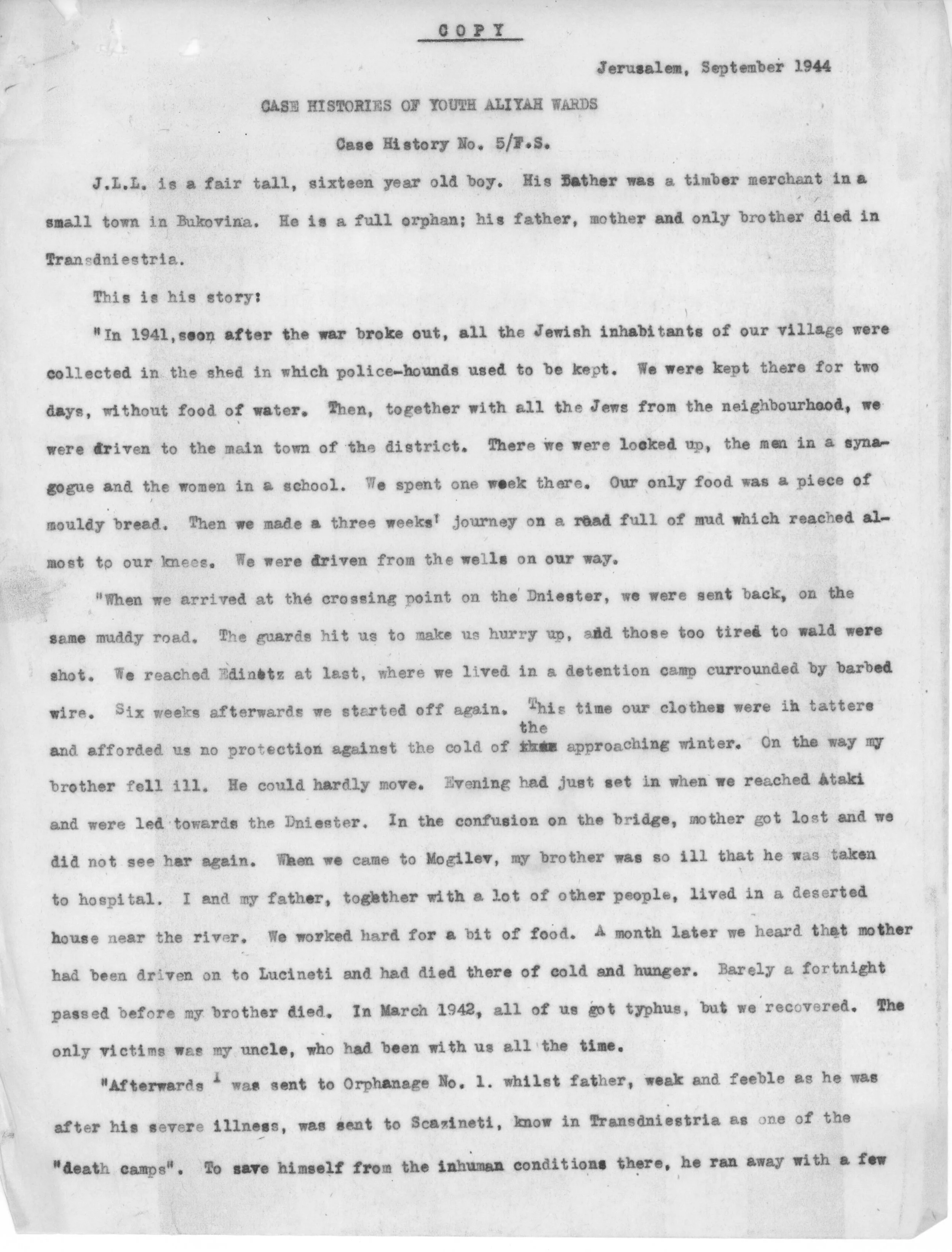
Jerusalem, September 1944
CASE HISTORIES OF YOUTH ALIYAH WARDS
Case History No. 5/F.S.
J.L.L. is a fair tall, sixteen year old boy. His father was a timber merchant in a small town in Bukovina. He is a full orphan; his father, mother and only brother died in Transnistria.
This is his story:
"In 1941, soon after the war broke out, all the Jewish inhabitants of our village were collected in the shed in which police-hounds used to be kept. We were kept there for two days, without food or water. Then, together with all the Jews from the neighbourhood, we were driven to the main town of the district. There we were locked up, the men in a synagogue and the women in a school. We spent one week there. Our only food was a piece of mouldy bread. Then we made a three weeks' journey on a road full of mud which reached almost to our knees. We were driven from the wells on our way.
"When we arrived at the crossing point on the Dniester, we were sent back, on the same muddy road. The guards hit us to make us hurry up, and those too tired to walk were shot. We reached Edinetz at last, where we lived in a detention camp surrounded by barbed wire. Six weeks afterwards we started off again. This time our clothes were in tatters and afforded us no protection against the cold of approaching winter. On the way my brother fell ill. He could hardly move. Evening had just set in when we reached Ataki and were led towards the Dniester. In the confusion on the bridge, mother got lost and we did not see her again. When we came to Mogilev, my brother was so ill that he was taken to hospital. I and my father, together with a lot of other people, lived in a deserted house near the river. We worked hard for a bit of food. A month later we heard that mother had been driven on to Lucineti and had died there of cold and hunger. Barely a fortnight passed before my brother died. In March 1942, all of us got typhus, but we recovered. The only victim was my uncle, who had been with us all the time.
"Afterwards I was sent to Orphanage No. 1. whilst father, weak and feeble as he was after his severe illness, was sent to Scazineti, know in Transnistria as one of the 'death camps'. To save himself from the inhuman conditions there, he ran away with a few others in October 1942. They wandered about for a time, and were found dead, frozen.
"We from the orphanage were also sent to work. I helped to build the iron bridge across the Dniester. I witnessed many cruelties that the Germans inflicted on the Jewish workers. For the smallest fault, sometimes, obviously trumped up, Jews were thrown into the water.
"......Now I am in Palestine, with the Youth Aliyah, happy to work on the land and to help build our country."...