
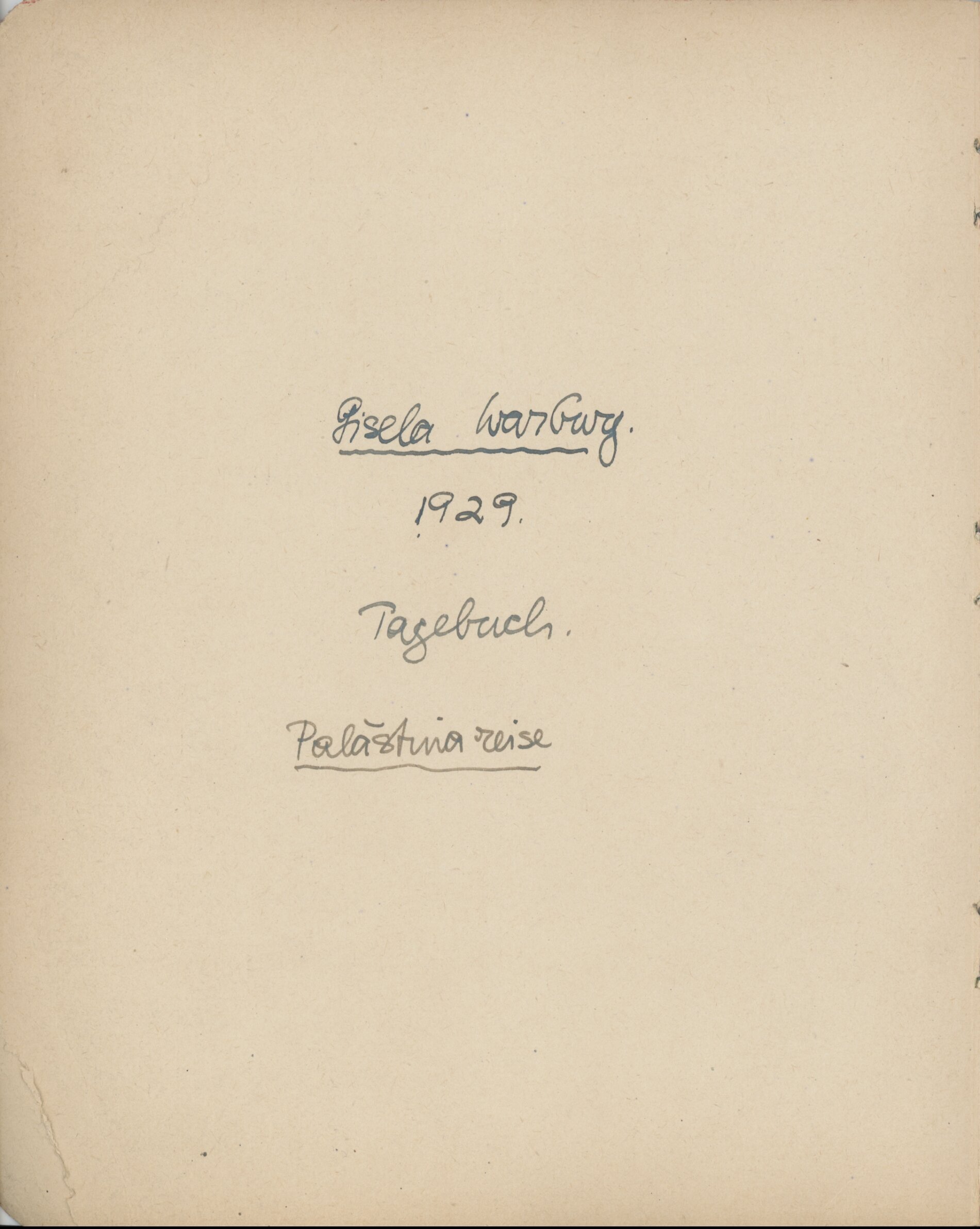
Diary: Gisela’s First Trip to Palestine (1929)
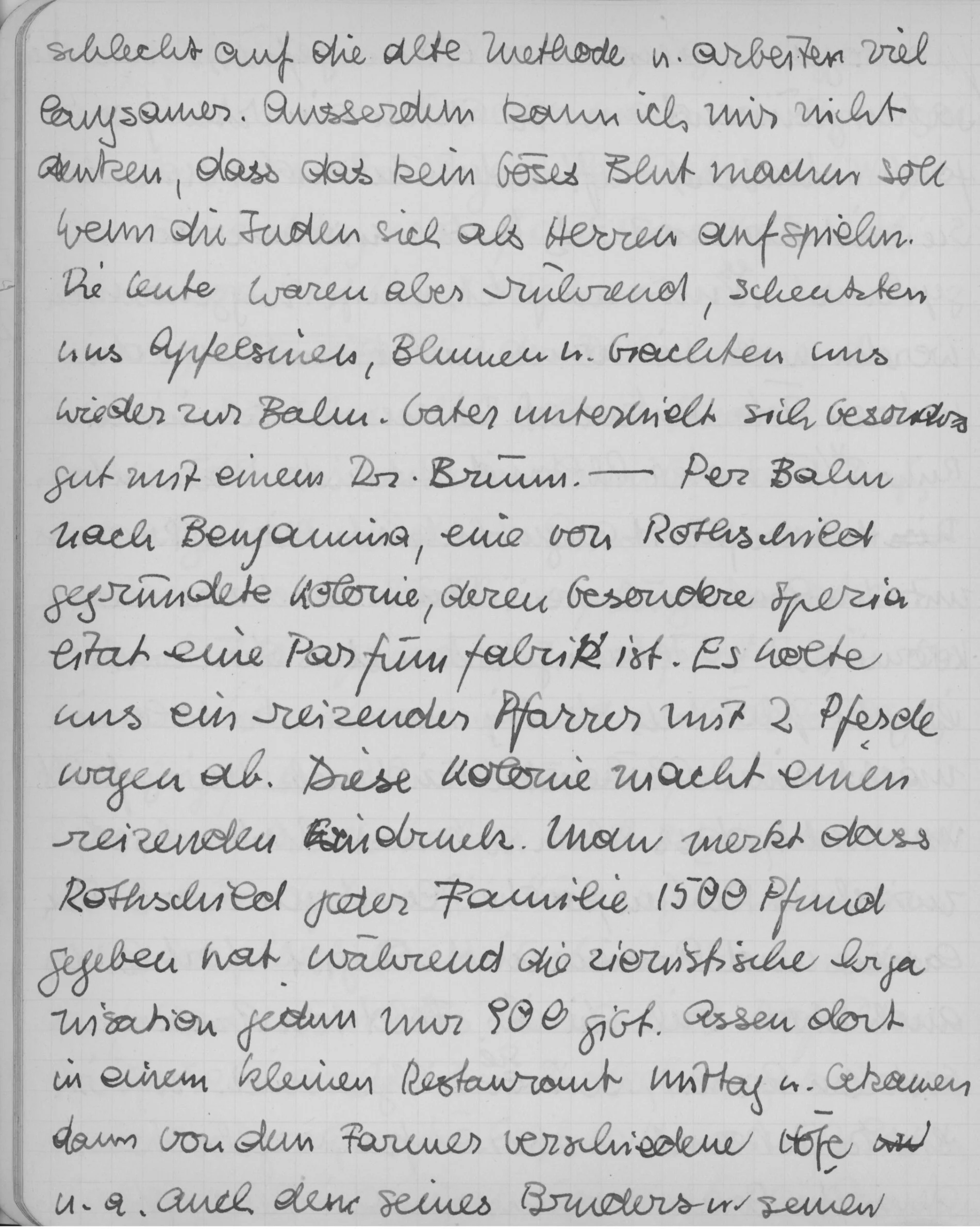
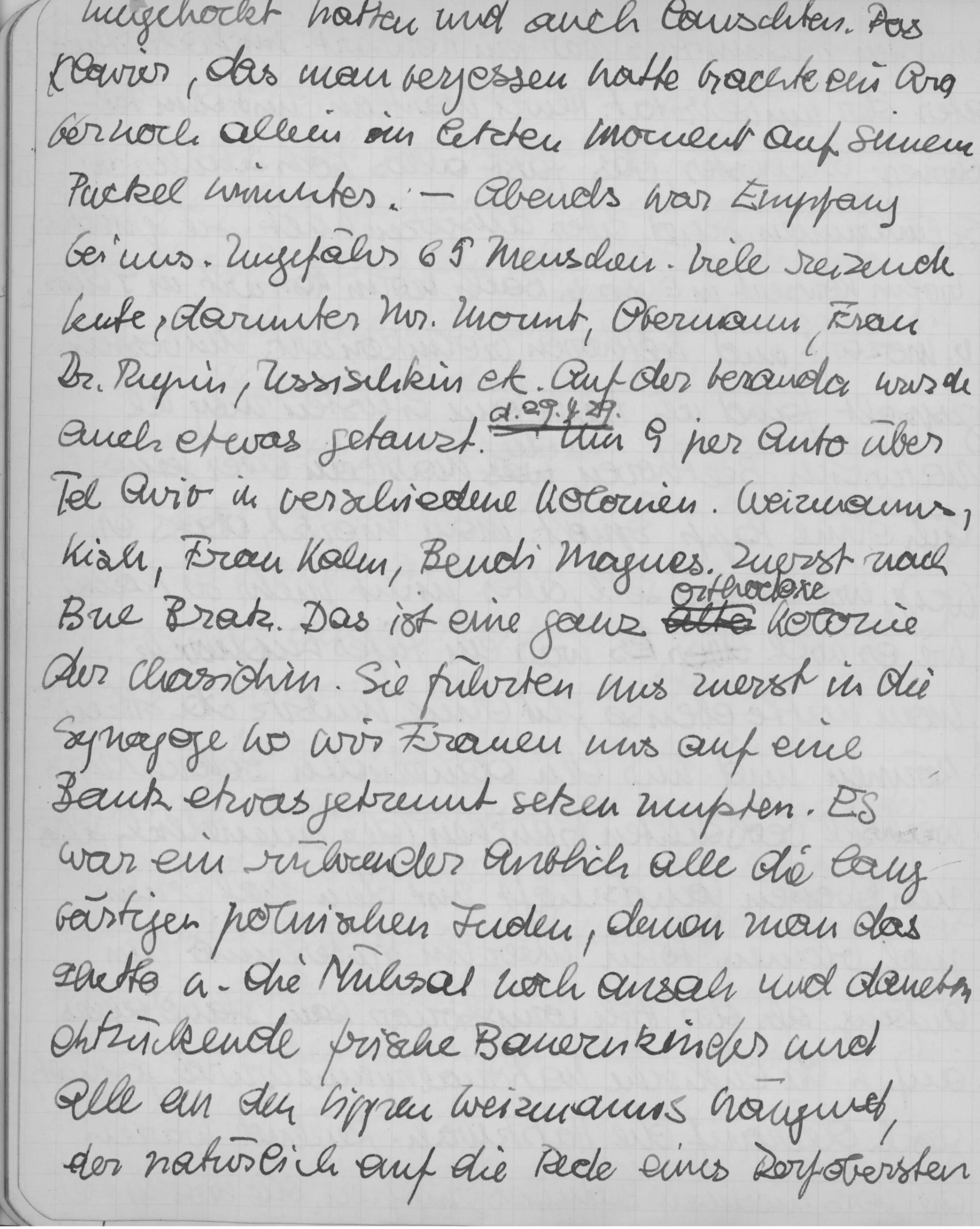
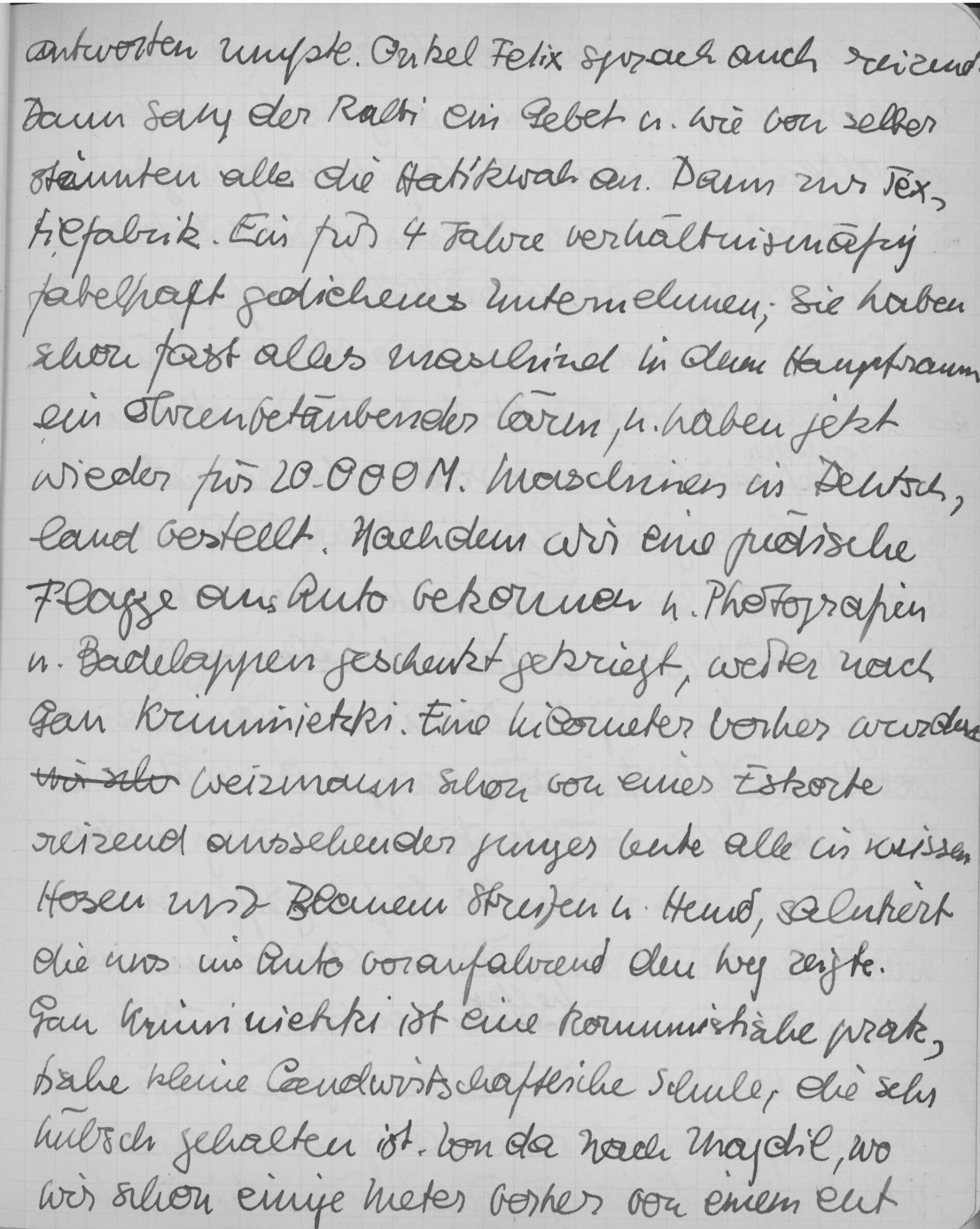
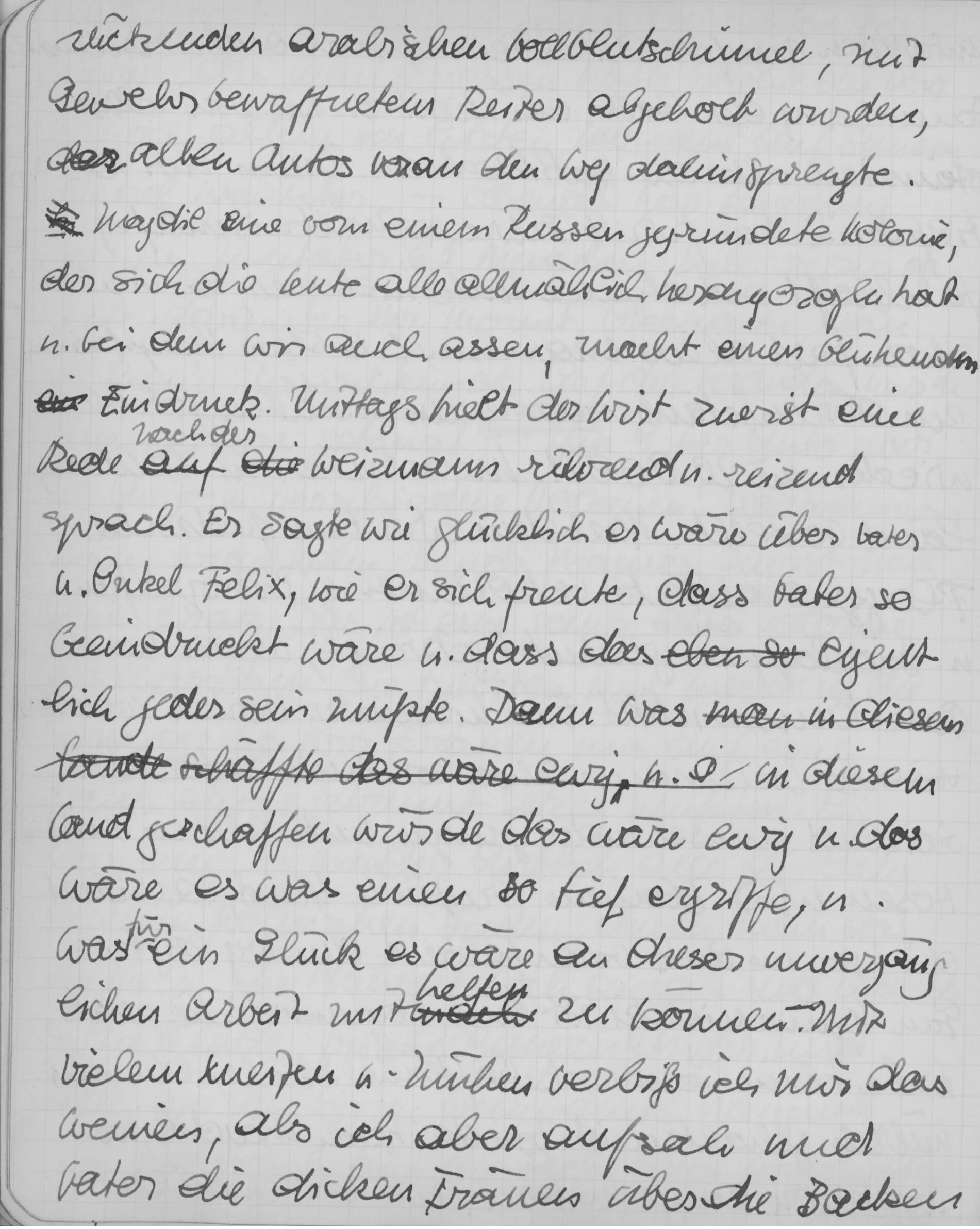
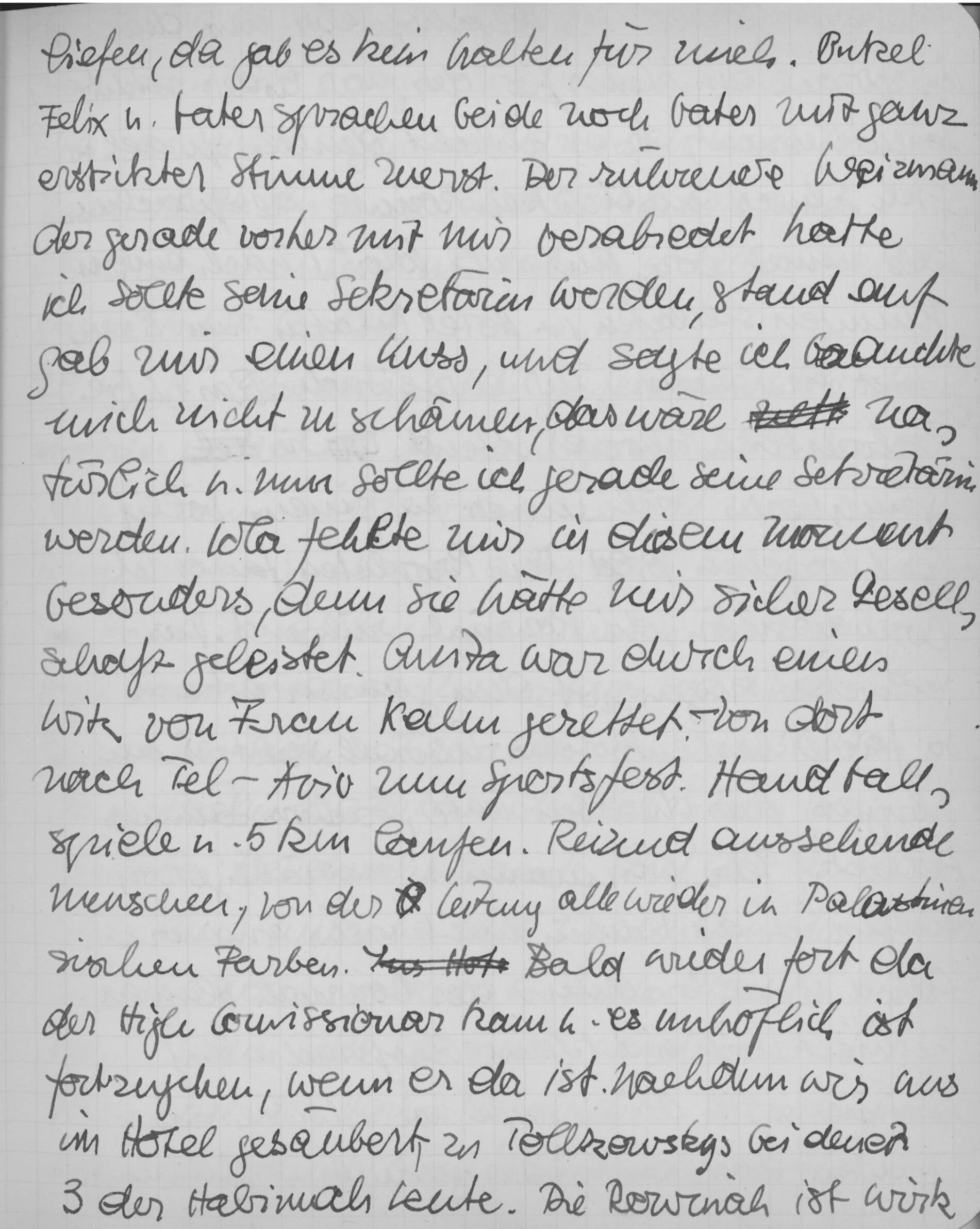
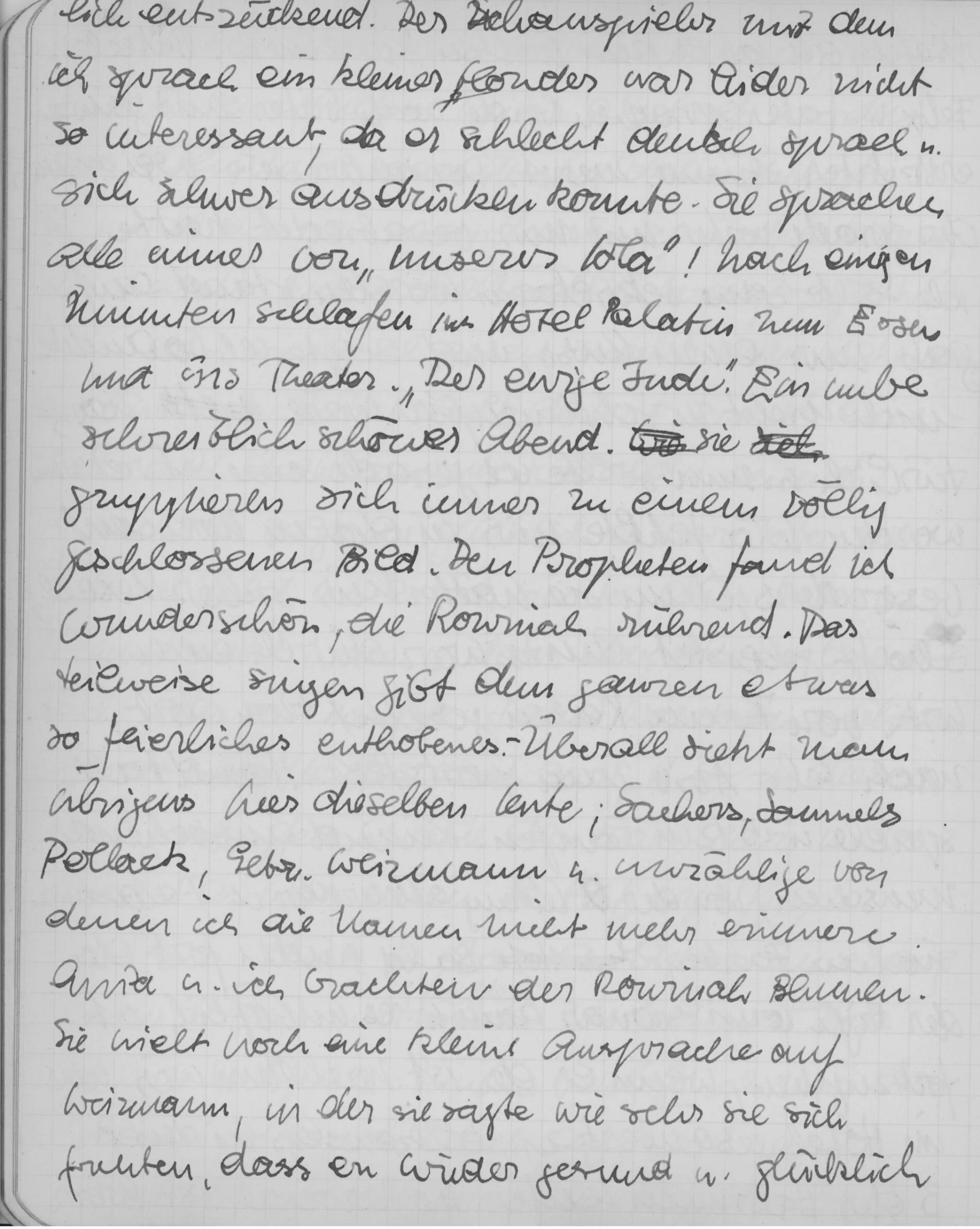
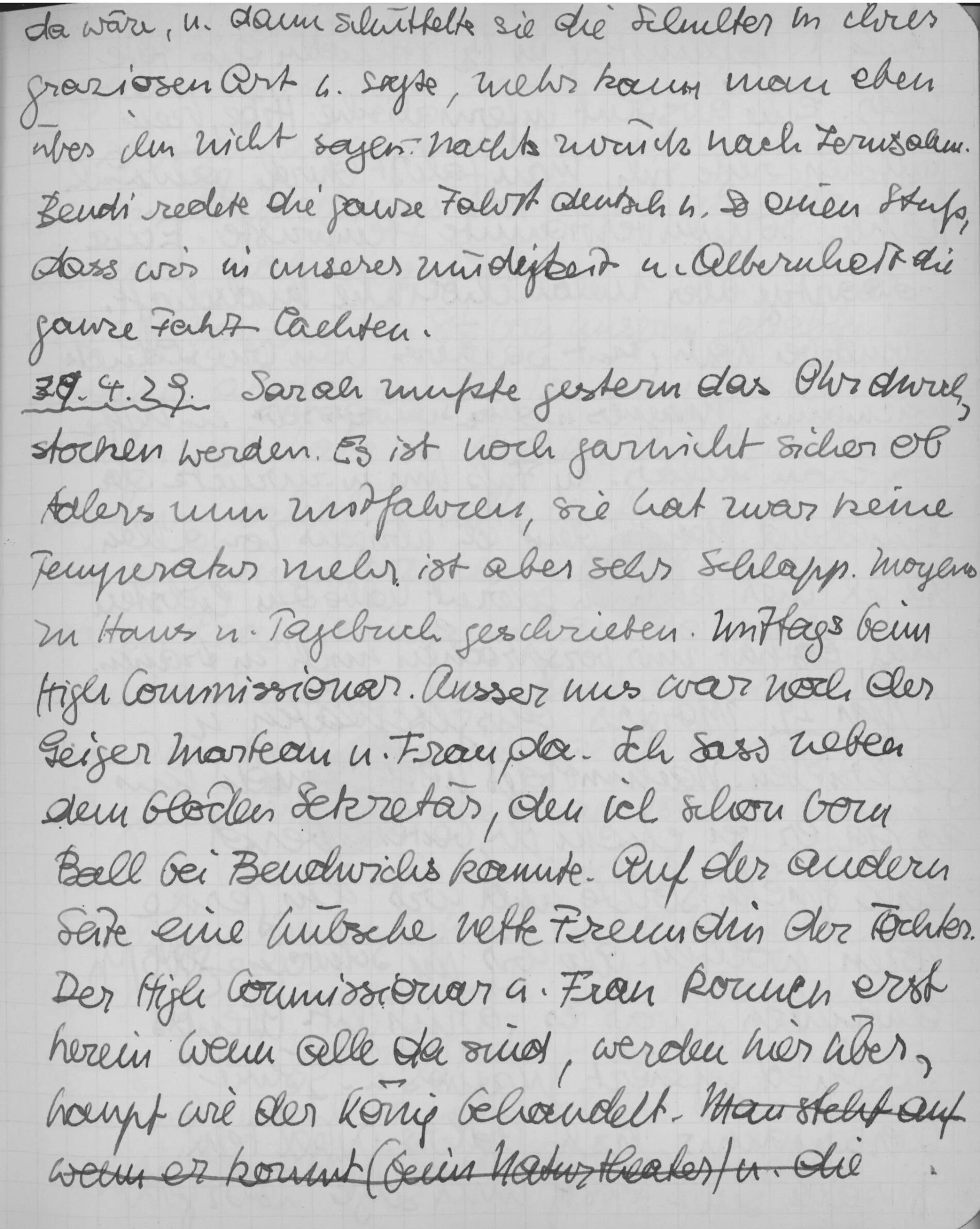
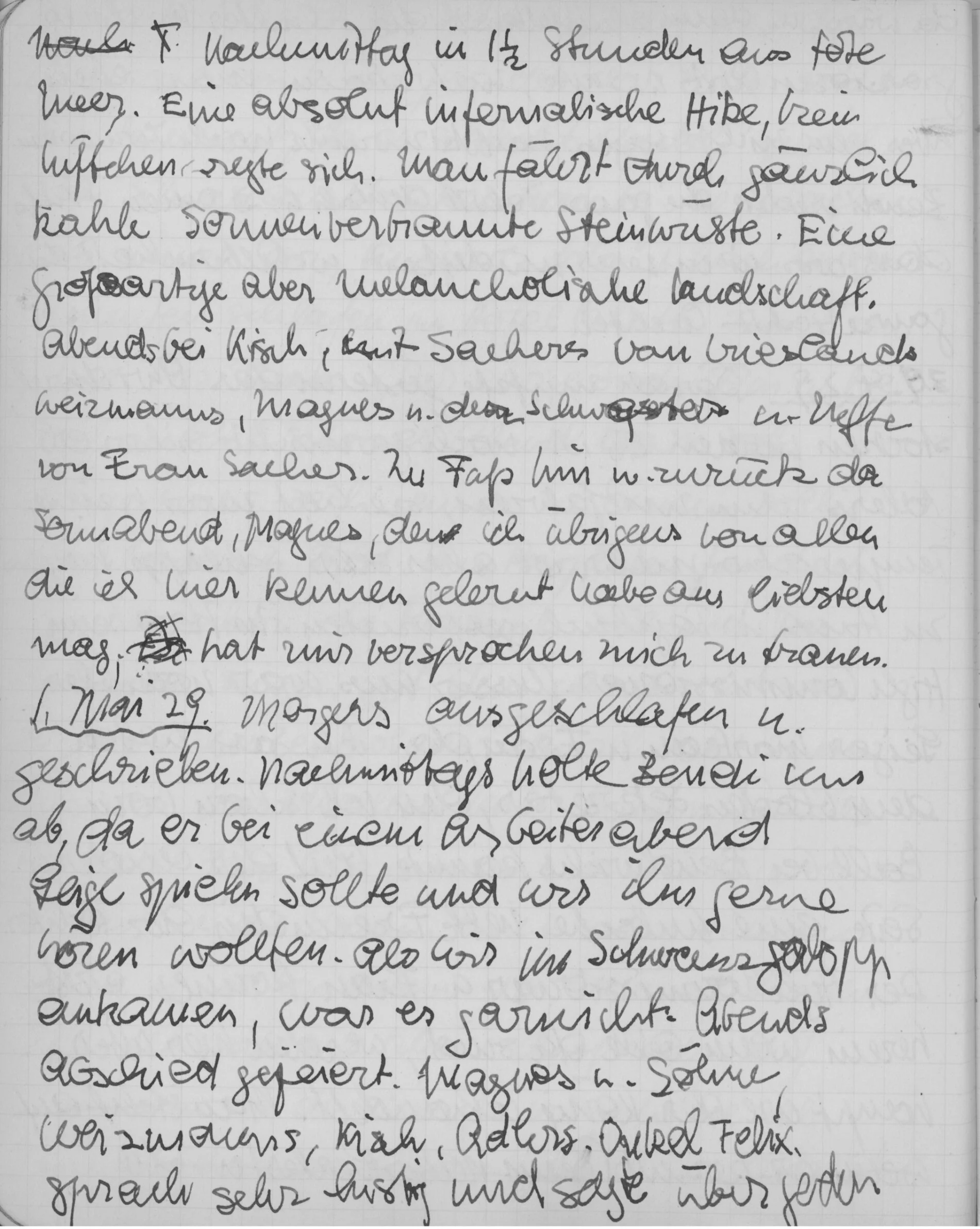
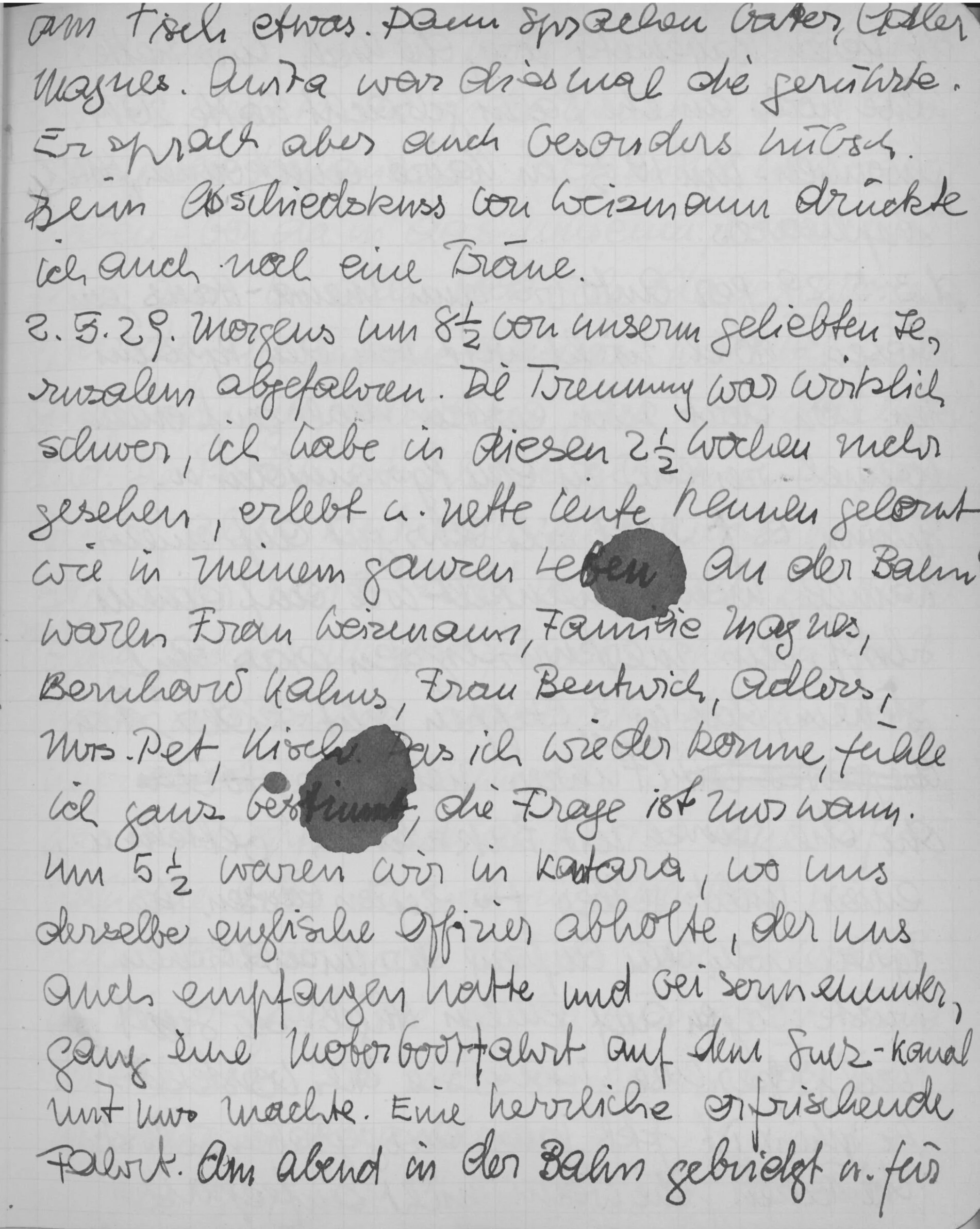
-
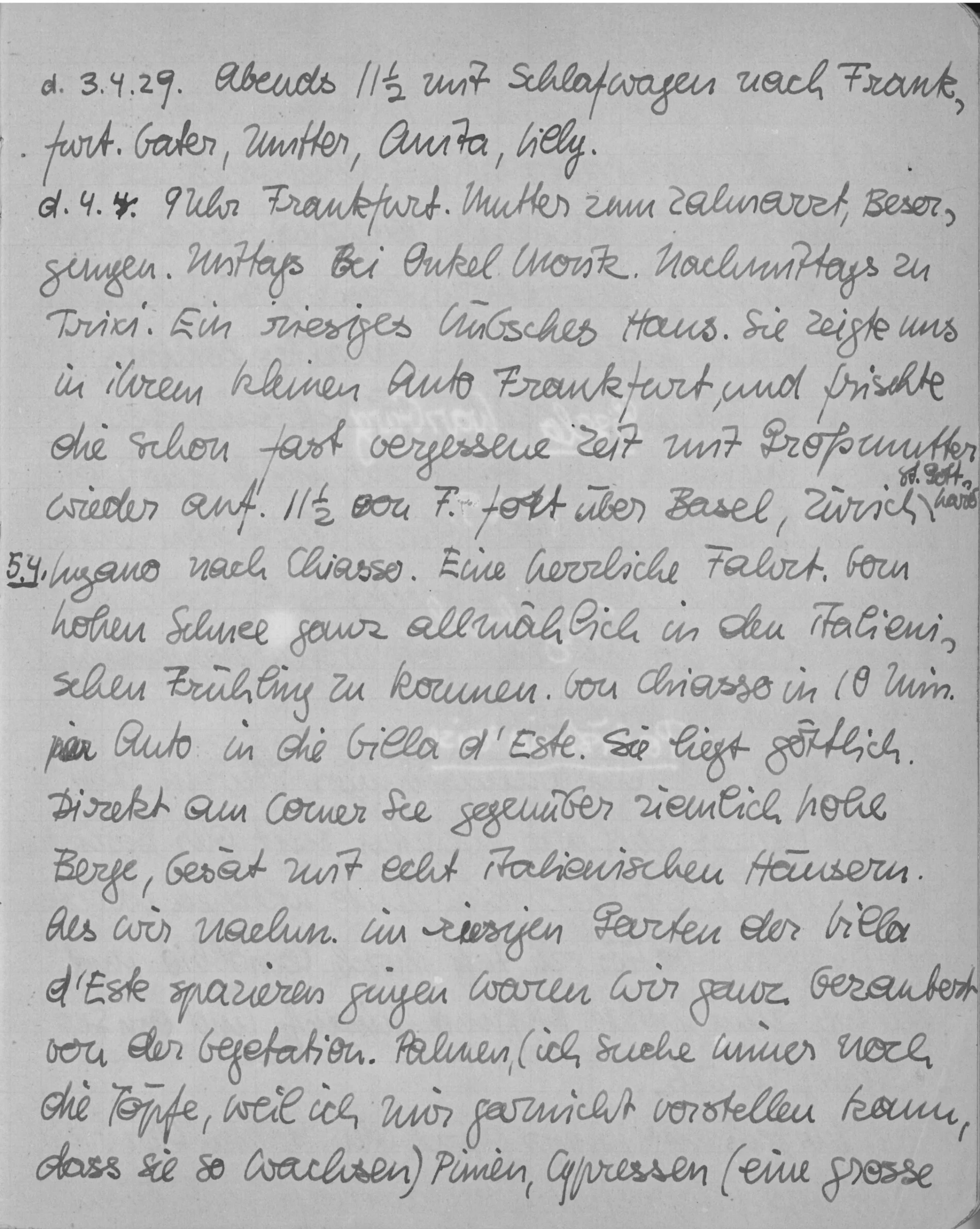
Father, Mother, Lilly and I took the night train to Frankfurt at 11:30pm
-
9am arrival in Frankfurt. Mother is setting out to attend her dental appointment, which resulted in an approvement. Lunch with uncle Moritz. Afternoon visiting Trixi. The house is beautiful and very big. She takes us on a sightseeing tour of Frankfurt in her little car. It brought back forgotten memories of times with grandmother.
11:30pm leaving Frankfurt to Chiasso, over Basel, Zurich, St. Gotthard Pass and Lugano.
-
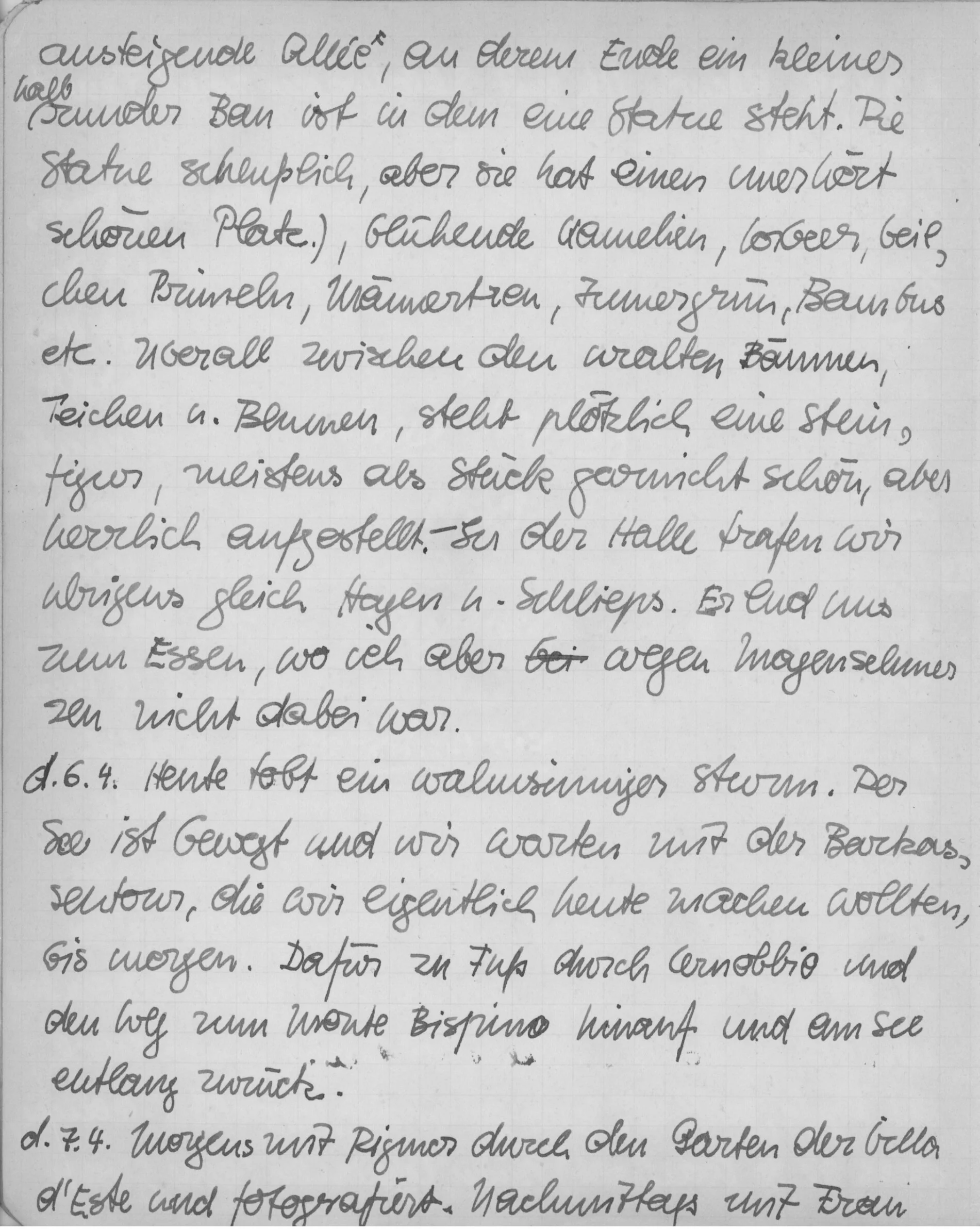
A breathtaking journey from snow covered mountains descending slowly into the Italian Spring. In 10 minutes from Chiasso to the Villa d’Este with its divine location. Situated directly on Lake Como, across from a rather large mountain range. Traditional Italian houses are seen everywhere.
Enchanted walk through the magnificent gardens in the afternoon. Big palm, pine and Cypress trees are planted along the path that brings us to a magnificent spot with a structure that holds a rather ugly statue. Glimmering camellias, laurel, violets, primrose, evergreens and bamboo among the ancient trees. Suddenly, we see a stone statue masterfully displayed in the middle of it. That is were we met Hagen and Schlieps, who invited us to join them for dinner, which I had to miss due to not feeling well.
-
Inclement weather today. The water of the lake is restless. We will wait until tomorrow with the ship tour. We instead embark on a walk through Cernobbio up to Monte Bispino returning along the lake.
-
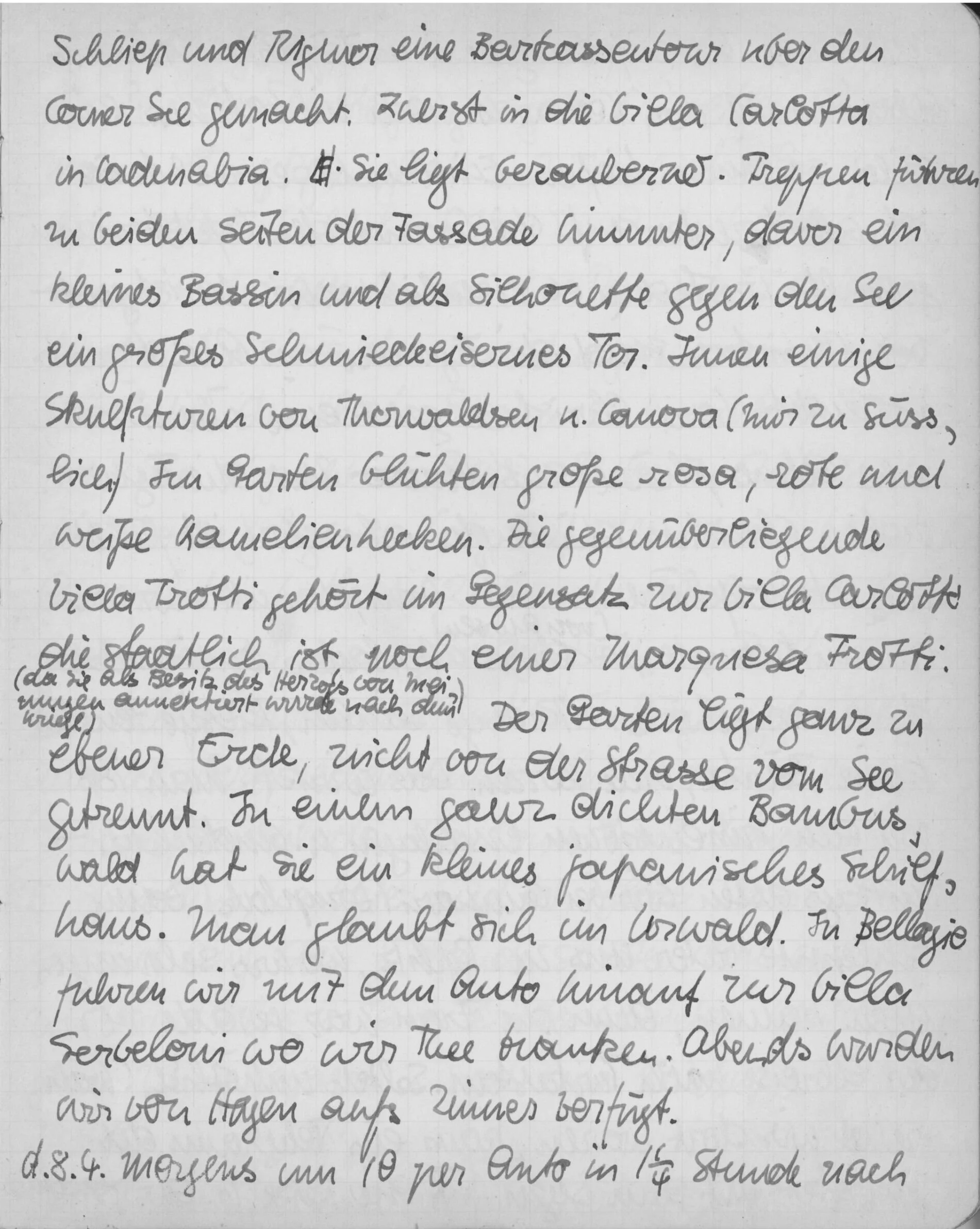
Taking pictures of the gardens with Rigmer in the morning. Afternoon, a mountain road tour along Lake Como with Mrs. Schliep and Rigmer. First stop the Villa Carlotta in Cadenabbia. Location is incredible. Stairs are leading down on both sides of the building to a little basin, a large rod iron fence serving as a silhouette against the lake. There are some sculptures of Thornwalessen and Canova, a little to elaborate for my personal taste. Large pink, red and white camelia hedges are in bright bloom. Located across is the Villa Trotti, in contrast to the Villa Carlotta, it is still owned by a Marquesa Trotti. The gardens are at ground level, not separated from the street and the lake. A little reed house is nicely tugged into a dense bamboo forest. It gives the visitor the feeling of walking in a jungle.
We are driving from Bellagio up to the villa Sebeloni for an afternoon tea. We are spending the evening in our room.
-
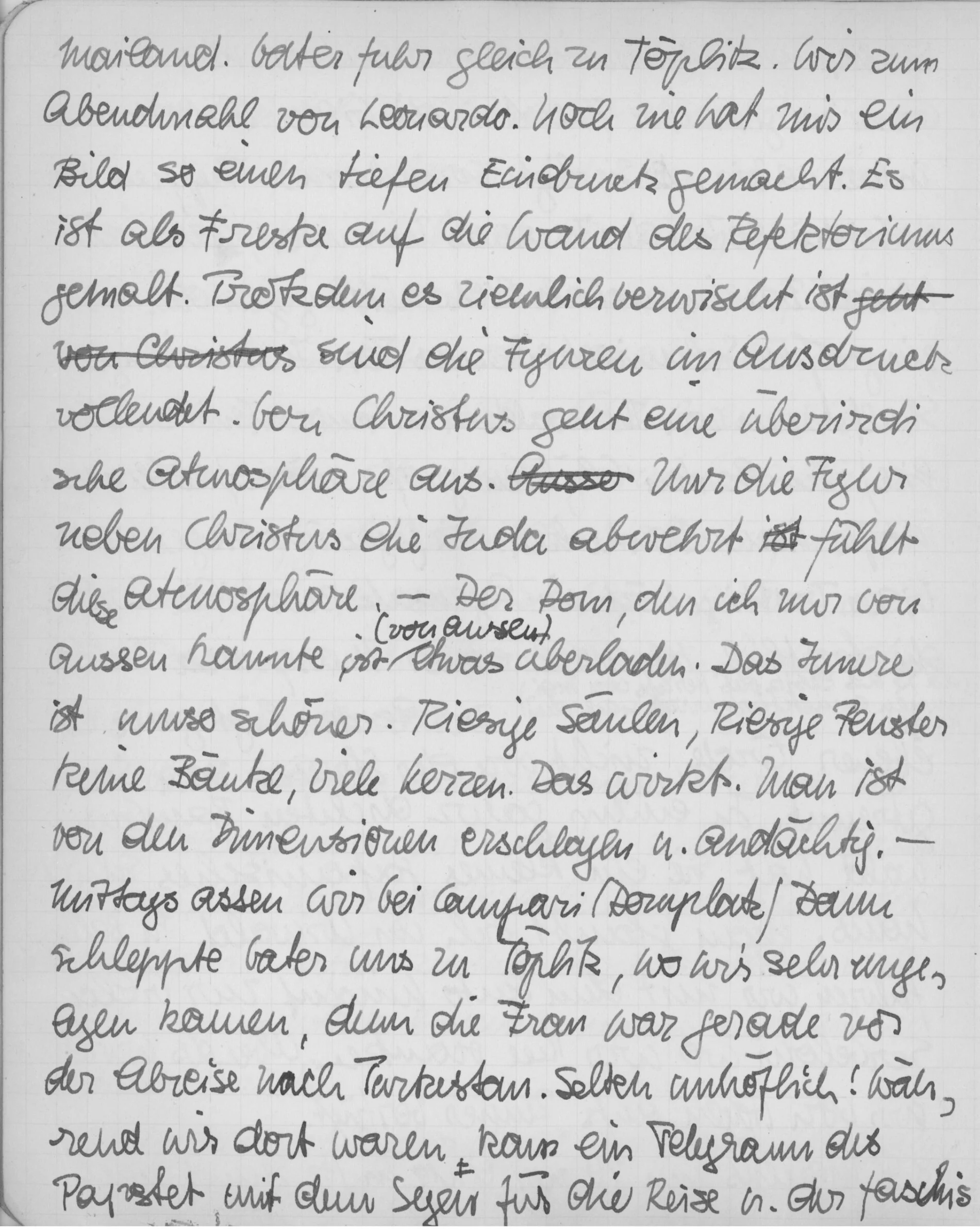
10am driving to Milan. Arriving after 1 hour and 15 minutes. Father heading to meet with Toeplitz. We are heading to visit the last supper by Leonardo. Never before has a painting left such a deep impression with me. A fresco painting on the wall of the refectory. Despite it being blurred the different figures are complete in their individual expressions.
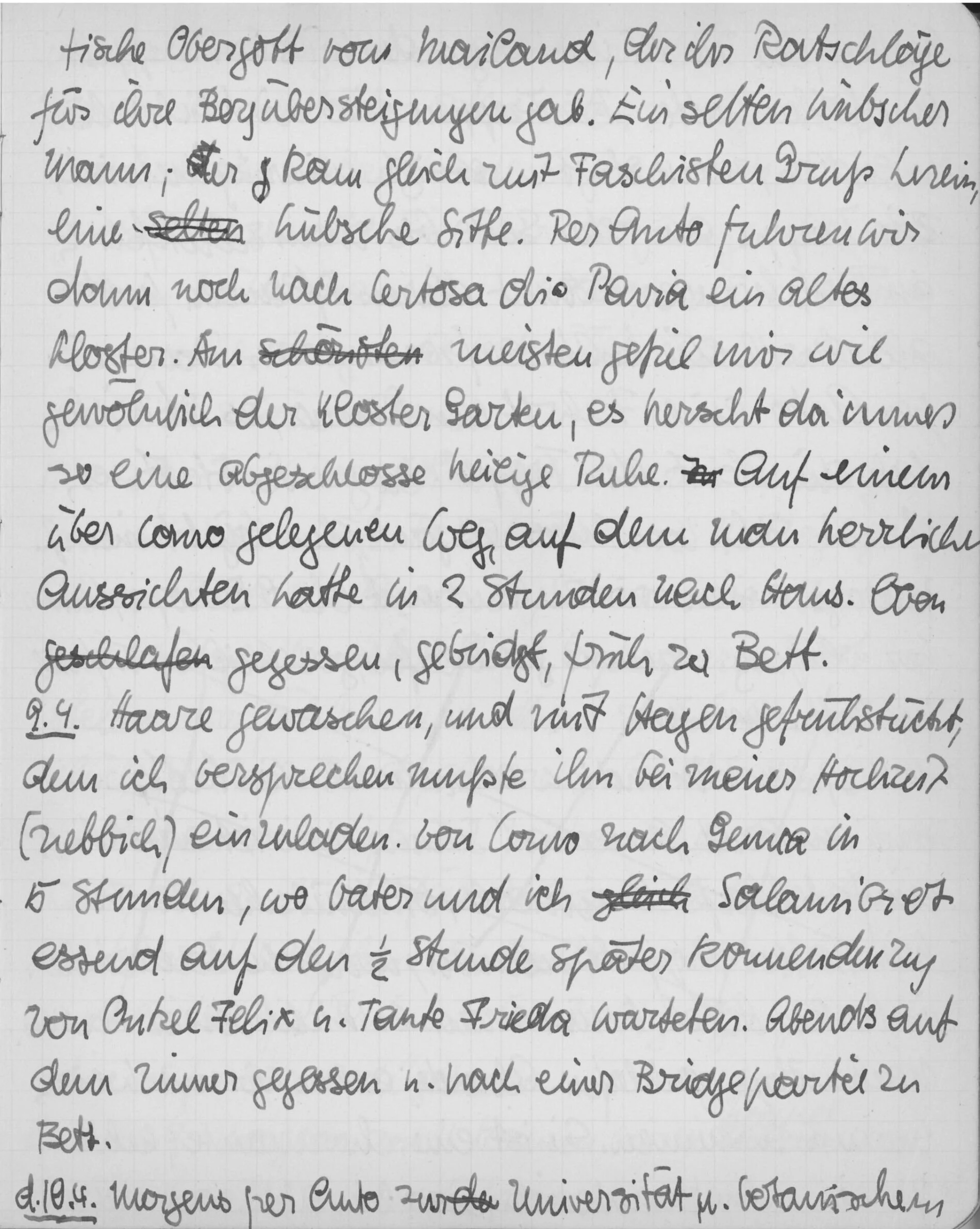
An unearthly luminosity emanates from Christ. Only the figure to the left of Christ, fending off Judas, feels this energy. The cathedral I only was familiar with from the outside, is a little overloaded. Although the interior makes up for it. Giant pillars, large windows, small benches and a sea of candles. The dimensions are devoutly overwhelming. We ate lunch at Campari on cathedral Square. Father dragged us to Toelplitz afterwards.Our visit appeared to be inconvenient to his wife, who was preparing to depart on a trip to Turkestan. A telegram from the Pope, with a blessing for the trip, arrived. The fascist god of Milan, a very handsome man entered with a fascist salute, to share his advice about crossing the Ural Mountains. A seldom impolite and unwelcoming experience.
On to Certosa di Pavia, an old monastery. As usual, I enjoyed the monastery garden. It is Always filled with such a sacred calmness. On a road above Lake Como, with a wonderful view, back to the hotel. Dinner, clothes ironed and early to bed.
-
Washed my hair. Followed by a breakfast with Hagen. I had to promise to invite him to my wedding. In 5 hours from Como to Genoa. Father and I were eating salami sandwiches, waiting for uncle Felix and aunt Frieda’s train to arrive, thirty minutes later. Dinner in my room, followed by a game of bridge. Heading to bed.
-
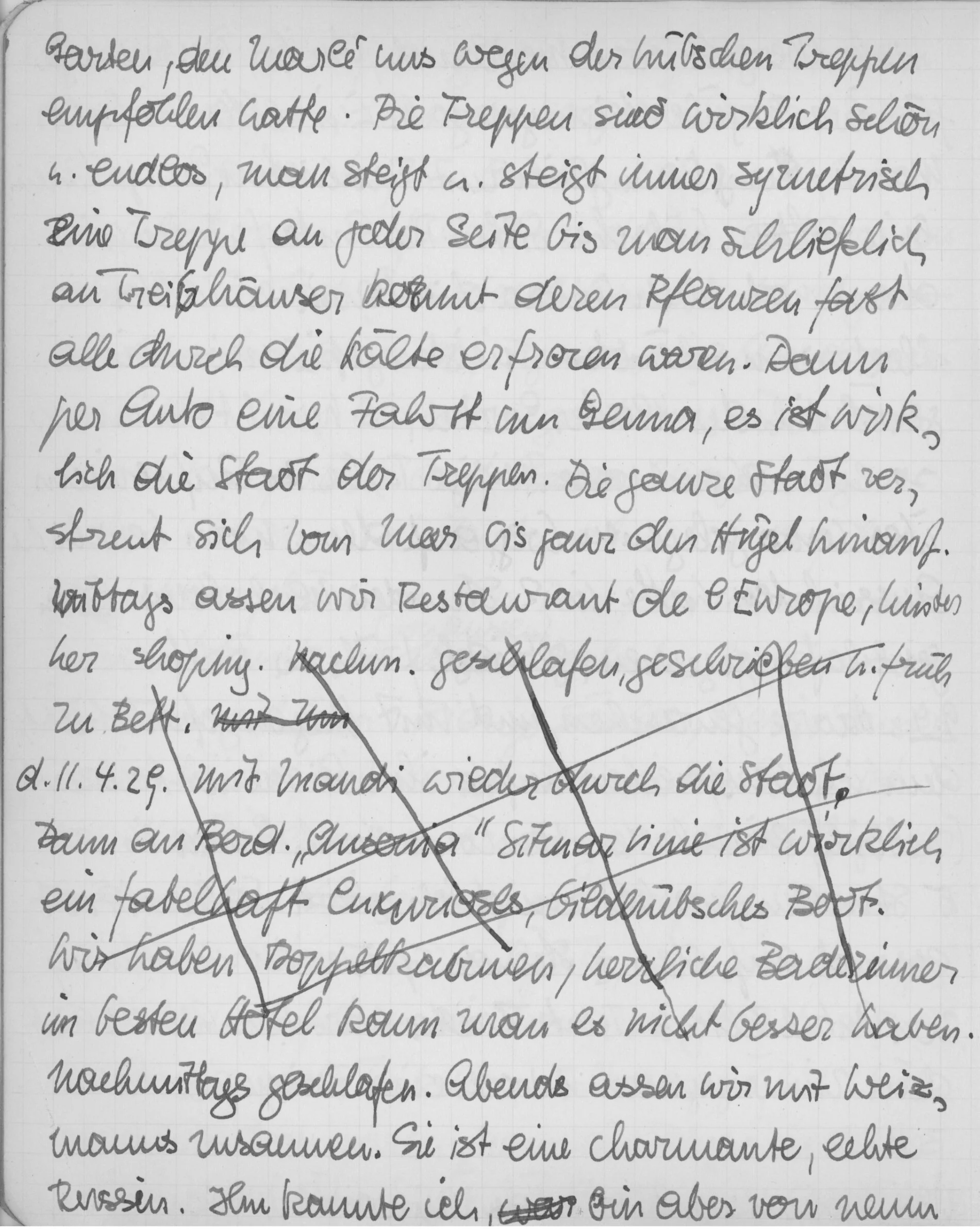
In the Morning we are driving to the university and the botanical gardens. Marle had recommended the beautiful staircases. They are indeed very nice and endless. Step for step we ascend symmetrically until reaching greenhouses. Most of the plants had died from an unexpected frost. A city tour of Genoa follows. It is indeed a city of stairs. It is stretching from the sea all the way up into the mountains. We are taking lunch at the restaurant L’Europe and explore the stores afterwards. Early to bed.
-
Maudi and I are strolling through the city. Then boarding the Ansonia, Sitmar Line, an Outstanding beautiful ship. We have double cabins, with incredible bathrooms that one cannot even find in a first-class hotel. We both feel happy and immediately at home on board.
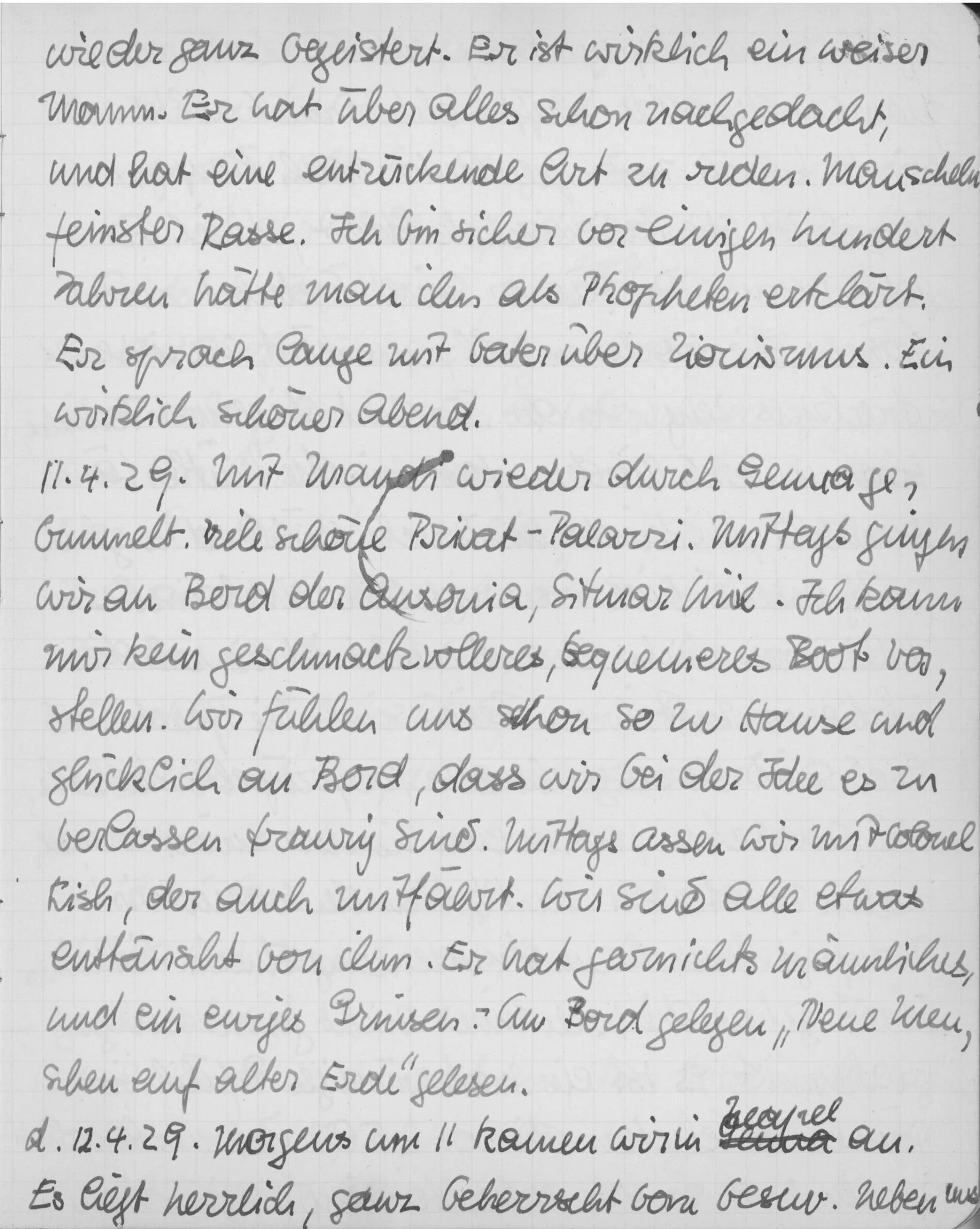
We have lunch with the Colonel Kish, who is also taking the journey. His incessant grin and lack of masculinity has us a little disappointed. After lunch we took a nap in the afternoon. We are joining the Weizmanns for dinner She is an authentic Russian woman. I had met him before, and once again I am very impressed. He is a truly wise man, who had thoroughly studied all aspects of life. He had a delightful manner of speaking. Human beings of the finest pedigree. I am convinced that hundreds of years ago he would have been viewed as a prophet. Father had a very long conversation with him about Zionism. An overall beautiful evening.
I started reading a book I found on the ship. “New People on old Soil” by Felix Salten.
-
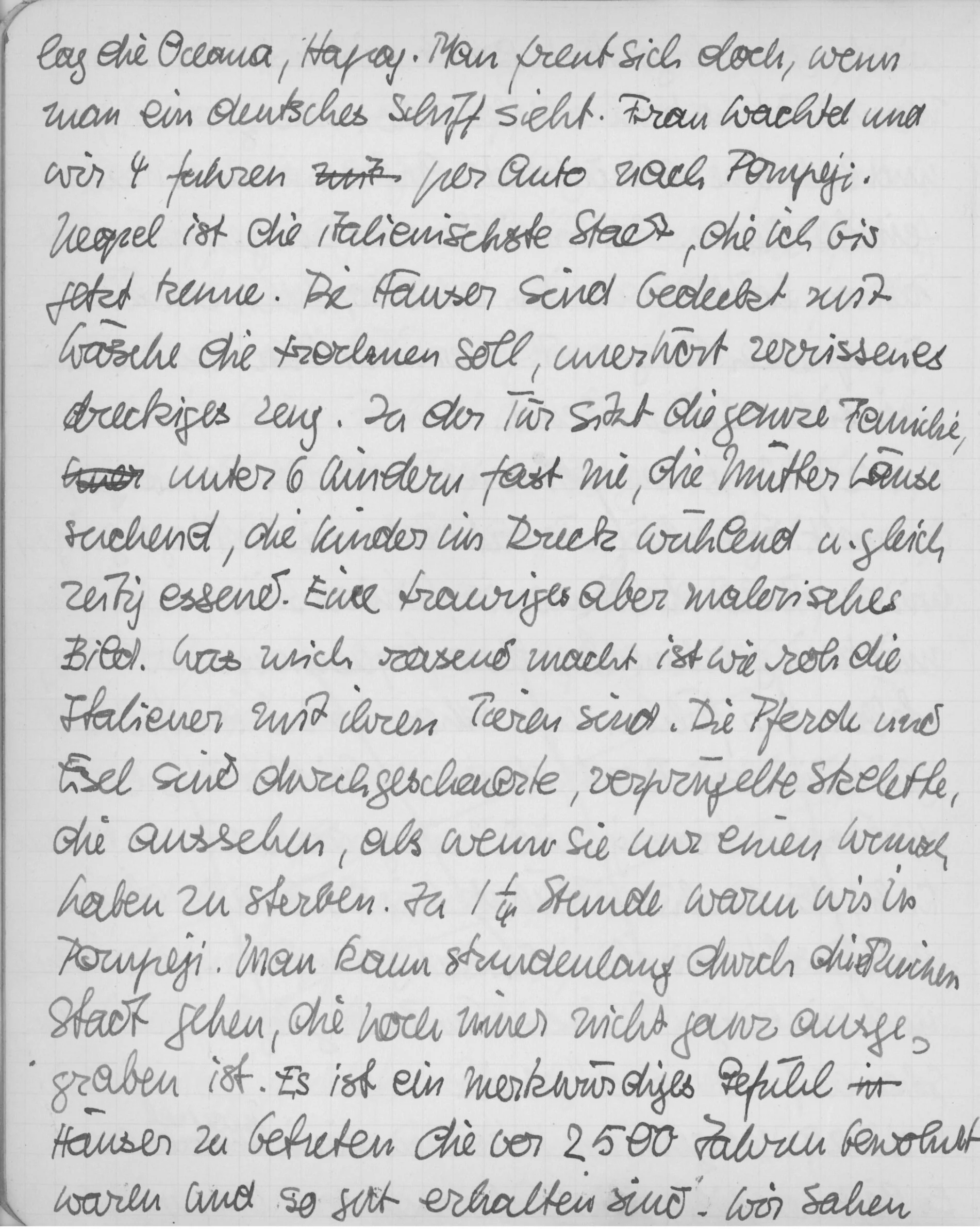
11am we arrived in Naples. It is located in a delightful area, flooded with tourists. The Oceana by Hapag is anchored next to us. It is always delightful to encounter a German Ship. Mrs. Wachtel and the four of us are taking heading with the car to Pompeii. Naples is the most authentic Italian city that I know of so far. Laundry to air dry is covering all the houses. Some still looking a little dirty and torn up. Families are sitting in open doorways with all their children. Mothers delousing their hair, while the others are playing and eating in the dirt. A sad but picturesque scene. What has my blood boil is how Italian abuse their animals. The horses and donkeys, look like chafed and beaten skeletons with only one wish, to die.
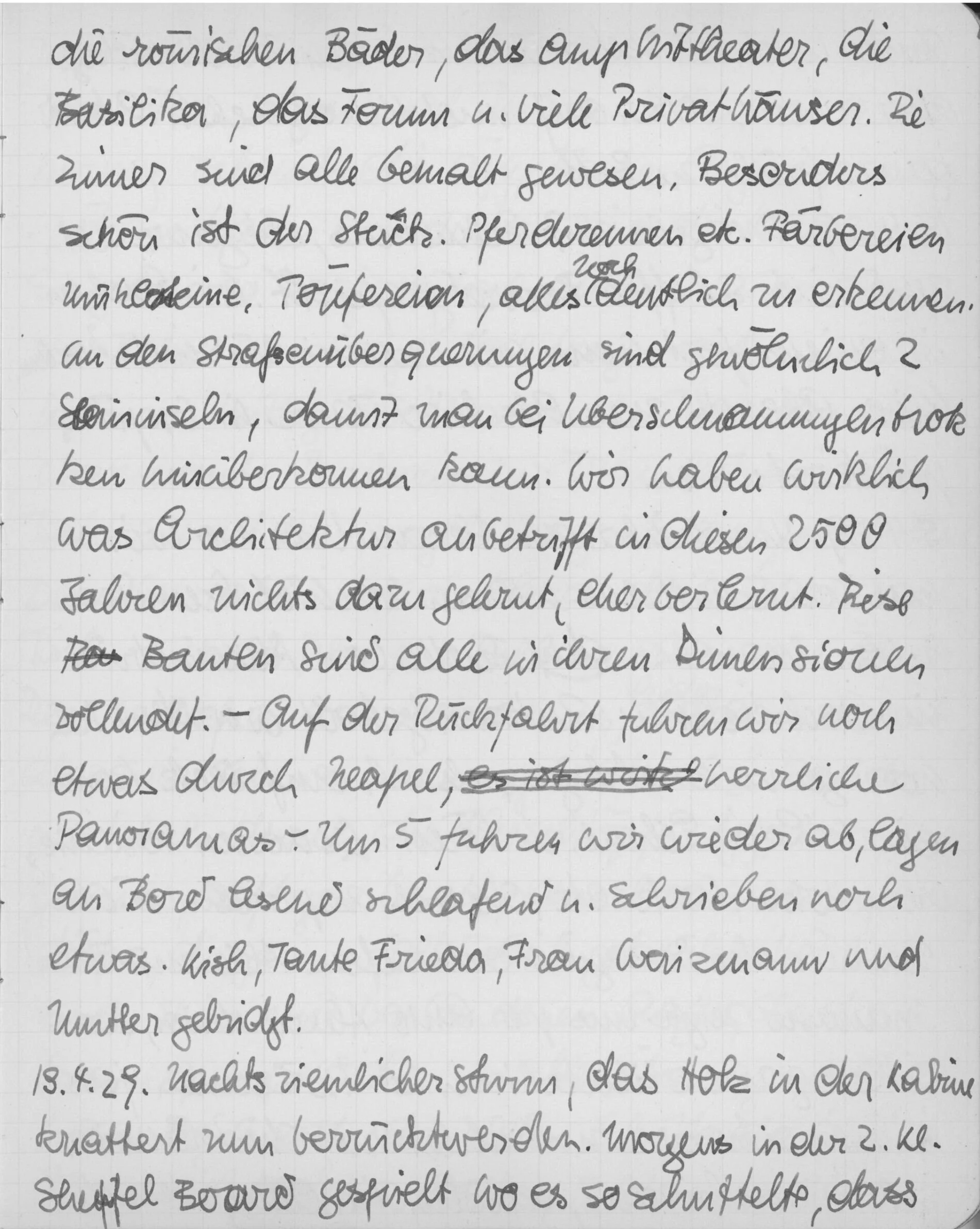
We arrive after 1 hour and 15 minutes in Pompeii. We could spend hours walking through the ruins of the city. Not all of it has been excavated. It is a little peculiar to enter such well preserved houses, that had been inhabited 2500 years ago. We visited the roman baths, the amphitheater, the basilica, the forum and many private homes. All the rooms displayed wall paintings. Some are extraordinarily beautiful like the horse’s races etc. On we go to the public mill, the dyeing structure, the pottery house with a perfectly intact kiln. Everything still recognizable.
It is common to have two elevated islands on each side of the roads crossing, so that one can still get to the other side in cases of flooding. Interestingly enough, we have not evolved much architecturally over the last 2500, I would dare to say we rather lost knowledge. Large structures are skillfully designed in their dimensions. We went exploring Naples a little more on the way back. Wonderful panoramas.
The ship departed at 5pm. We were nestled in our beds napping or writing. Kish, aunt Frieda, Mrs. Weizmann and mother.
-
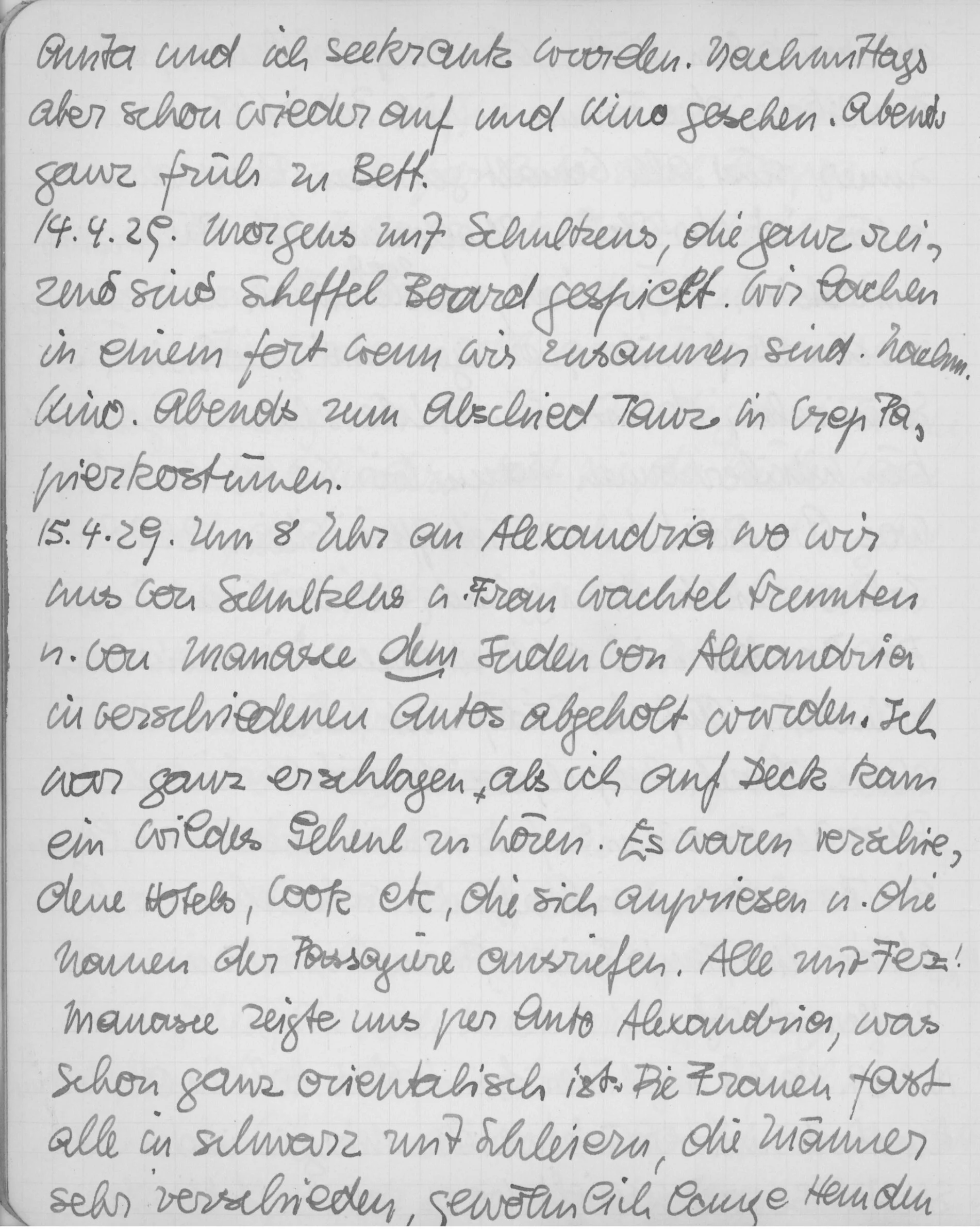
Turbulent storm during the night. The wood in our room groans throughout the night. We went to the economy deck to play shuffle board in the morning. The floor was moving which resulted in Anita and I becoming sea sick. We were fully recovered by the afternoon and went to the cinema. We went to bed early.
-
We played another game of shuffle board in the morning with the Schultzen family, accompanied with consistent laughter. Another visit to the cinema in the afternoon. In the evening a goodbye dance with paper costumes.
-
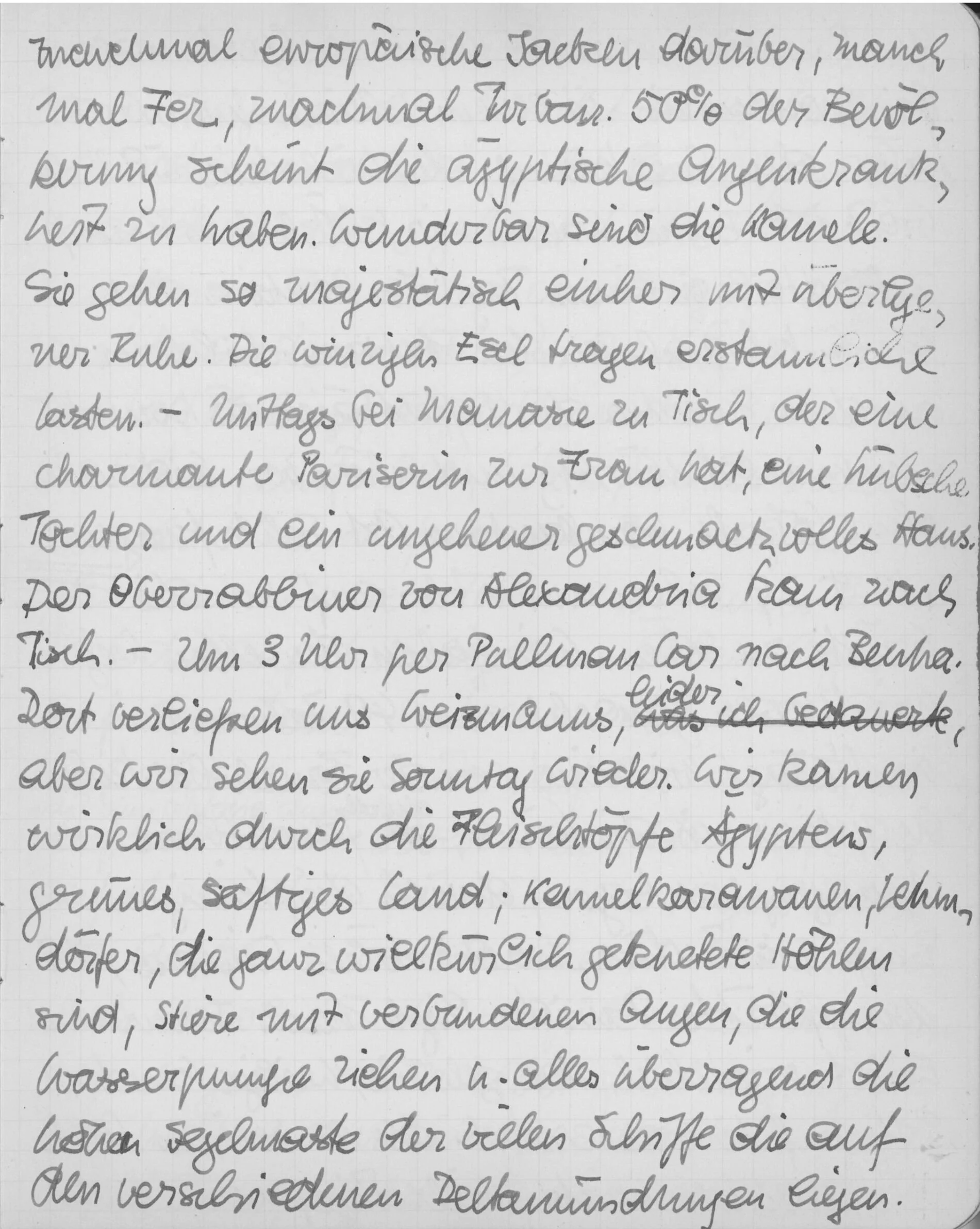
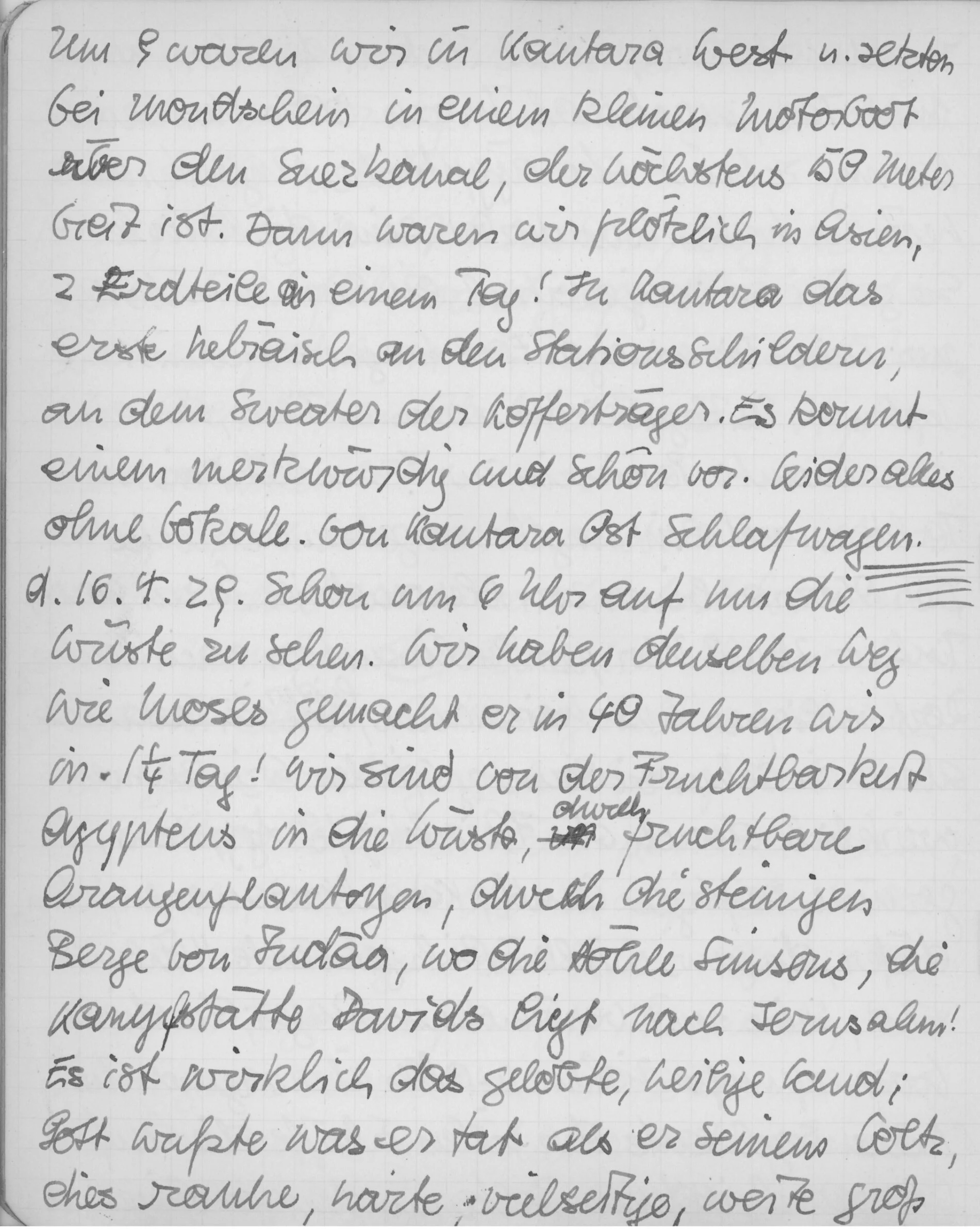
8 o’clock arrival in Alexandria. I was overwhelmed when I came on deck. All I heard was a loud commotion of noise, hotels, cooks etc, offering their services to the passengers, whose names were calling out. All wearing a Fez. We left the Schultzen family and Mrs. Wachtel and went to the car of Magnes, the Jew of Alexandria, who had arranged a fleet to pick us up. He showed us around Alexandria which has a truly oriental flair. Almost all the women are wearing veils and are dressed in black. The men are more diverse. Many are wearing long shirts with western jackets. Some chose a Fez other a turban. 50 percent of the population appears to suffer from the Egyptian eye disease. The camels are wonderful, striding majestically with an innate calmness along the streets. The smaller donkeys are carrying surprisingly heavy baggage. We are having lunch at Magnes’s stupendously tasteful house, with his charming Parisian wife and pretty daughter. The chief Rabbi of Alexandria joined us. We left for Benha at 3pm in the afternoon. This is were Mr. and Mrs. Weizmann left us, unfortunately! We will reunite on Sunday. We drove through green, lush land, passing camel caravans. Villages with huts made of dirt and clay, arbitrarily kneaded into little caves. Blindfolded bulls pulling the water pump. Visible are the monumental high masts of ships anchored at various locations of the delta mouths. We arrived at 9pm in Kantara West. Crossing the Suez Cana, which was merely 5 meters wide, in a little motor boat under shimmering moonlight. We suddenly had entered Asia, two continents in just one day. We see the first Hebrew words on the train station signs and the uniforms of the personnel that is carrying our suitcases. It all appears strange but beautiful. We board the night train from Kantara.
-
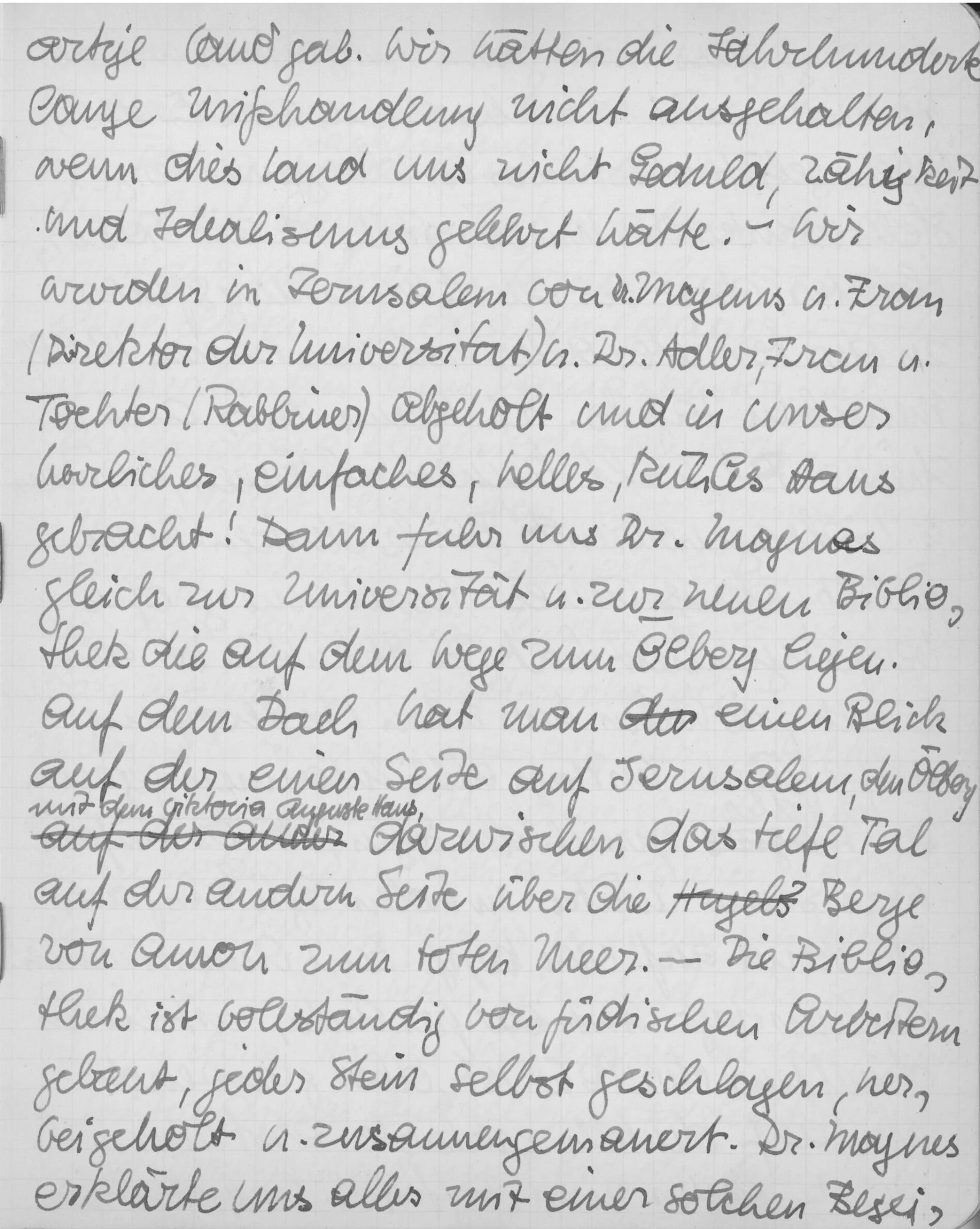
6 am, we are getting a head start, heading into the desert. We traveled the same route than Moses. It took him 40 years, us 1 ¼ days. We left the fertile land of Egypt and entered the desert with its stone filled mountains and caves of the Judaean desert, King Solomon’s battle fields all the way to Jerusalem. It is really the Promised Land. God knew what he was doing when he gave his people this rough, hard, versatile, vast and great land. We would not have been able to endure centuries of abuse if this land had not taught us patience, tenacity and idealism.
Rabbi Dr Adler came to pick us up, with his wife and daughter. He brought us to a wonderful, simple, bright and quiet house. He drove us afterwards to the university where Dr. Mayers, the director of the university, and his wife welcome us to Jerusalem. Afterwards we went to visit the new library which was located in the way to Mount Olive. The view from the roof has Jerusalem one of side, the Olive Mount and Augusta Victoria Hospital on the other. In between the deep valley of the Ammon Mountains all the way to the Dead Sea.
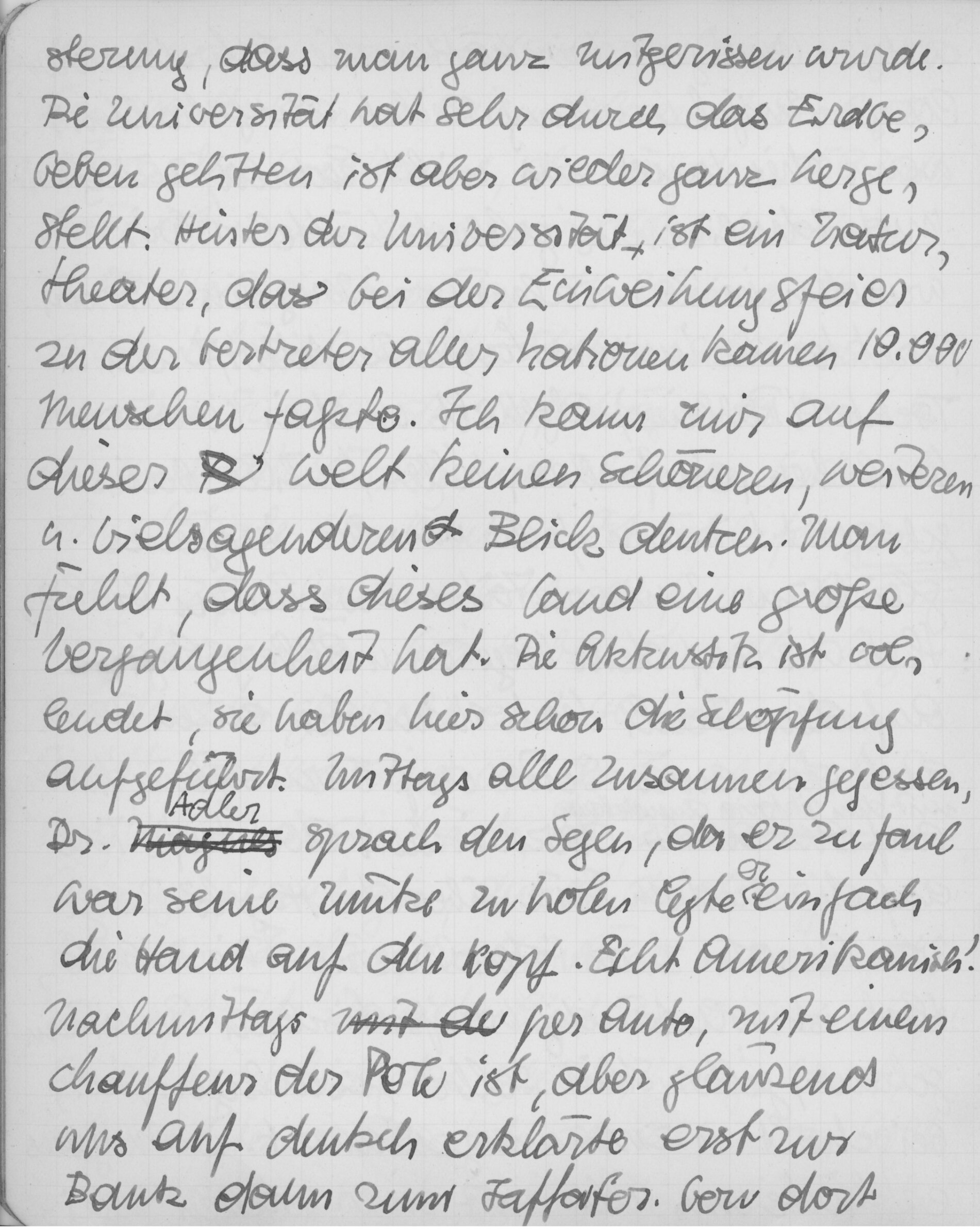
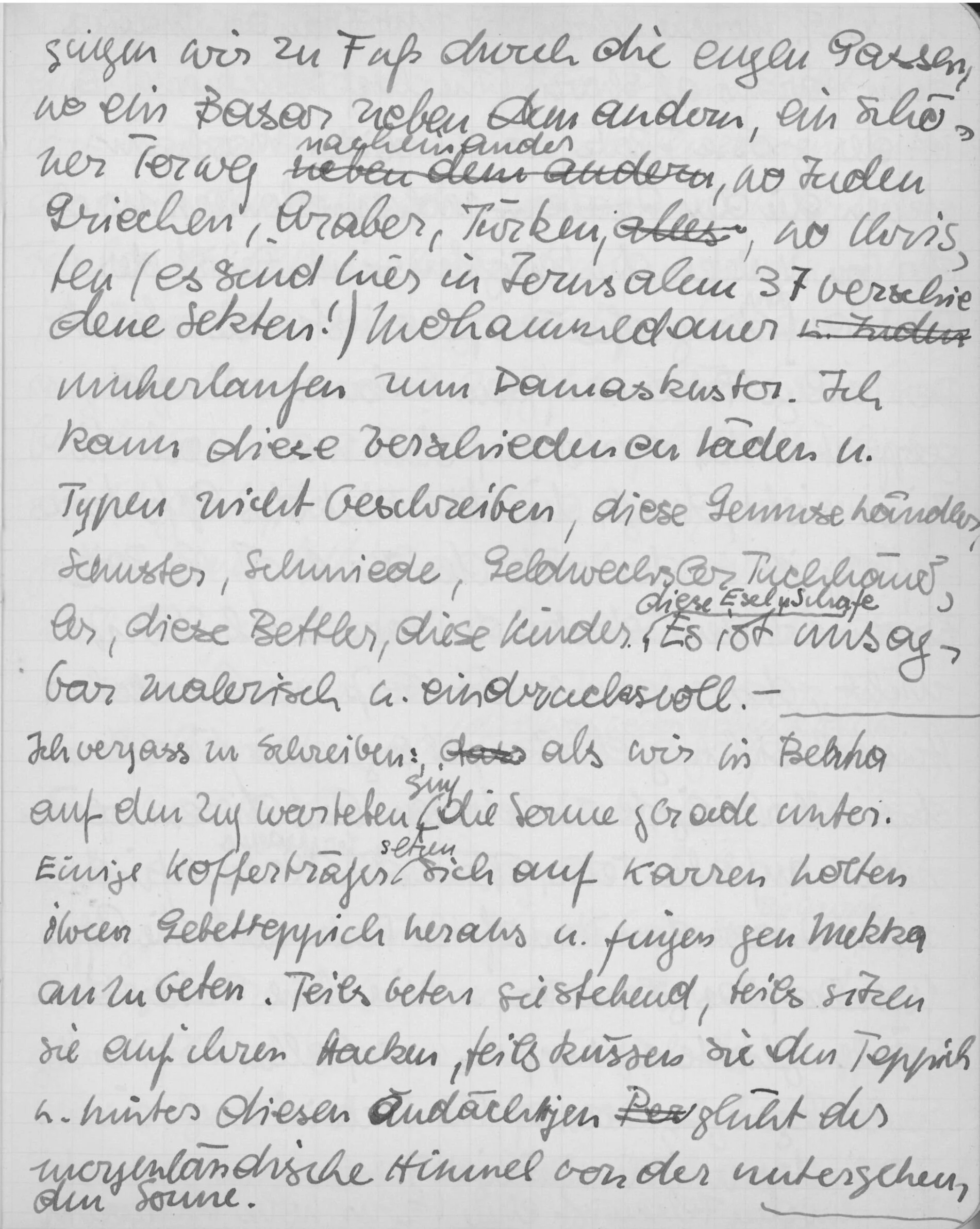
Every stone of the library is cut, delivered and bricked by Jewish workers. Dr. Magnes’ enthusiastic explanations are contagious. The library was very much jeopardized through an earthquake but has been fully restored. There is an outdoor open theatre, behind the main campus. It held 10.000 guests from many nations during the inauguration initial inauguration ceremony. I cannot think of a nicer, more open and meaningful place in the world. The acoustics are magnified and complete. They already performed (die Schoepfung) The Creation. One literally senses the rich history of this land! All of us ate lunch together. Dr Adler gave the blessing. Since he was too lazy, to fetch his Yarmulke, he simply put his hand on his head. Very American of him! A very knowledgeable chauffeur takes us to the bank in the afternoon, he explains Everything in perfect German. He drops us at the Jaffa Gate, from which we walk through the narrow alleys that are crowded with one bazaar next to another. There are Jews, Greeks, Arabs, Turks and Christians of which there are all together 37 denominations in the city. It is challenging to fully describe this cultural and religious diversity with its bartering and trading of good of various supplies and services. The sheep and donkeys resting next to their owners stand create a rather idyllic and picturesque still life. It even made me forget to write it all down, until we were waiting to board the train later on. The sun was slowly setting, when suddenly some of the luggage carriers rolled out their carpets and began praying on their knees facing Mecca kissing the rug. Others remained standing, bowing in the same direction. Behind this memorable scene the glimmering oriental sun was setting.
-
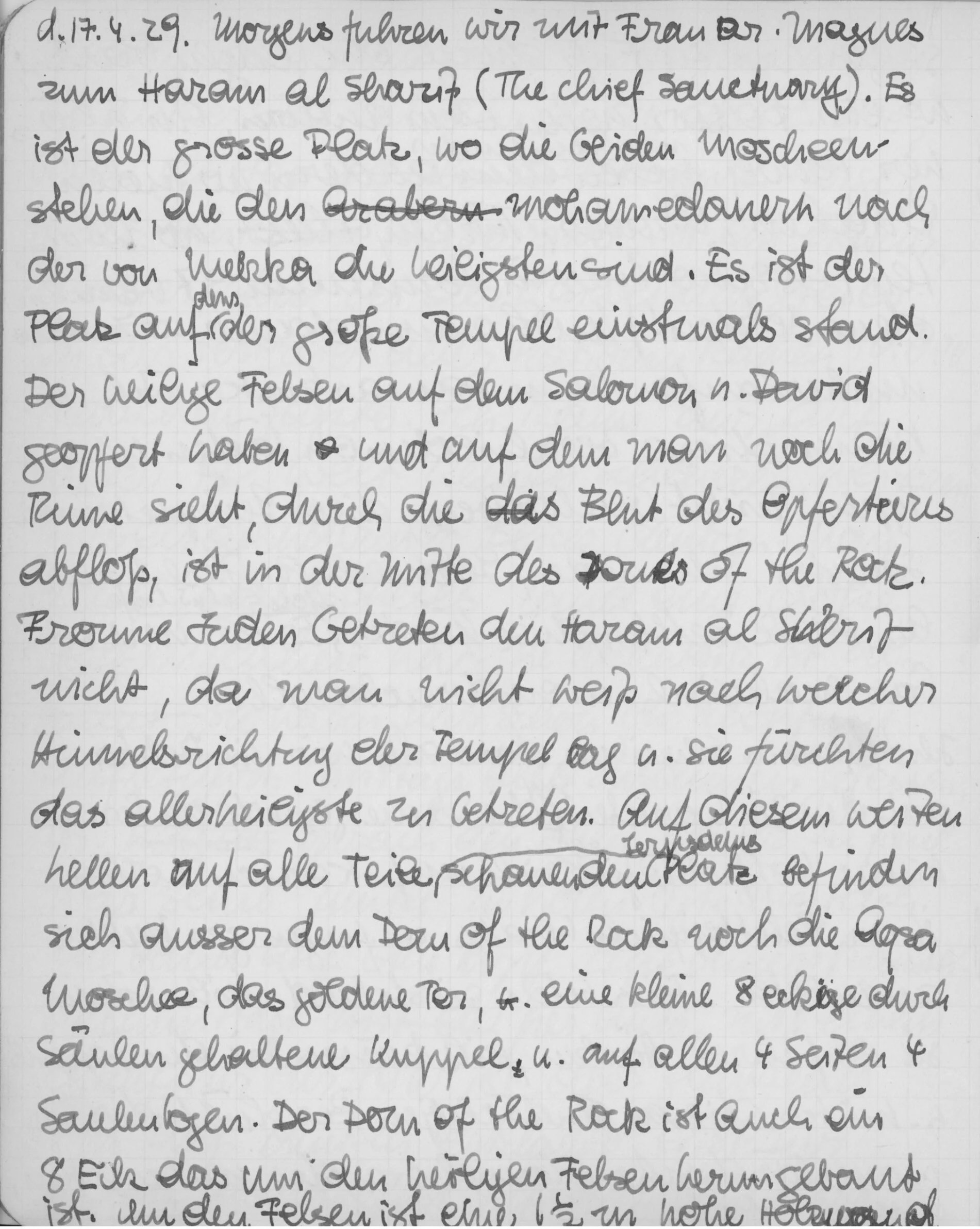
Mrs. Magnes brought us to The Chief Sanctuary, Haram al Sharif in the morning. The location and the Mosque are one of the holiest sites in Islam, next to Mecca. It is also the rock on which king Solomon and David made their sacrifices, the remnants of the stone carved drains allow us a glimpse into how the blood of the sacrificial animals had run down into the center of the rock.
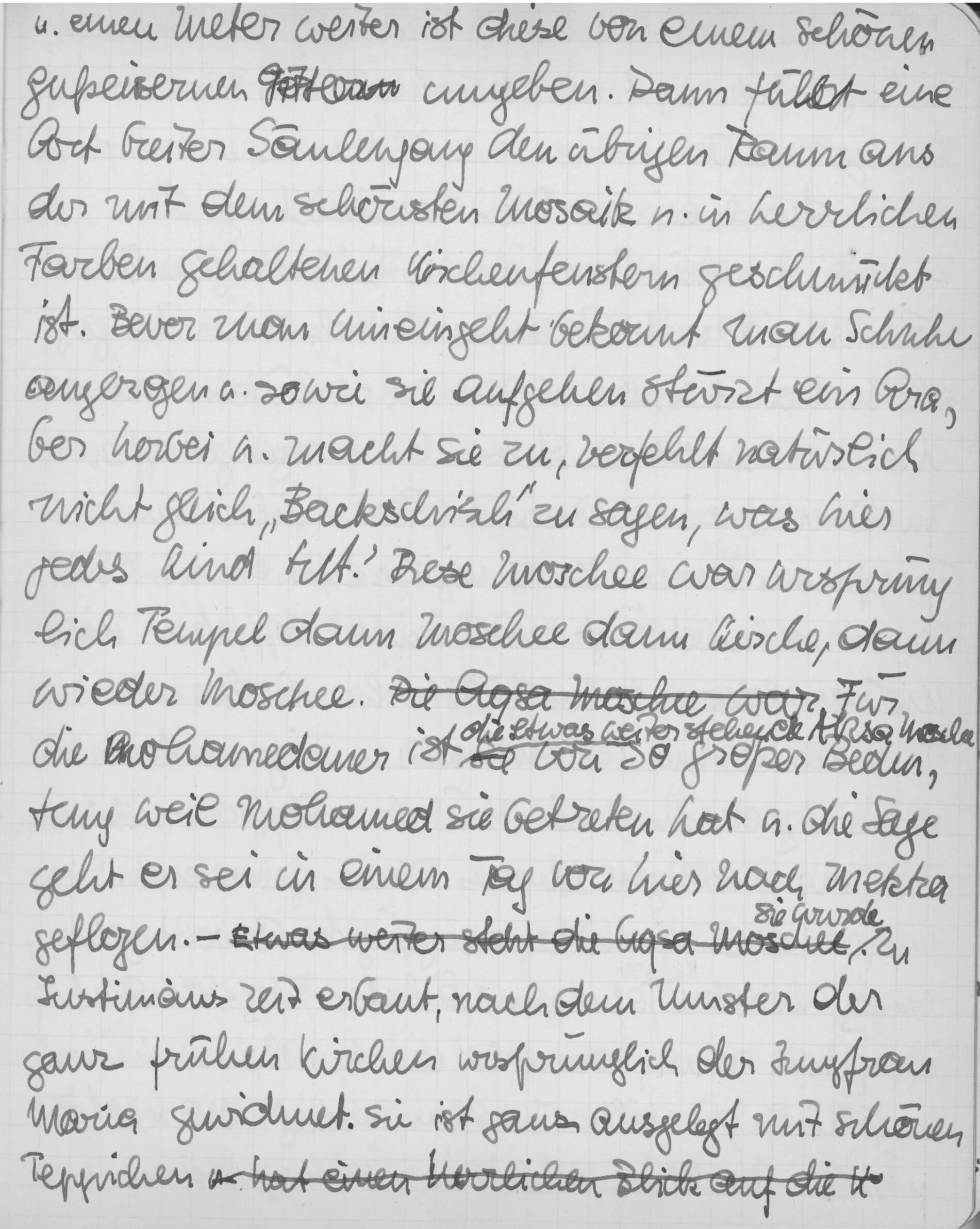
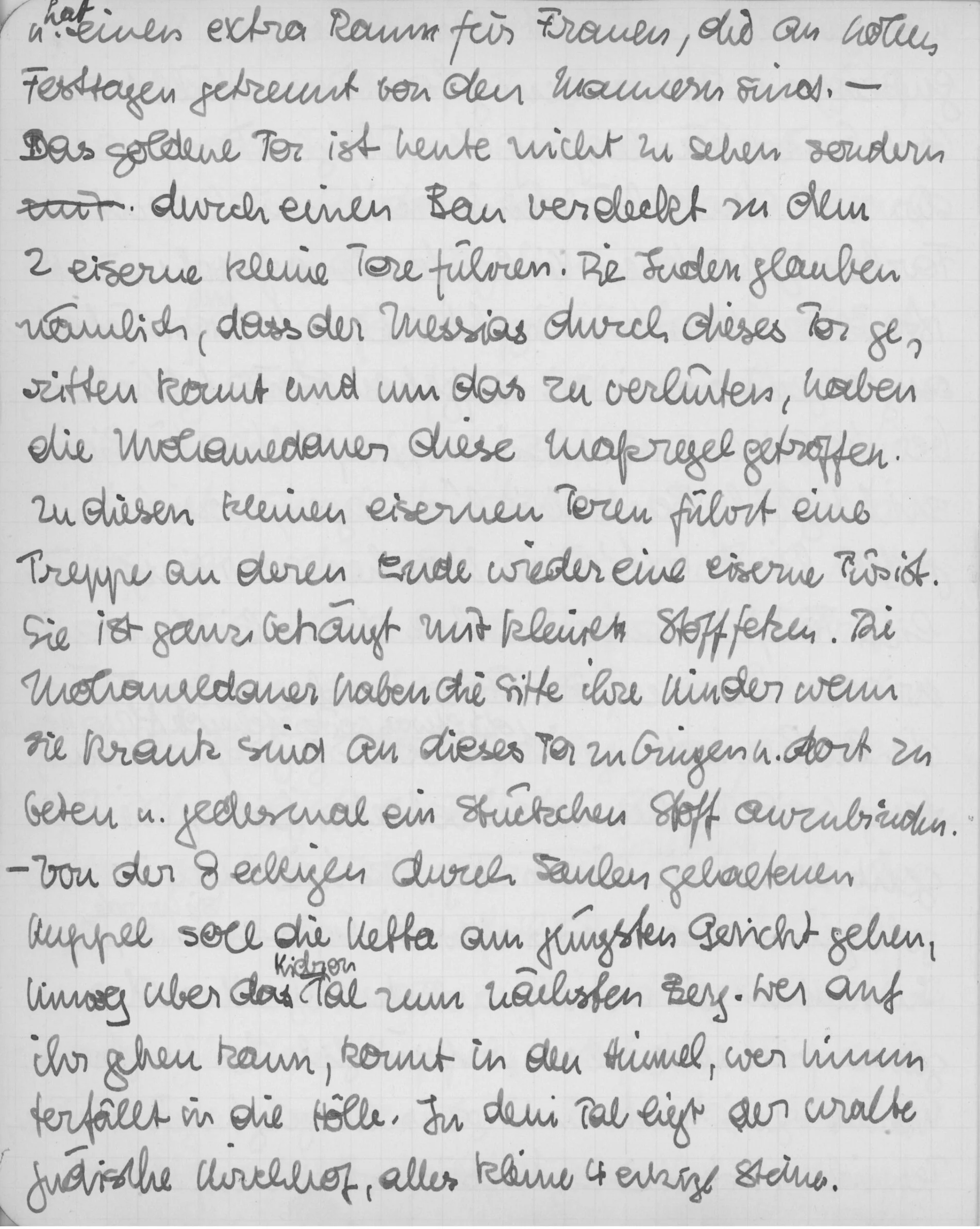
Orthodox Jews do not enter Haram al Sharif, because it is not clear, which direction the Temple is facing, they fear and are too much in awe to enter this holy site. There is also the Al Aqsa Mosque and the Golden Gate in this light filled, wide open open square that points in all the cardinal directions. There are 4 columned arches on the 4 sides of the square and an octagon dome held up by pillars. The Dom of the Rock is also octagon shaped and built around the magnificent rock. A 1,5-meter-high wooden fence is built around the entire Rock meeting a beautiful copper-iron gate. A broad colonnade, adorned with the most beautiful mosaics and beautiful designed church windows lead up to the entrance. We are urged to put on separate shoes which an Arab helps us with, while mumbling Baksheesh. This large mosque was originally a temple before being converted into a church and then a mosque again. It is a meaningful Islamic shrine. Legend has it that Mohamed himself had flown to Mecca the same day he had entered the Dome on the Rock. The structure was erected during the Justinian era, based on the outline of the early churches, that were originally dedicated to the Virgin Mary. The floor in the inner sanctum is covered with beautiful carpets. A separate Room is set aside for women, that worship apart from each other on high holidays. We could not see the Golden Gate today. It was covered by scaffolding. There are two small iron gates leading up to it. In the Jewish religion it is believed, that the Messiah will come riding through the Golden Gate. The Moslems have taken this measure to prevent exactly that. A staircase leads to these gates, there is an iron door all the way at the end. It is completely covered in colorful little scraps of fabric. It is a Moslem tradition to bring their sick children there to pray for them and tie a piece of cloth on the door during each visit. From the octagon shaped dome, held up by imposing pillars, the Ketta? is supposed to pass during the Last Judgement over the Kidron Valley to the next highest mountain. Whoever is able to cross it will ascend into heaven. The ones that fell into it will end up on hell. There is an ancient Jewish cemetery in the valley, filled with small square stones.
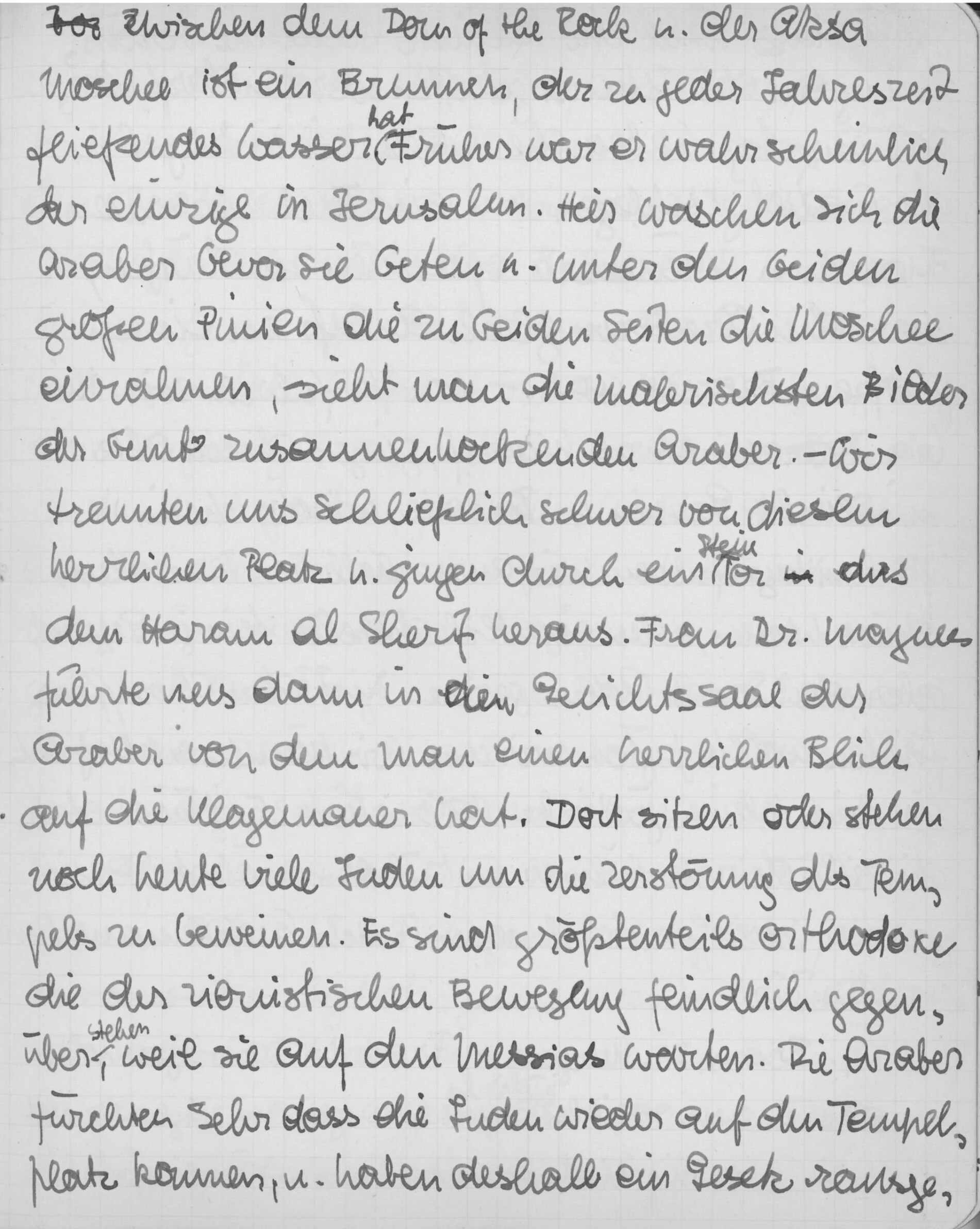
Between the Dome of the Rock and the Aqsa Mosque is a fountain with year around running water, which was most likely the only one in the olden days in Jerusalem. Here, the Arabs are doing their ritual cleansing bevor their prayers. Beneath the two large pine trees that frame the mosque on both sides, we become witness to picturesque scene of Arabs sitting together.
It was hard to leave this special square but finally parted through a stone gate the Haram Al Sherif.
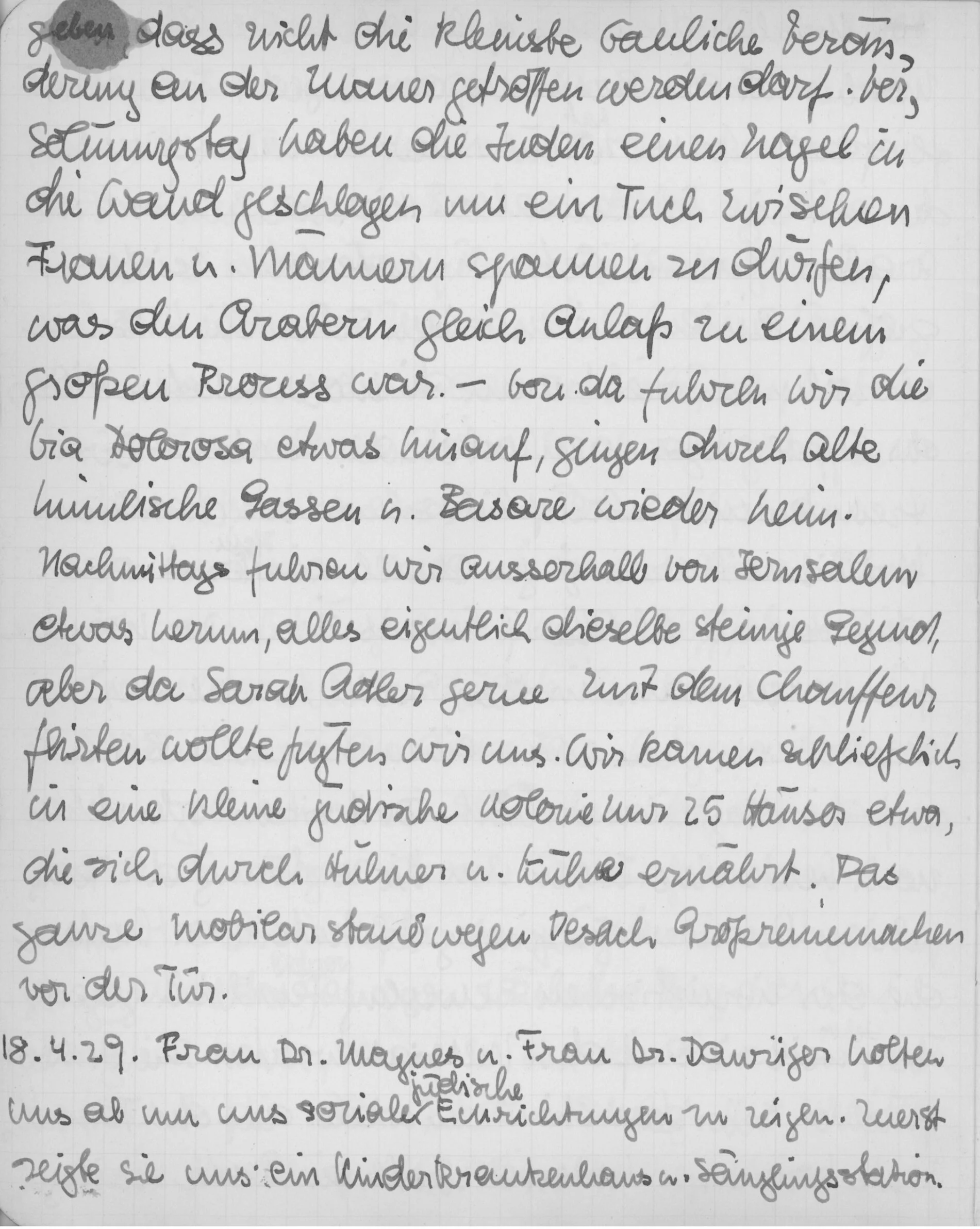
Mrs. Magnes led us to the Arab courtroom which had a magnificent view of the Western Wall (Weiling Wall). To this day, there are Jews, sitting or standing, mourning the Destruction of the Temple. Many of them are orthodox and waiting for the Messiah, and harbor hostile feelings against Zionism. The Arabs are harboring their own concerns about the Jewish ambitions to reclaim this area. They have therefore passed a new law that not even the slightest structural changes can be made to the wall. Arabs initiated a large law suit after the Jewish community put an anchor in the wall to separate the female from the male with a large cloth.
From there we drove up through the Via Dolorosa, strolled through old charming alleys and bazaars and returned home.
We spend the afternoon exploring the suburbs of Jerusalem. The rocky, rugged and stony landscape was more of the same. But complied since Sarah Adler wanted to have her time flirting with the chauffeur. We came to a little settlement, with approximately 25 houses that was in the process of getting ready for Pesach and had all their belongings and furniture in front of their houses that were in the process of getting a major cleaning. Their main source of nutrition came from cows and chickens.
-
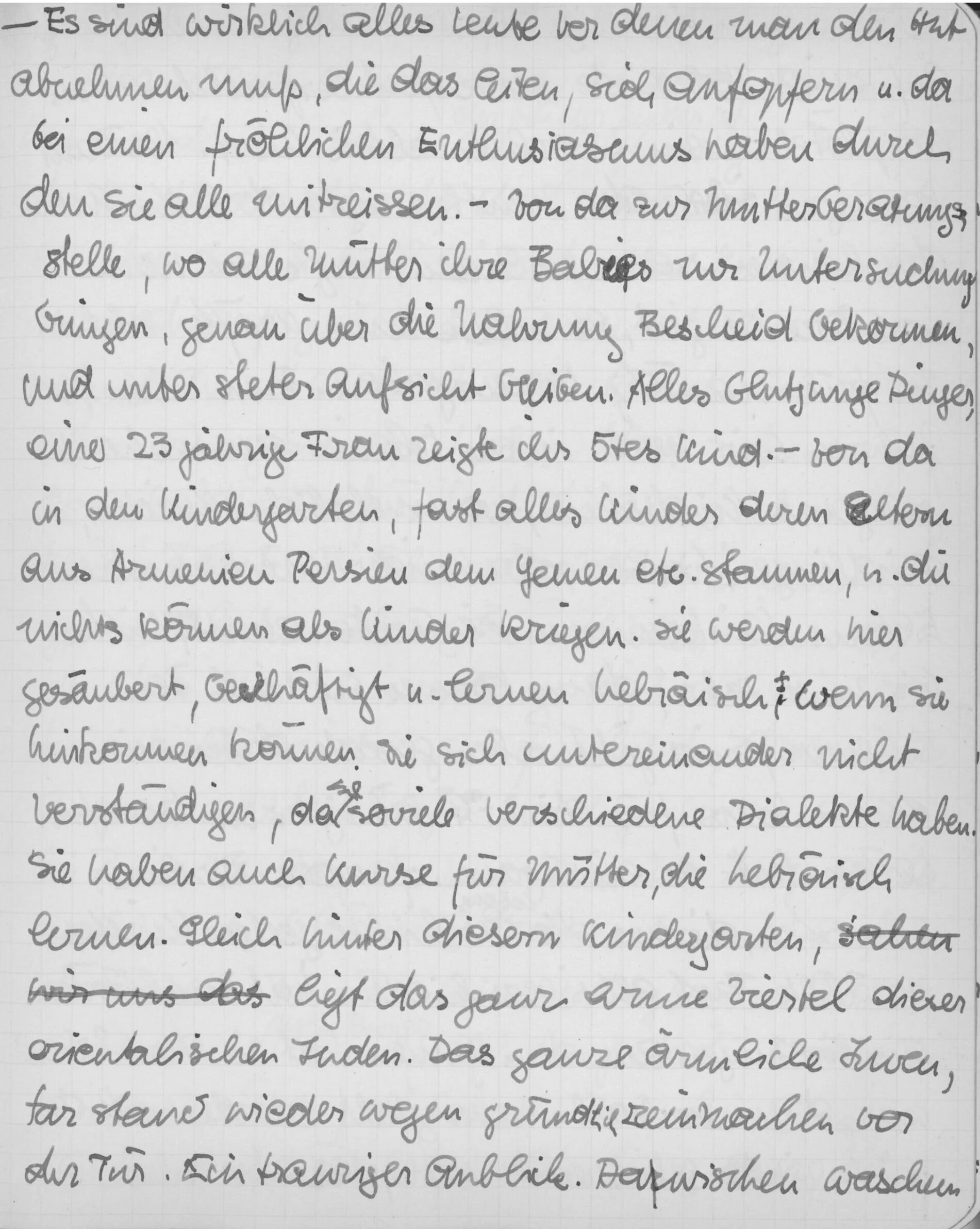
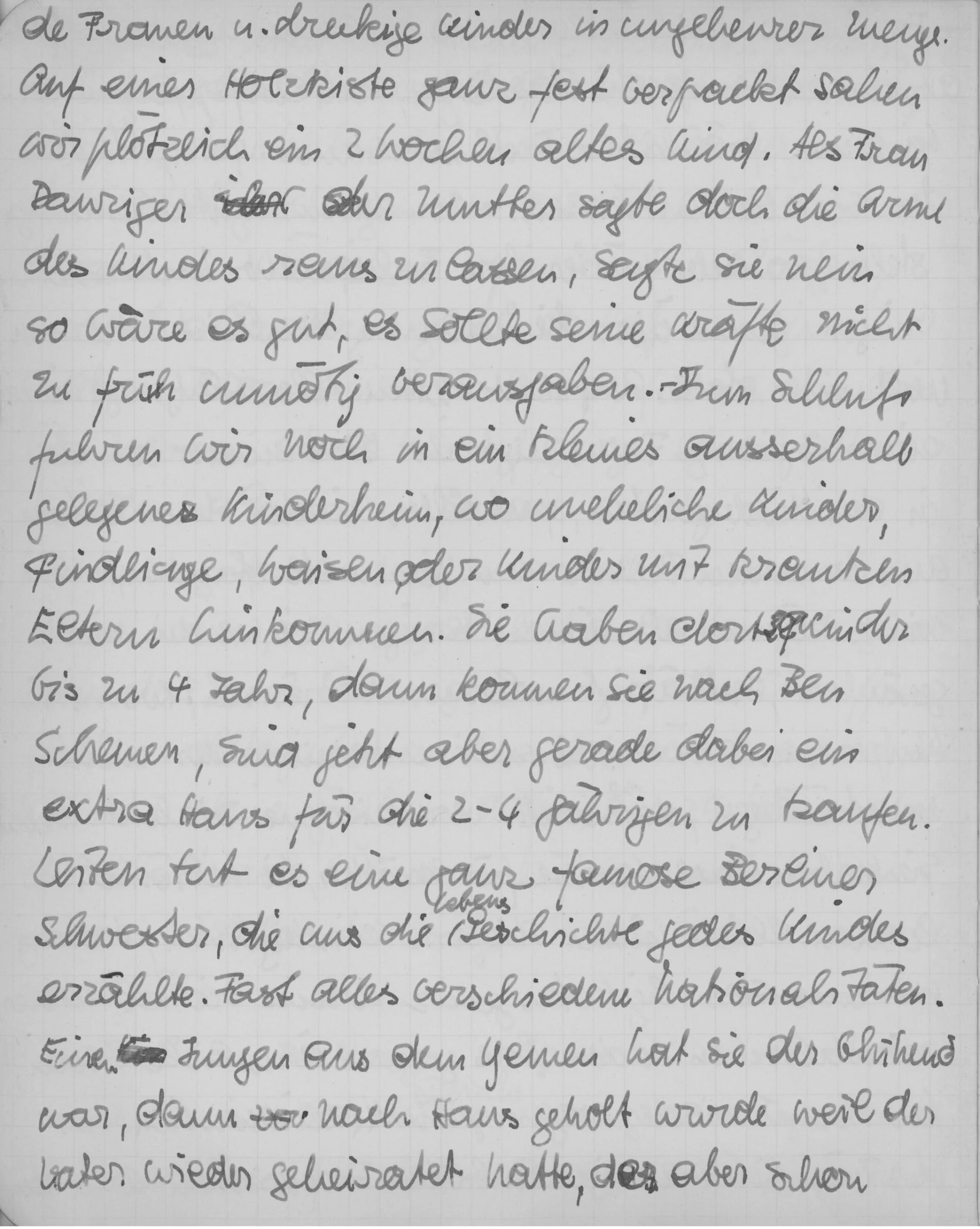
Mrs. Magnes and Mrs. Danziger picked us up. They wanted to show us social Jewish Institutions. The first stop was a pediatric hospital with a neo natal unit. All of the people deserve the utmost respect. They have an innate sense of enthusiasm that is contagious, despite their self-sacrificing leadership positions. From there on the women’s center, where children get their pediatric visits and mothers are supervised and instructed about various areas of child rearing. All the mothers are very young. A 23-year-old is expecting her 5th child. We go on to visit a preschool. Most children’s parents are originally from Persia, Armenia and Yemen. They are taught about hygiene. At the beginning most children are not able to communicate due to the language barrier but they all are instructed to become fluent in Hebrew. Language courses for mothers are offered as well. The quarter of these oriental Jews is right behind the preschool. There too, all the inventory of the houses is outside. While the houses are being cleaned and prepared for the holiday. There are women and dirty kids everywhere. On top of a wooden box, all wrapped up, is a 2-week-old infant. When Mrs. Danziger suggested to the mother to free the infant’s arms, the mother replied that she prefers her child not to waste his strength to early.
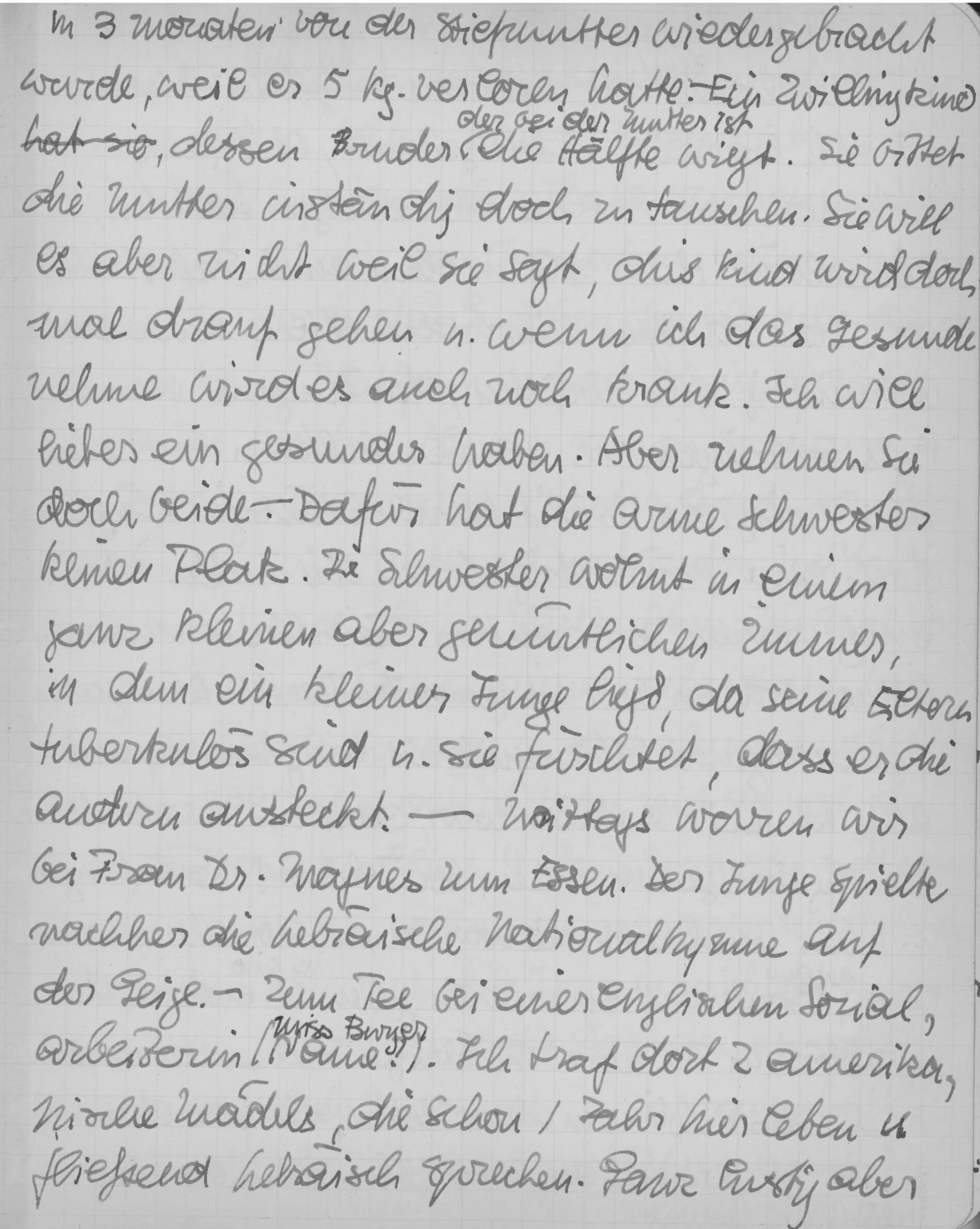
We drove to an orphanage located on the outskirt after that. It housed illegitimate and abandoned children, orphaned and children with sick parents. The children remain there until they are 4 years old at which point, they are being brought to Ben Schemen. A search for a new house for the 2-4 years olds is currently taking place. It is managed by An incredible lady from Berlin who shares the life story of every single child with us. Most representing a patchwork of different nationalities. She points out a little boy from Yemen that had been sent back to live with his widowed father, after he had remarried. The step mother had returned him after 3 months, because he had lost 5 Kg.
A twin child has a brother who weighs half as much and is living with the mother, who has been asked to trade. She is afraid that she would lose both of the children and is unwilling to comply and offered both of her children to live in the orphanage. Unfortunately, there is not enough room to accommodate these siblings. The head of the orphanage lives in a cozy room that she was sharing with a little boy whose parents were suffering from TB. We had lunch with Mrs. Magnes. The boy performed the Hebrew national anthem on a violin after we finished eating.
We were invited to have tea with Miss Buyer, an English social worker. I met two American girls that spoke fluent Hebrew and had been living there for the last 12 months. They were very giddy but also a little naïve.
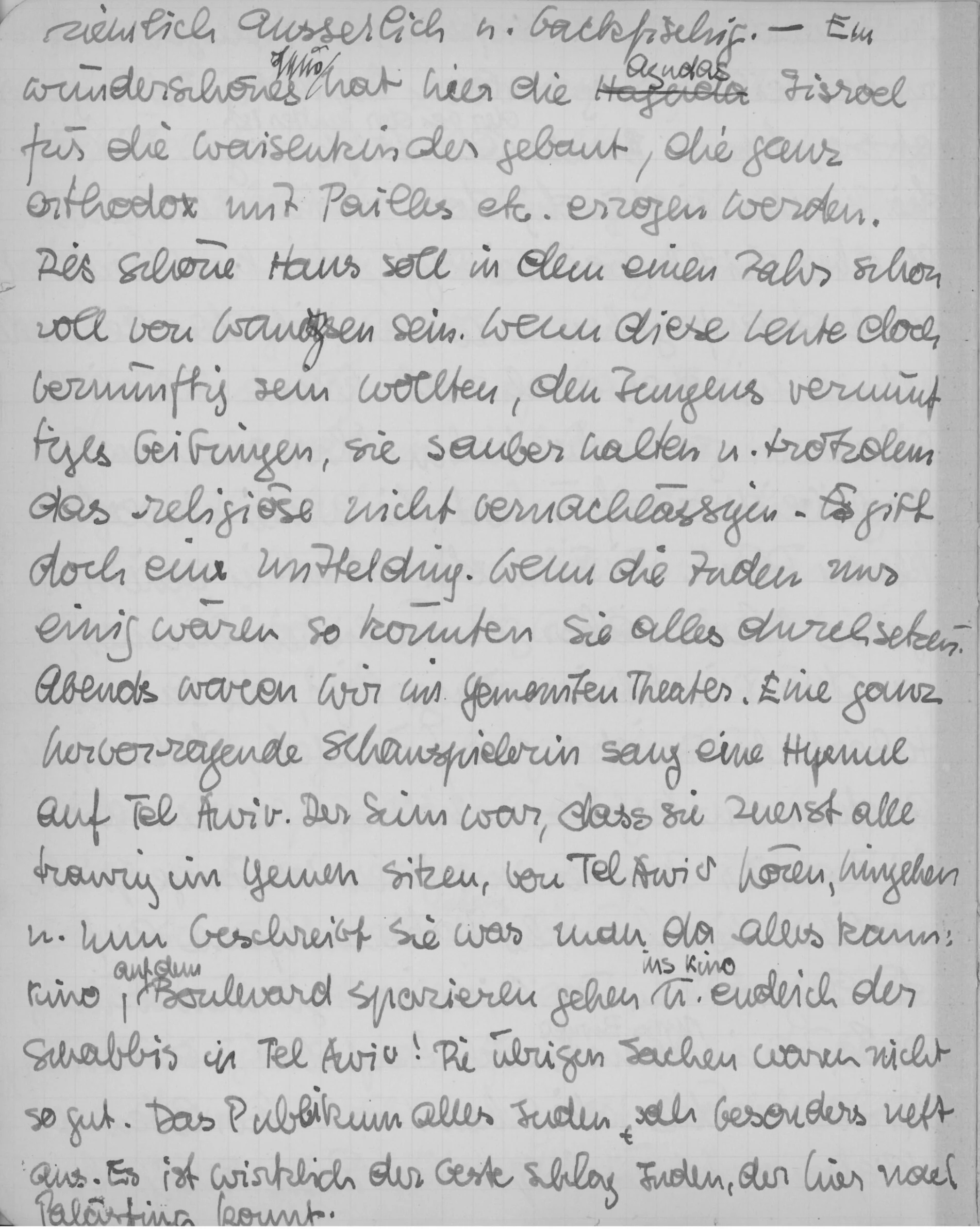
The Agudas Israel has built a beautiful for orphans, raising them along strict orthodox Guidelines. If only they were more reasonable teaching the boys how to keep clean and level headed without neglecting the religious instruction. A middle road should not be that hard to find. If all the Jews would be united, they could create whatever they would envision.
We visited the Yemenite theatre in the evening. An exceptionally talented actress sang a hymn about Tel Aviv. It portrayed people sadly living in Yemen, hearing about the city that they embark on visiting and all the good that came after living in Tel Aviv. From cinemas and strolling along beautiful boulevards to celebrating the Shabbat. The other performers were not as talented. The audience was absolutely lovely, all Jewish it seems that the people that come to Palestine are very much unique and special.
-
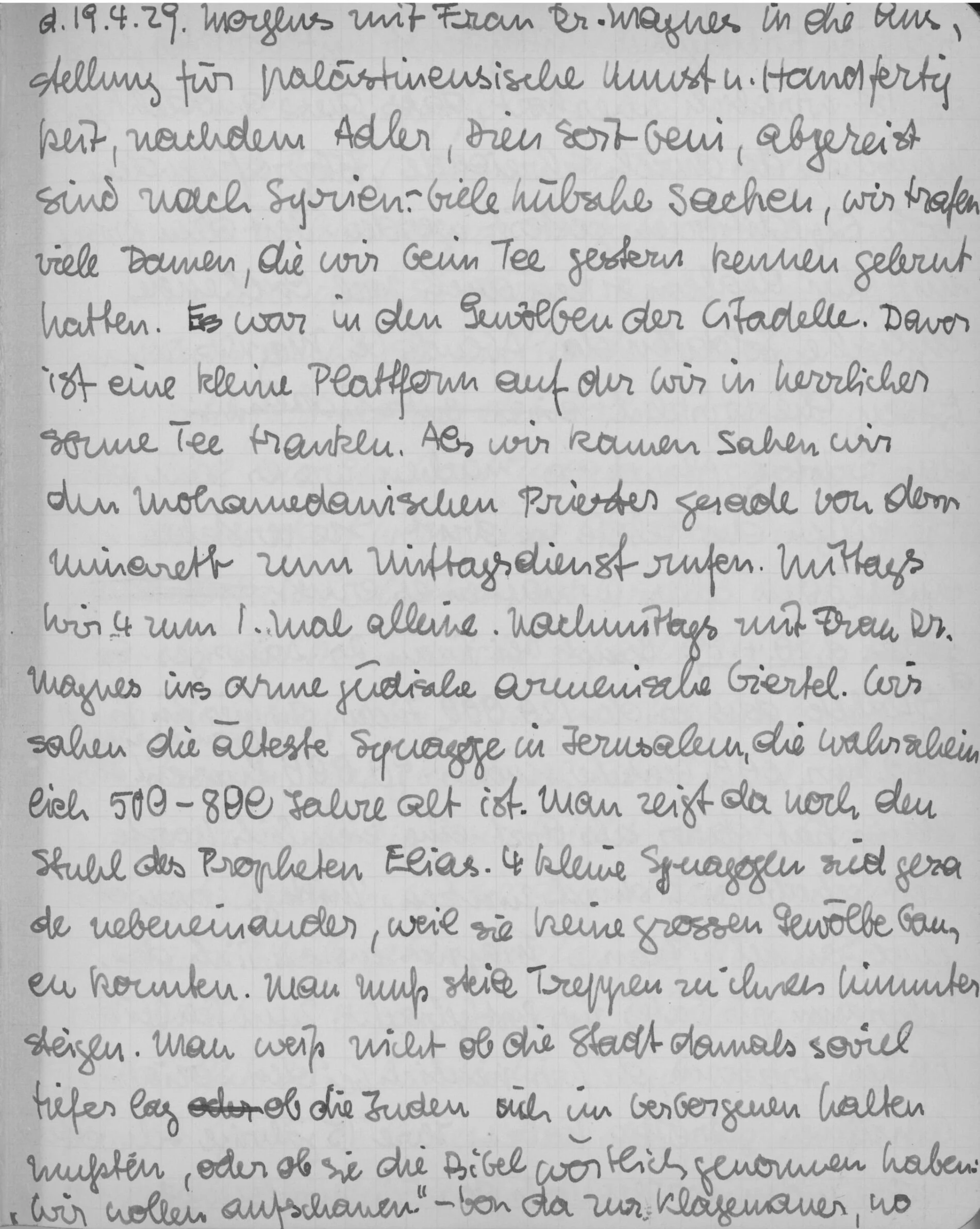
Early in the morning we are visiting the cultural and art center which was located in the vaulted ground floor of the Citadelle. We met some of the ladies we had been introduced to yesterday. Adlers, had left for Syria. We saw many beautiful pieces and enjoyed a cup tea in the bright and warm afternoon sun. A Muslim imam is calling out to pray. Mrs. Magnes shows us the poor Armenian quatre and the oldest synagogue in Jerusalem which is said to be between 500-800 years old. The chair of the prophet Elias is still there. Four smaller synagogues are right next door because the space did not allow for larger basement crypts. Steep steps are leading down to the structures. It could be that the city might have been much lower back then, or it could be that the Jews had to hide in secret to worship. They could also have taken the biblical guidance literal “We want to look up at you.”
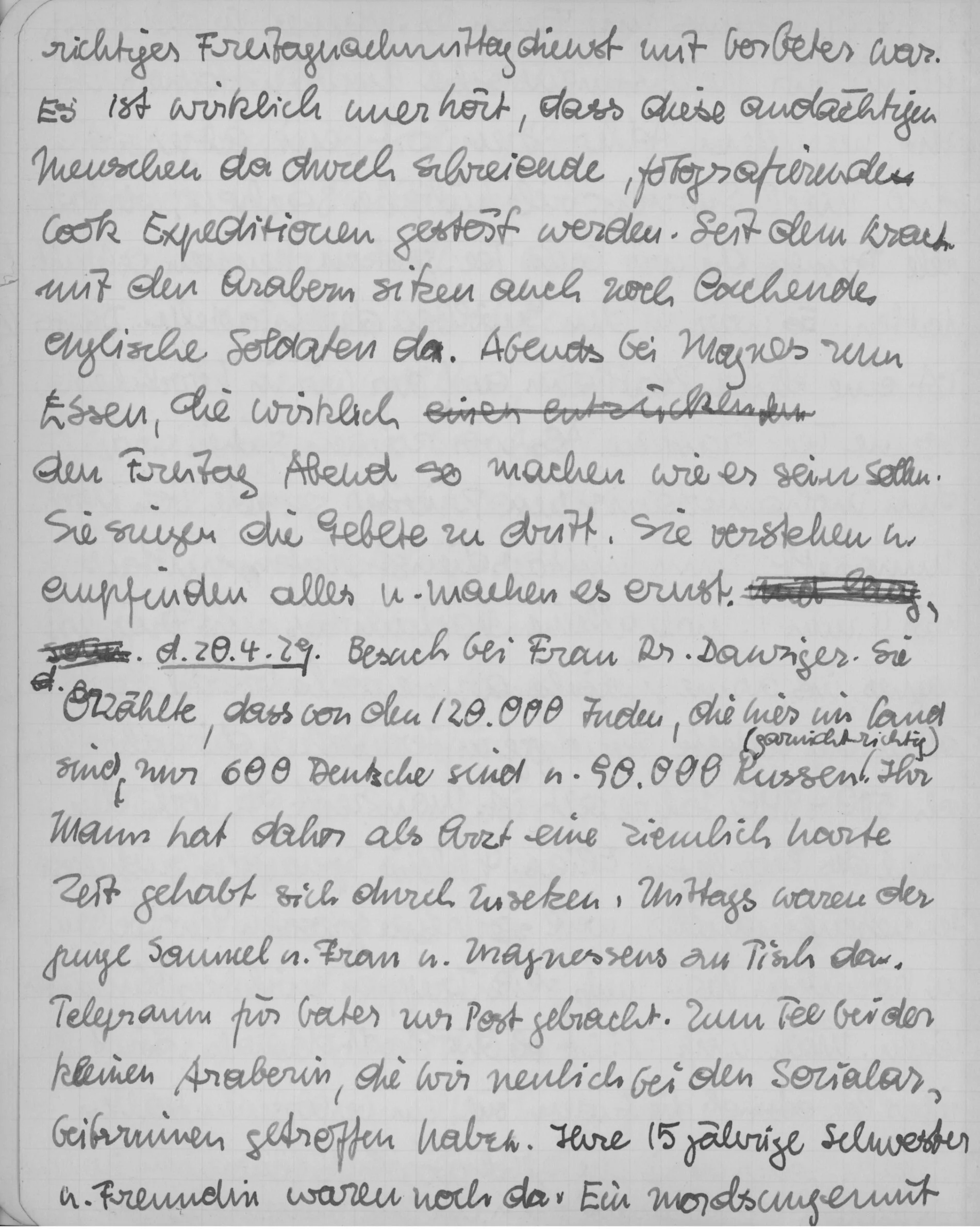
From there to the Wailing Wall, where we witness traditional Friday afternoon prayers. Unfortunately, the noise of screaming tourists with their cameras is outrageously disturbing this ritual and sacred tradition. Due to Arabic unrest laughing English soldiers have become part of the scene as well.
We are having Friday night dinner with the Magnes. It feels like the way it really should be. The three of them are singing the prayers. They understand and magnify the emotion which makes it become reality.
-
Visit to Mrs. Danziger. She shares the statistic that only 600 out of 120,000 Jews, in the in the country, are originally from Germany. The majority, 90,000 are from Russia. Her husband, who was a physician had therefore experienced quite the challenges to get things passed.
We had lunch with young Samuel and Mrs. Magnes. Afterwards, I dropped of a telegram for father at the post office.
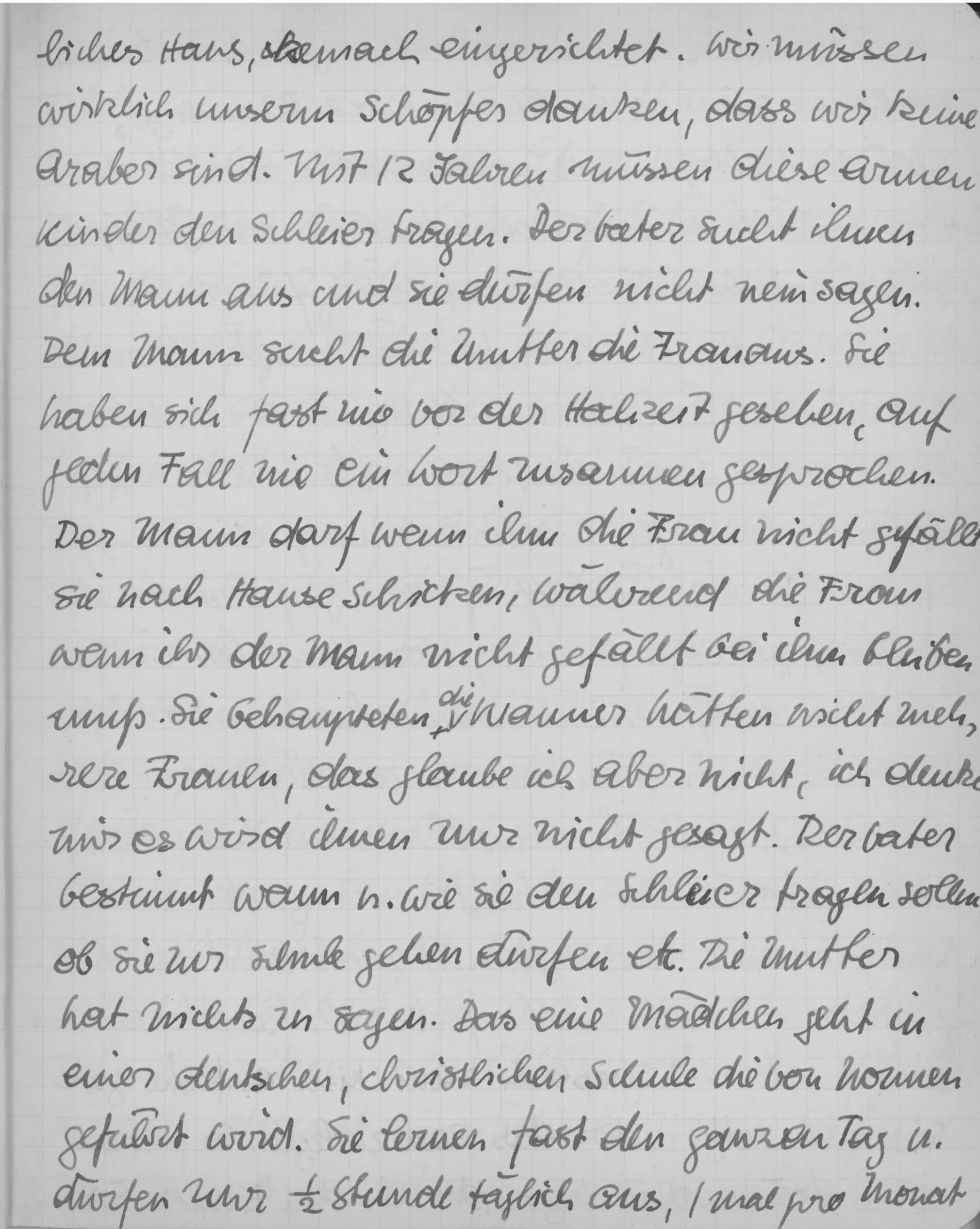
A little Arabic lady, we had recently met at the social worker’s event, invited us to have tea. Her 15-year-old sister and a friend joined us. The house was very scarcely furnished and quite uncomfortable. We have to thank our creator that we were not born as Arabs. The poor girls have to wear a veil once they turn eighteen. A father is choosing the husband, and will not accept rejections. The mother of the groom will pick the wife. The couple has barely seen each other or even exchanged any words. A husband can return a wife if he is unhappy with her. The wife does not have that option and is forced to stay. The statement that men do not have more than one wife appears to be untrue. It is just not made public. A father ultimately decides, how or when, his daughter will have to start wearing a veil or if she is allowed to go to school. A mother does not have many rights. One of the girls attends a German Christian school run by nuns. They only have a 30-minute break each day and are only allowed to visit home once a month. The school teaches Arabic, English and German. They handed us a hand-picked bouquet of flowers and asked us to stop in before returning back home.
We spent the evening alone at home and go to bed early.
-
We are taking cars early in the morning to visit the colonies. Uncle Felix, mother, Anita and I. It is the first bad day with lots of rain which makes the streets a bud bath. Some stretches of road were closed down. We were forced to take detours which made it not much easier. We had to make our way back to the main road and slipped of into a ditch. It took 30 minutes to get the car back on to the road. Kish decided to attach a chain under the wheel which enabled the car to find traction and got us driving in pouring rain through the Emek. What a beautiful location. The different colored, organized fields appear like a chessboard. We drove over Nablus to Nahal. An agricultural all girl school. It is a two-year program, only for well built girls that have to attend to all parts of work. This is were we ran into Mr. and Mrs. Weismann. During lunch, the girls and boys, visiting, stared at us as if we were all wonders of the world! Weizmann, the director, Uncle Felix and father held speeches.
From there we drove through Nazareth to Haifa, heavenly located by the sea, surrounded By large palm trees. Dr. Biram shows us his all boy junior high school, that is similar to Salem. There are a lot of students from America who want to get a Jewish education. The technical center is located in a very appealing building. There seem to be a lot of architecturally gifted students.
We had tea with the senior mother Weizmann who was delightful. She gave birth to 14 children of which 12 are still alive. 3 of them were present but did not have the same spirit than Chaim. We stayed overnight on Mount Carmel, in the Herzlia Hotel. The location and views over Haifa and the Mediterranean Sea are magnificent. The hotel is strictly kosher and has a mezuzah on every door.
Struck the artist and his wife are at the dinner table with the brothers Pollock.
-
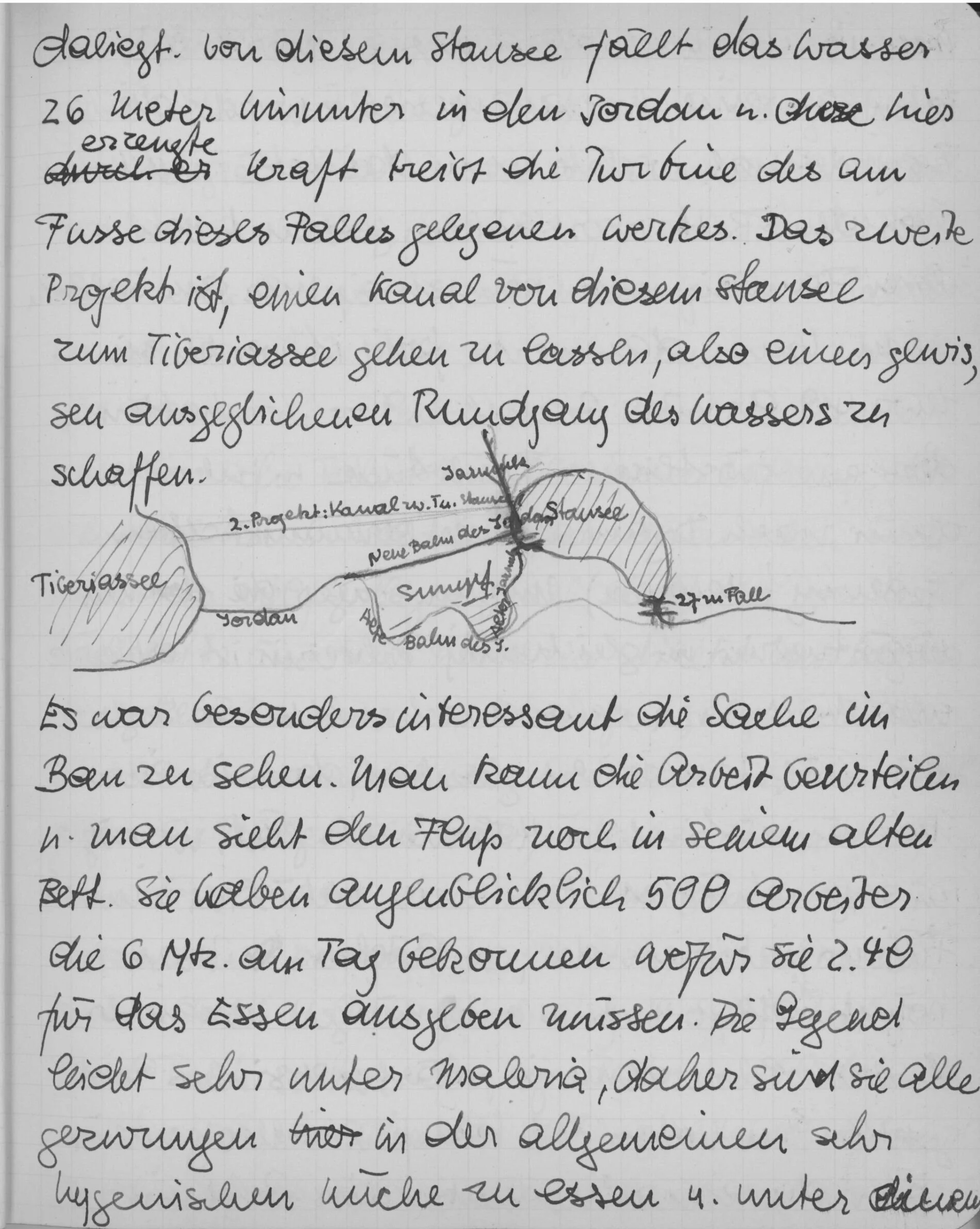
8.5 hours with the train the Rutenberg power plant. A Mr. Gordon took excellent care of us explaining this fabulous plant construction. The Yarmuk, a tributary of the Jordan river, flows in many areas creating swamps. It is being guided into a separate river bed that empties into a man-made reservoir. From there the water is naturally falling 26 meters down into the Jordan river. The power generated through this fire up the Turbine located at the basin below in a power plant. The second phase is to build a canal from the reservoir to the Tiberias lake to create a balanced return of the water.
[pen drawing]
It was especially interesting and educational to view everything from the inside of the building. The old riverbed is still visible. There are currently 500 workers employed. They are paid 6 Marks a day of which 2,40 are going to food. This area is heavily plagued by malaria. This forces everybody to sleep with mosquito nets and eat together in the unhygienic cafeteria. Guards were hired to reinforce the protective measures. The workers are separated from their families and are only allowed to visit on the Sabbath. It will only require about 40 workers once the plant is completed.
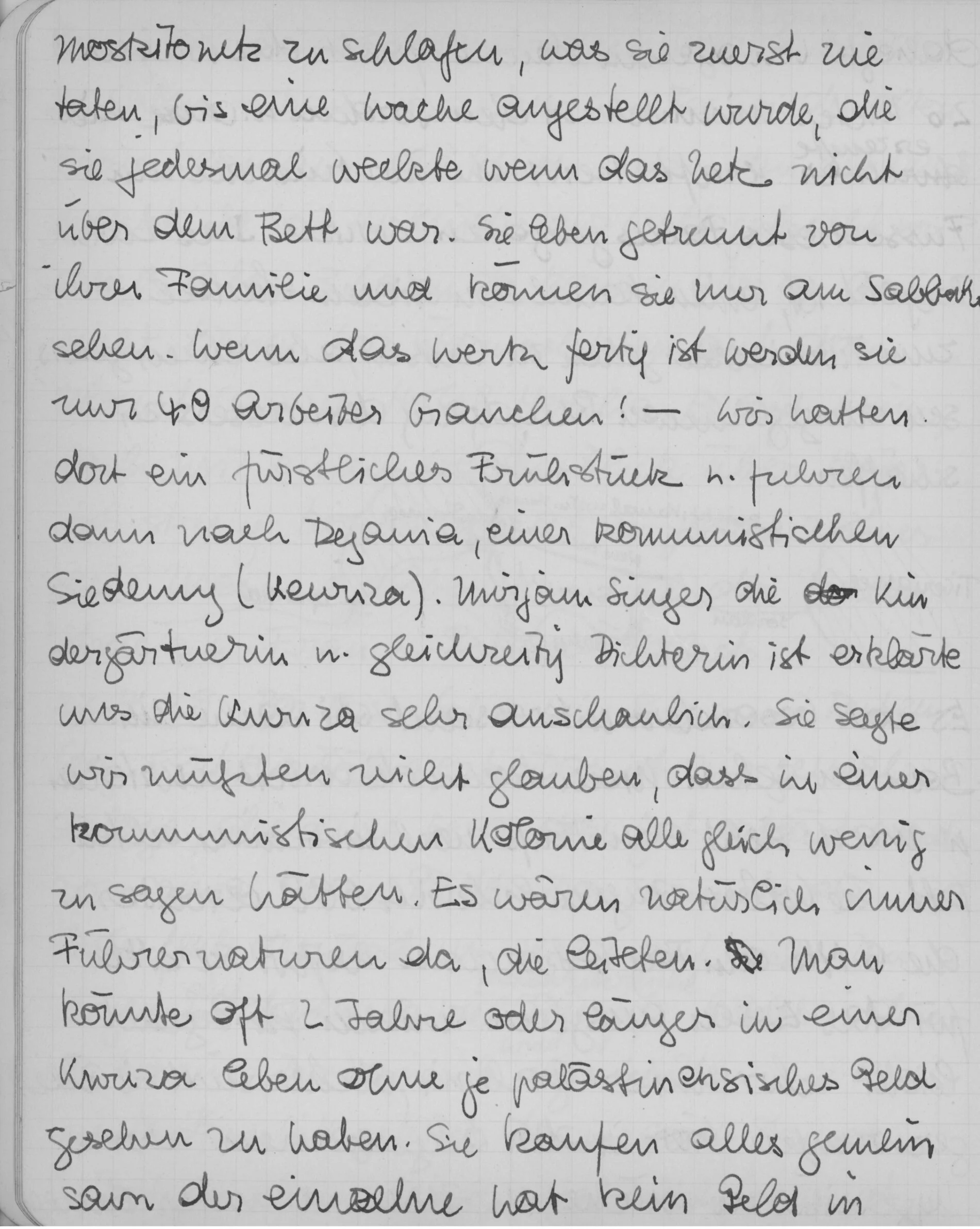
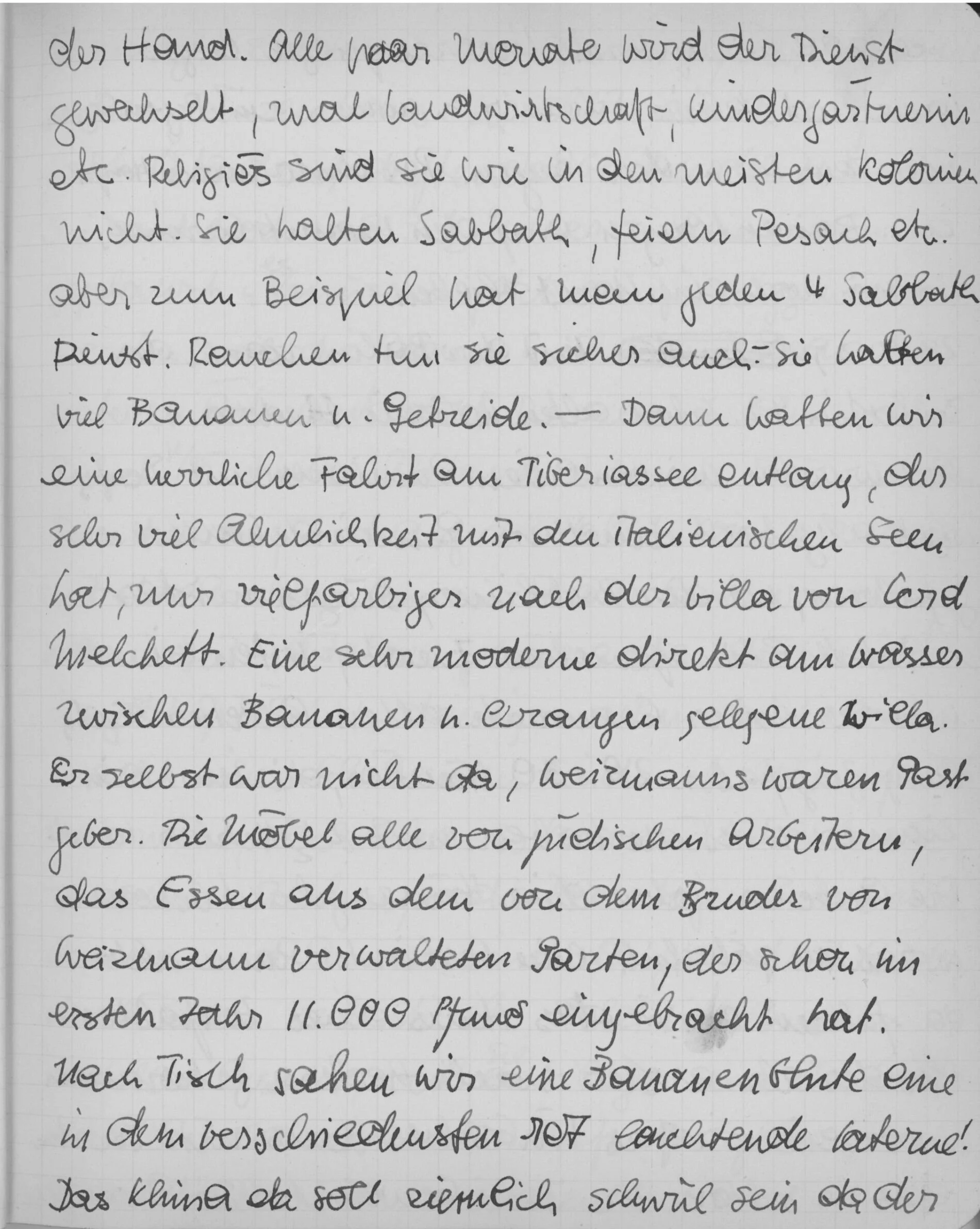
We were served a royal breakfast before driving to the communist settlement Kurizal. The preschool teacher and poet Miss Singer did an excellent job explaining the settlement to us. She pointed out that there were natural leaders even in a communist colony to oversee the administrative aspects and we should not be under the impression that everyone had little to say. One could often live there for 2 years without ever seeing Palestinian money. Everything is being purchased together. Nobody has their individual money. Every couple of months the jobs get rotated from childcare to agriculture, there are no religious instructions like in the other colonies. They observe the Sabbath and celebrate Pesach. People are obligated to work every fourth Saturday. Their main crops are bananas and grain.
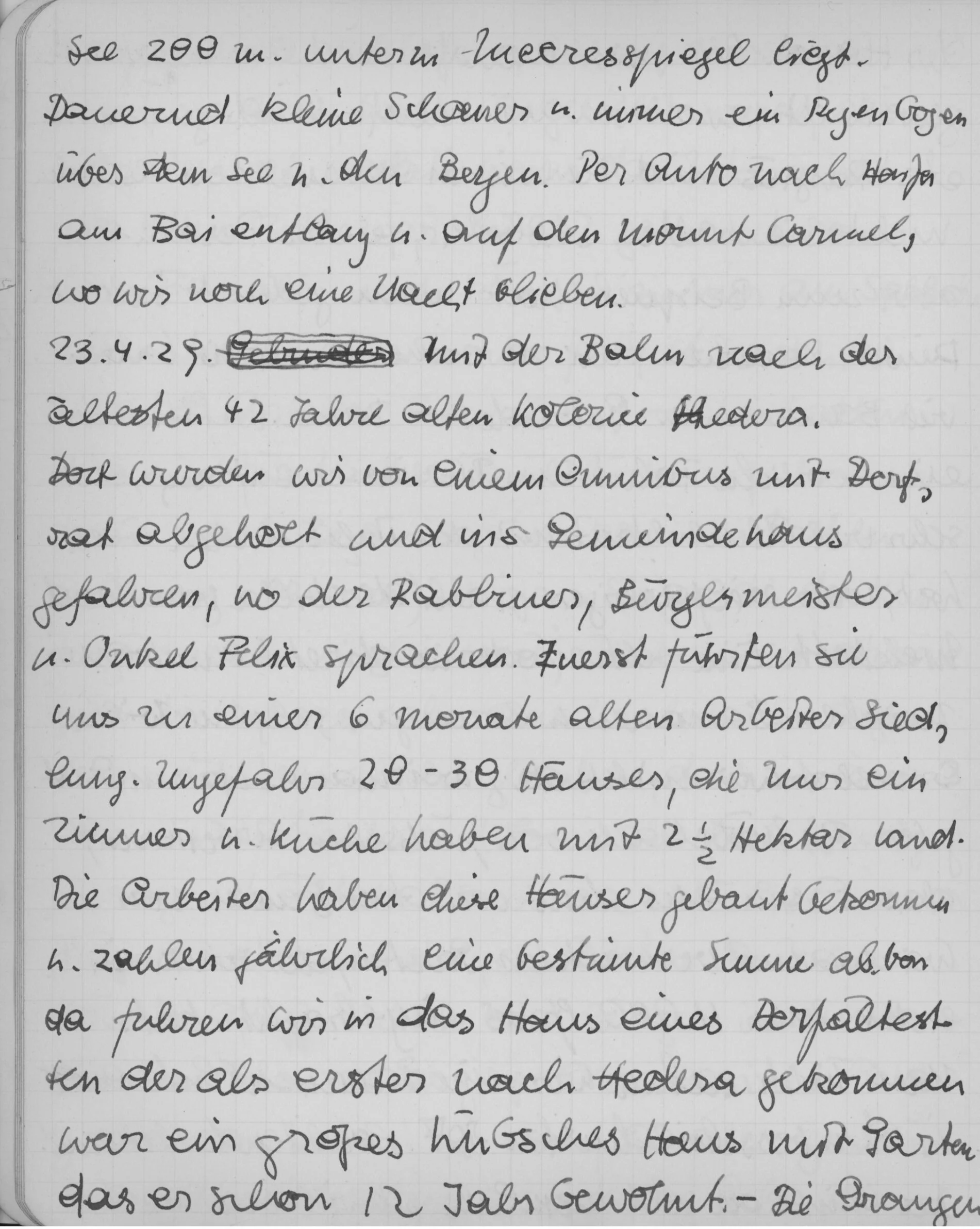
We drove along the Tiberias Lake which resembled the ones in Italy, to the Lord Melchett estate. The villa was ultra-modern and located right at the water’s edge in the middle of orange and banana plantations. He was not at home. Weizmann and his wife were filling in as hosts. The inventory was all made by Jewish hands and the food came from the gardens run by the brother of Weismann. He had yielded a profit of 11,000 British pounds in the first year. We saw a banana blossom, turned into a lantern, glowing in all shades of red after dinner. The climate is rather humid, since the lake is 200 meters below sea level. We drive along the bay back to Mount Carmel and Haifa where we spend one more night.
-
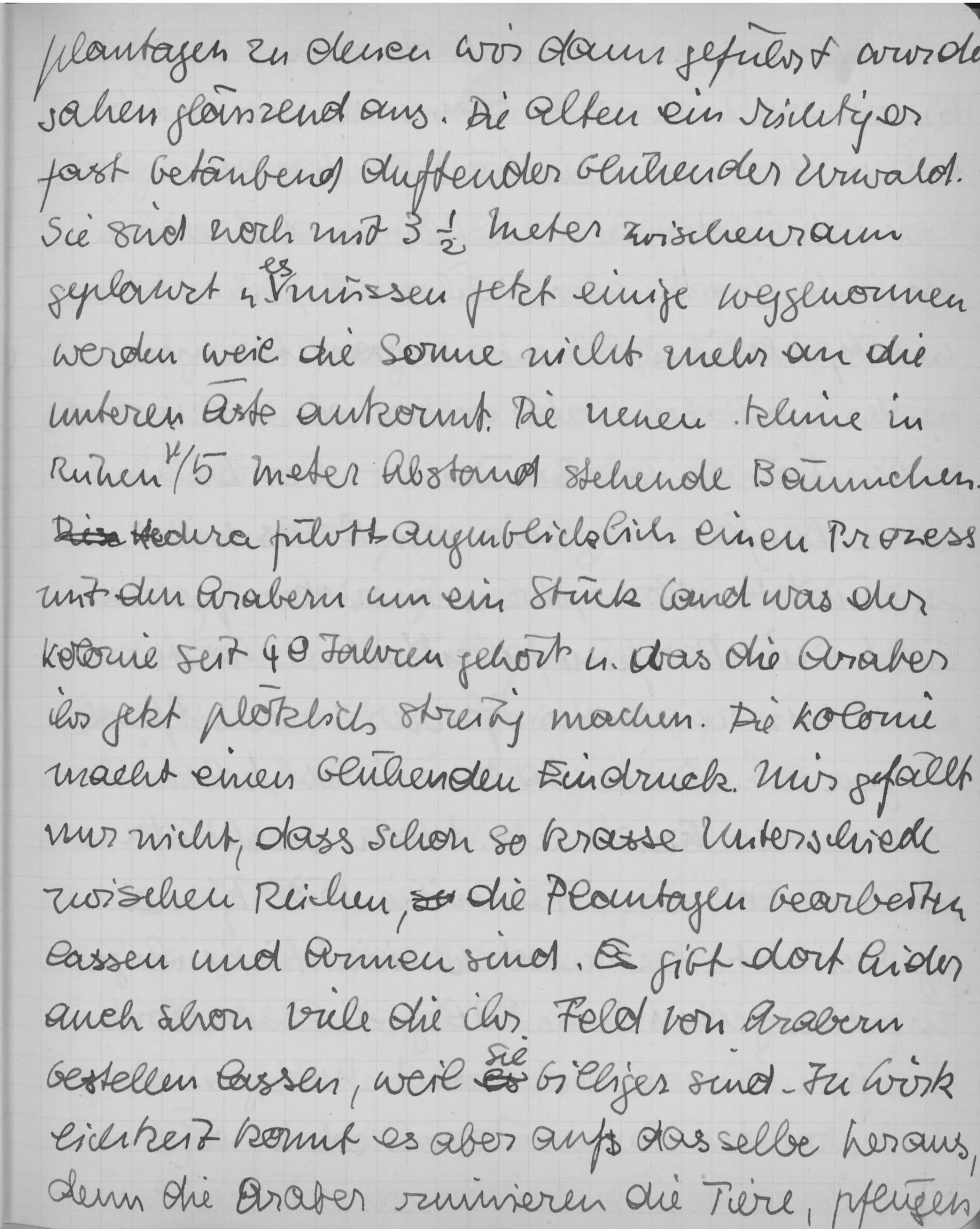
By train to the oldest, 42 year old Hadera colony. Upon arrival we were picked up by an army bus that was driven by a village councilman. We were brought to the city hall where the rabbi, the mayor and uncle Felix held a speech. It was followed by visiting a 6-month- old workers’ settlement. There were approximately 20-30 houses, that had each one room, a kitchen and 11,959 square feet of land. These houses had been built specifically for the workers. The families are making annual payments to pay them of. From there we drove to the house of one of the village elders, who was the first to come to Hadesa. He lived in a very pretty house with an inviting garden. He brought us to an impressive orange plantation, a stunningly fragrant blooming jungle. They were still planted 3,5 meters apart. Some plants need to be removed since the sun is not able to reach the lower branches. The new orange groves is spacing the plants 5 meters apart. Hadera is currently involved with law suit with the Arabs over a piece of land that has belonged to the colony for the last 40 years. The settlement appears to be blossoming. I just do not like that there are such stark differences between the rich and the poor. Unfortunately, there are some that are hiring Arabic farm workers to attend to the fields, because they are cheaper. It ultimately comes down to the same thing, because the Arabs ruin the animals, apply old farming techniques and work much slower. Furthermore, I cannot help but think how this would not contribute to creating bad blood, if the Jews assert themselves as “masters.” The people were heartwarming and gifted us with fresh oranges, flowers and drove us back to the train station. Father had a particularly engaging conversation with a Dr. Bruenn.
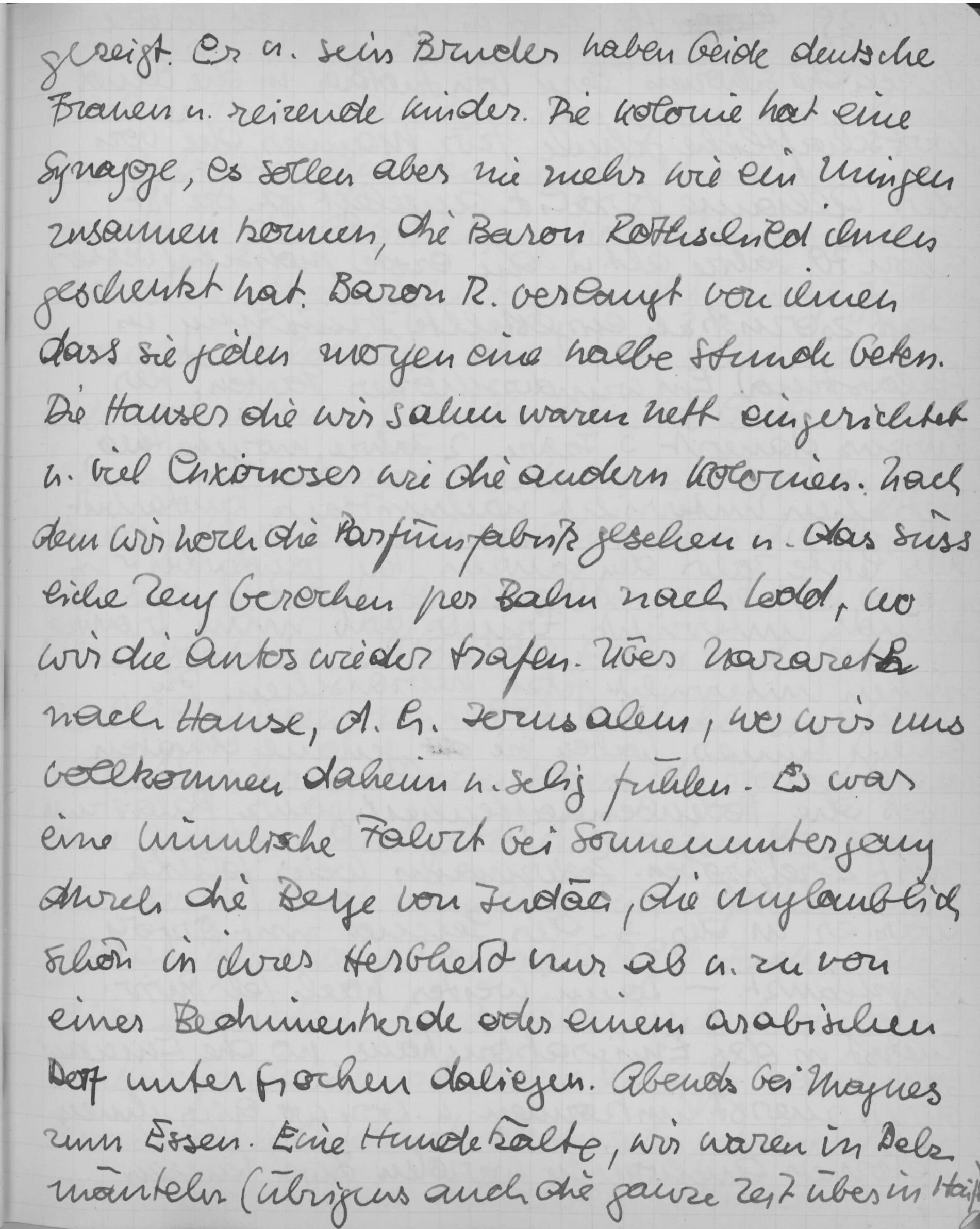
By train to Binyamina, a colony founded by the Rothschild. Their specialty is a perfume factory. A very friendly minister came to pick us up with a two horse-drawn carriage. The settlement made a lovely impression. The Rothschilds had bestowed 1500 pounds to each of the families, while the Zionistic organization had allotted 900 pounds to the settlers in the other colonies. We had lunch in a wonderful little restaurant. A farmer showed us different farmsteads among them his brother’s. Both have adorable children and employ German foremen. The colony had a synagogue that had been donated by the Baron Rothschild. He made it a requirement that everyone will start the day with a 30 minute Prayer. The houses we visited were tastefully furnished and more luxurious than in the other places we had visited. Engulfed by a palate of sweet fragrance in the perfume factory, we took the train to Lod, where we got picked up by the cars. We made our way through Nazareth back to Jerusalem where we felt completely at home. It was a divine drive through the mountains of Judea while the sun was setting. These glorious mountains are incredibly beautiful. We are passing Bedouin herds and little Arabic villages before reaching Jerusalem.
Dinner at the Magnes. We are all wrapped in fur coats due to the drop temperatures, even back in Haifa.
-
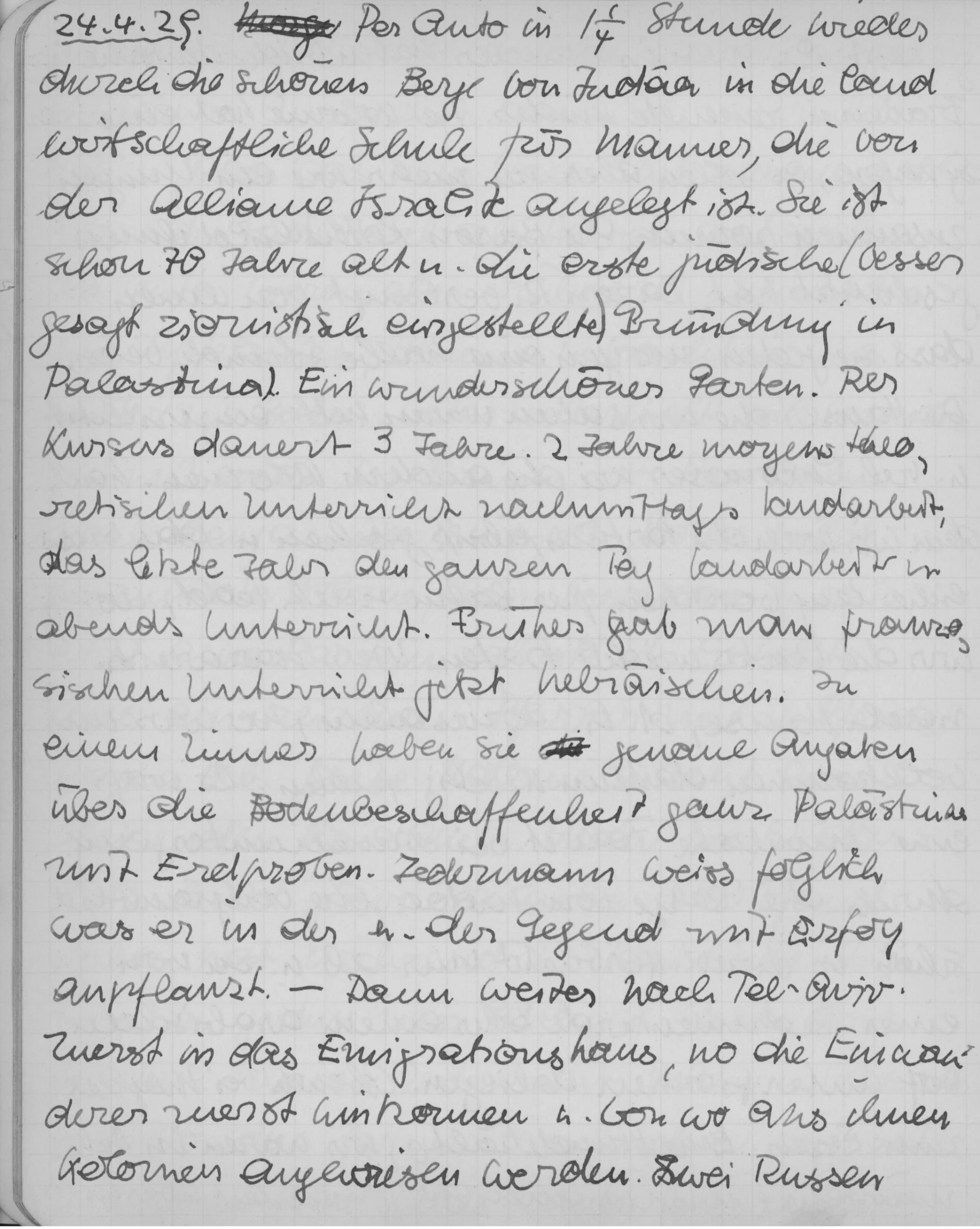
By car once again through the mountains of Judea to visit the agricultural and farming school for boys. It was founded 70 years ago by the Alliance Isrealite. The first Jewish, or better Zionistic foundation in Palestine. Incredibly well-designed gardens. The studies will span over 3 years. For the first 2 years, students attend classroom instructions in the mornings and hands on agricultural training in the afternoon. The last year is is the designed to work all day and attend evening classes. Before the students were taught French which has now been replaced by Hebrew. There is one room filled with samples and precise data about the soil properties of every region in Palestine. This enables every farmer to know exactly what crops to plant.
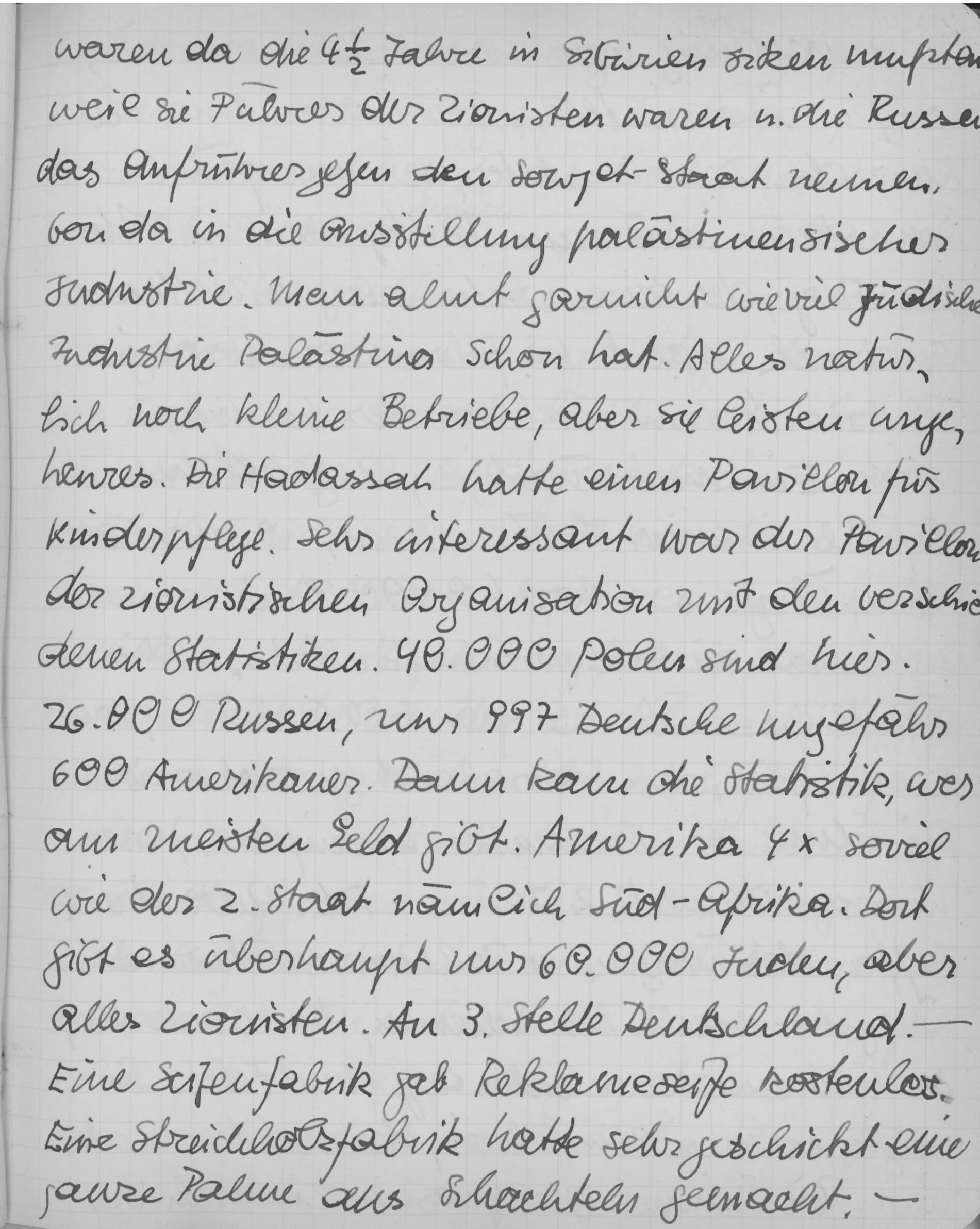
Next stop is Tel Aviv, the immigration authority building, where every single immigrant is checked in and assigned to his or her subsequent colony. There were two Russians who had been sentenced to 4,5 years in Siberia for representing a danger to the soviet govern- ment for being the head of the Zionist organization.
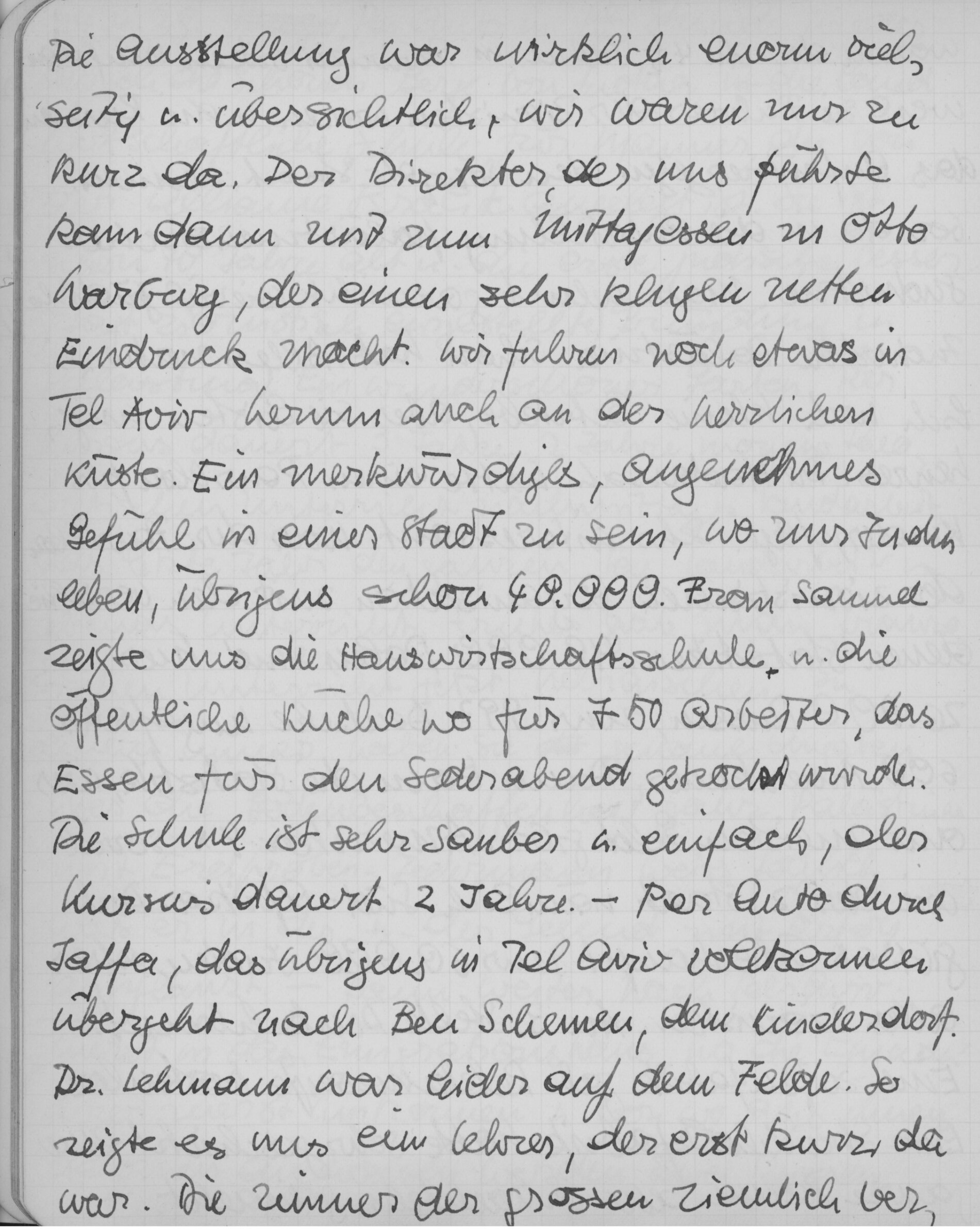
A visit to an exhibit of Palestinian industry follows. One does not fully grasp how much Jewish industry Palestine already has. Small enterprises for now of course but already extremely productive. The Hadassah owned their own pavilion about childcare. The Zionistic organization had a fascinating display of different statistics. 40,000 Polish, 26,000 Russians, 997 Germans and roughly about 600 Americans. Financial contributions, headed by America, that is donating 4 times as much as South Africa that is holding the 2nd place. They only have 60,000 Jews but most of them are Zionists. Germany is in 3rd place. A soap factory donated free soaps bars. A match factory cleverly constructed an entire palm tree out of little boxes.
I wished we would have been able to spend more time. The exhibition was enormous, very diverse and highly educational. The director who gave us the tour was a very competent man and joined us at lunch with Otto Warburg.
We explored Tel Aviv with the car and drove along the ocean for a little bit. It was a strange but pleasant feeling to drive through a city that was only inhabited by Jews, 40,000 by the way already.
Mrs. Saumel showed us the home economics school. The school is very clean and simple Their kitchen is responsible to prepare food for the Seder. The education lasts 2 years.
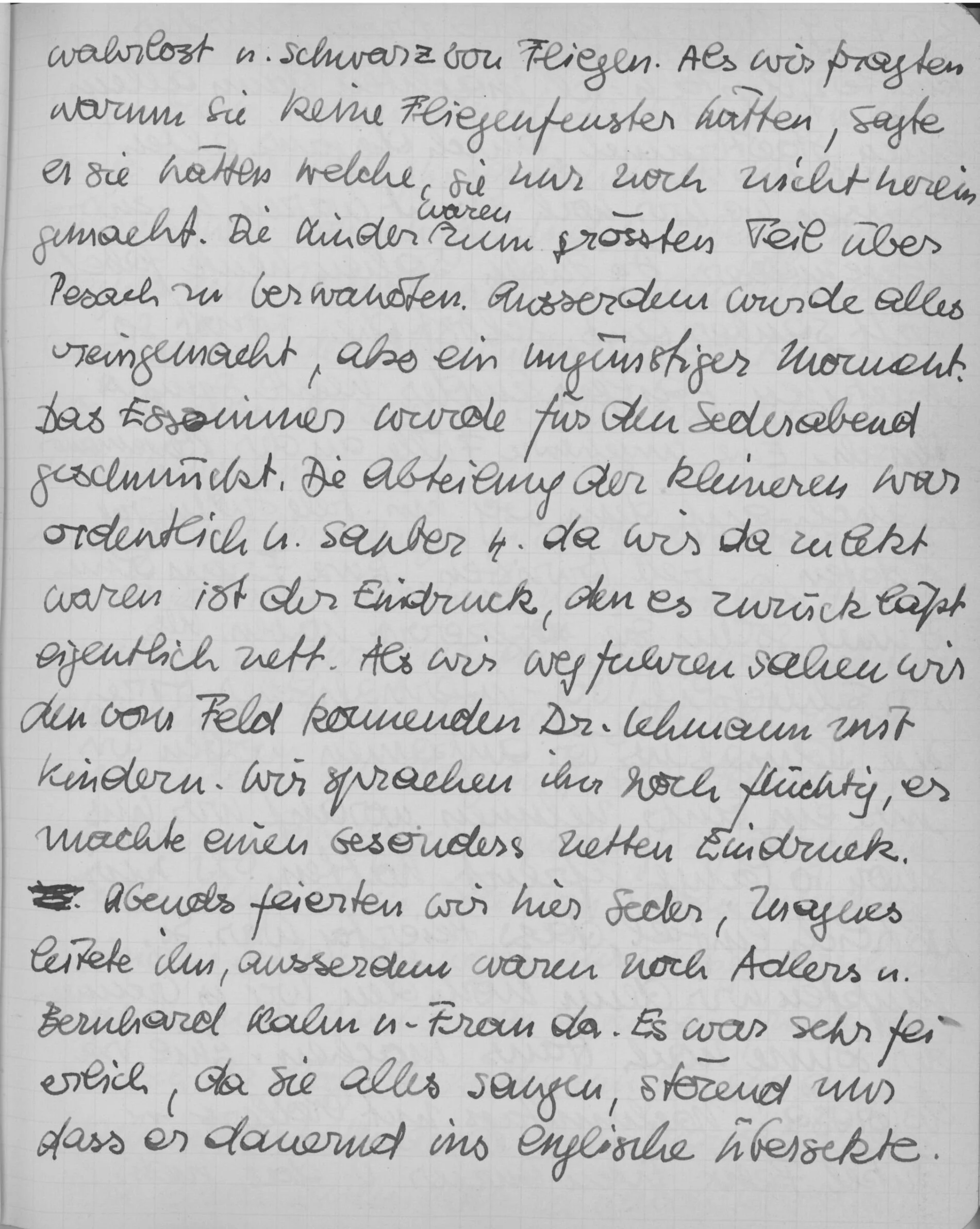
By car on to Jaffa, which passes needlessly from Tel Aviv to Ben Schemen, the children’s village. Unfortunately, Dr. Lehmann was in the field and had one of his teachers show us around. The rooms appeared a little dirty and neglected with flies everywhere. Upon inquiring why there were no screens, we were told that they just had not been installed yet. The majority of the children were gone, celebrating Passover with relatives. The area for the younger children was cleaner and more inviting which changed our initial impression. The dinning room was decorated tastefully for the Seder. Right when we left we ran into Dr Lehmann and some children returning from the field. He appeared to be a particularly nice man.
We joined the Magnes family, the Adlers and Bernhard Kahn with his wife in the evening for the Seder. It was very festive; everybody was singing. The only disturbing thing was the continuous translation into English.
-
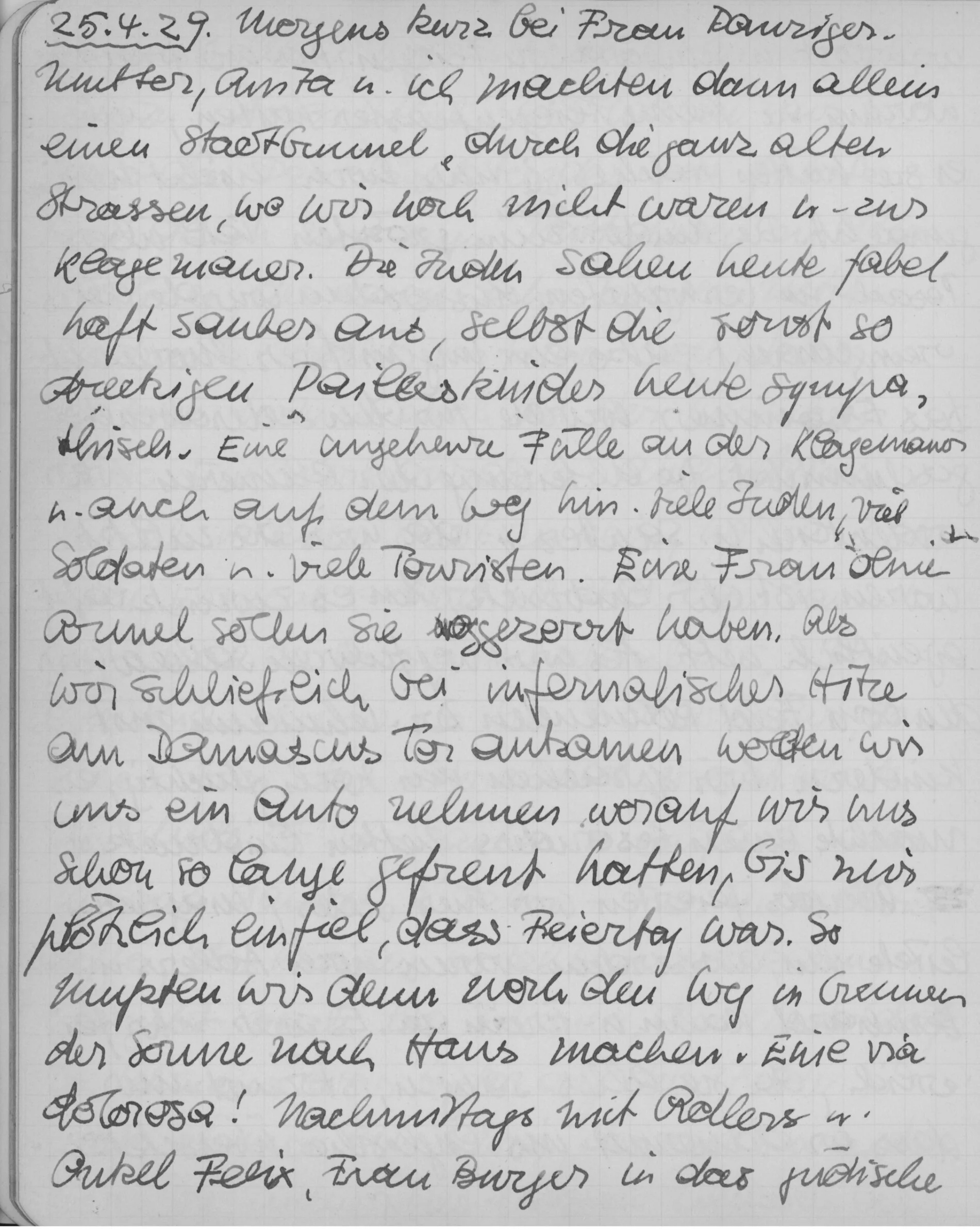
A quick visit to Mrs. Danziger in the morning.
Mother, Anita and I are going on a stroll through the city afterwards. Passing by many old little alleys we had not explored before, all the way to the Wailing Wall. There are a lot of people on the streets, soldiers, tourists and Jews. Everybody looked all cleaned up and amazing.
Under oppressive heat we finally reach the Damascus Gate trying to find a car to take us Back when we suddenly realized that it was a holiday. We had to walk all the way back home under the glaring sun along the Via Dolorosa.
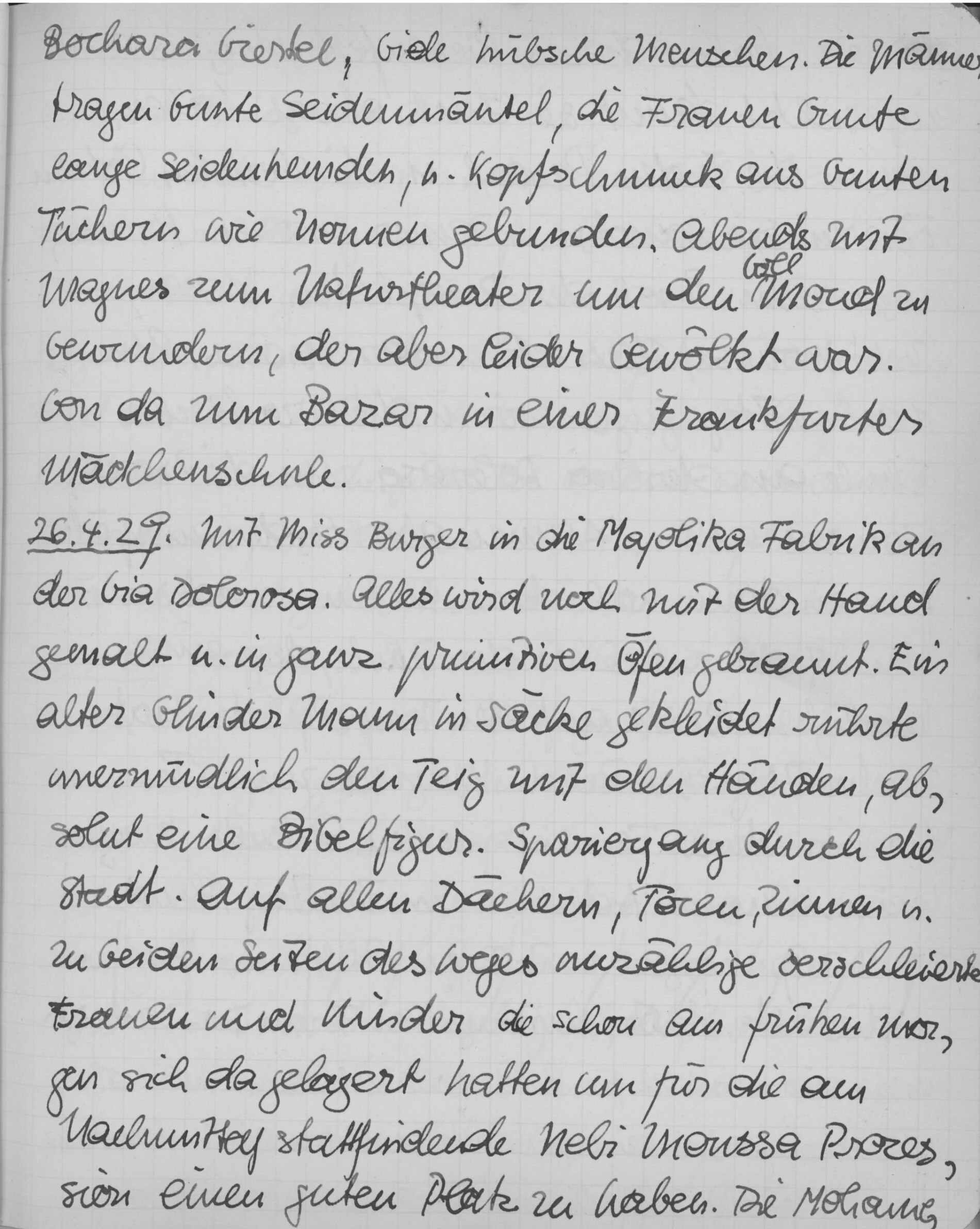
We visited the Jewish quatres (Bochara?) with Adlers, uncle Felix and Mrs. Burger in the afternoon. There are lots of very attractive people. The men are wearing colorful silk coats and the headdresses tied in the same tradition as nuns. In the evening a visit to an amphitheater with the Magnes’ to admire the full moon, which was sadly hidden behind clouds. We wrapped up the day visiting a bazar at am all girls’ school from Frankfurt.
-
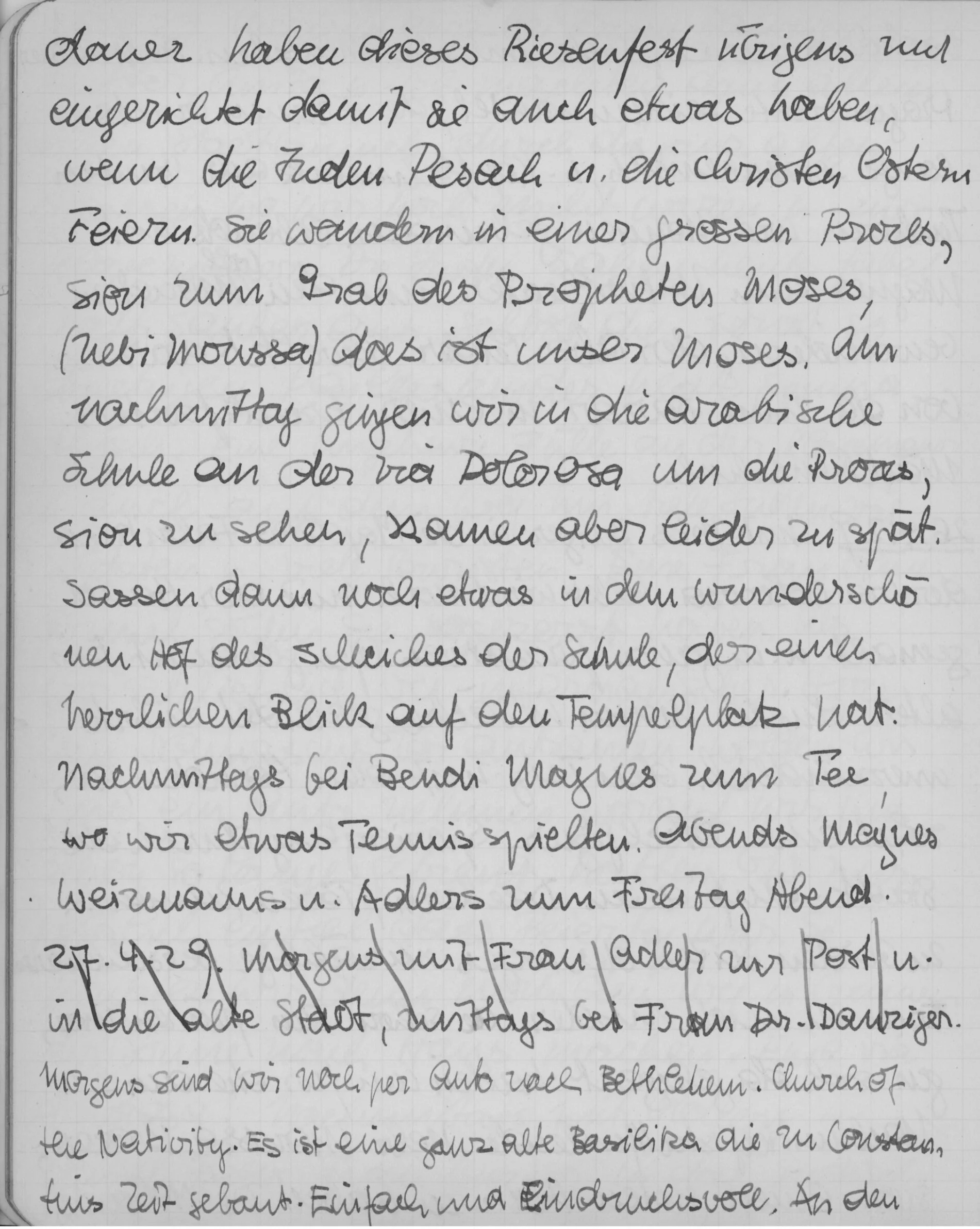
Visiting the Mayolica factory on the Via Dolorosa. Everything is still painted by hand and fired in primitive kilns. A very old, blind man keeps working the masses of clay with his hands, a truly biblical character. There were innumerable veiled women with children on rooftops, gates and both sides of the road. Scouting a good position for the afternoon Moussa Procession in the afternoon. By the way the Muslims created this festival to have Something to celebrate, while the Jews observe Passover and the Christians Easter. They walk in a large procession to the grave of Nebi Moussa, who is also Moses. We are heading to the Arabic school on the Via Dolorosa to view the procession but arrive to late. We are enjoying the incredibly beautiful courtyard of the sheikh with a direct view onto the Dom of the Rock.
A game of tennis at Bendi Magnes in the afternoon followed by high tea. Friday dinner with Magnes’, Adlers and Weizmanns.
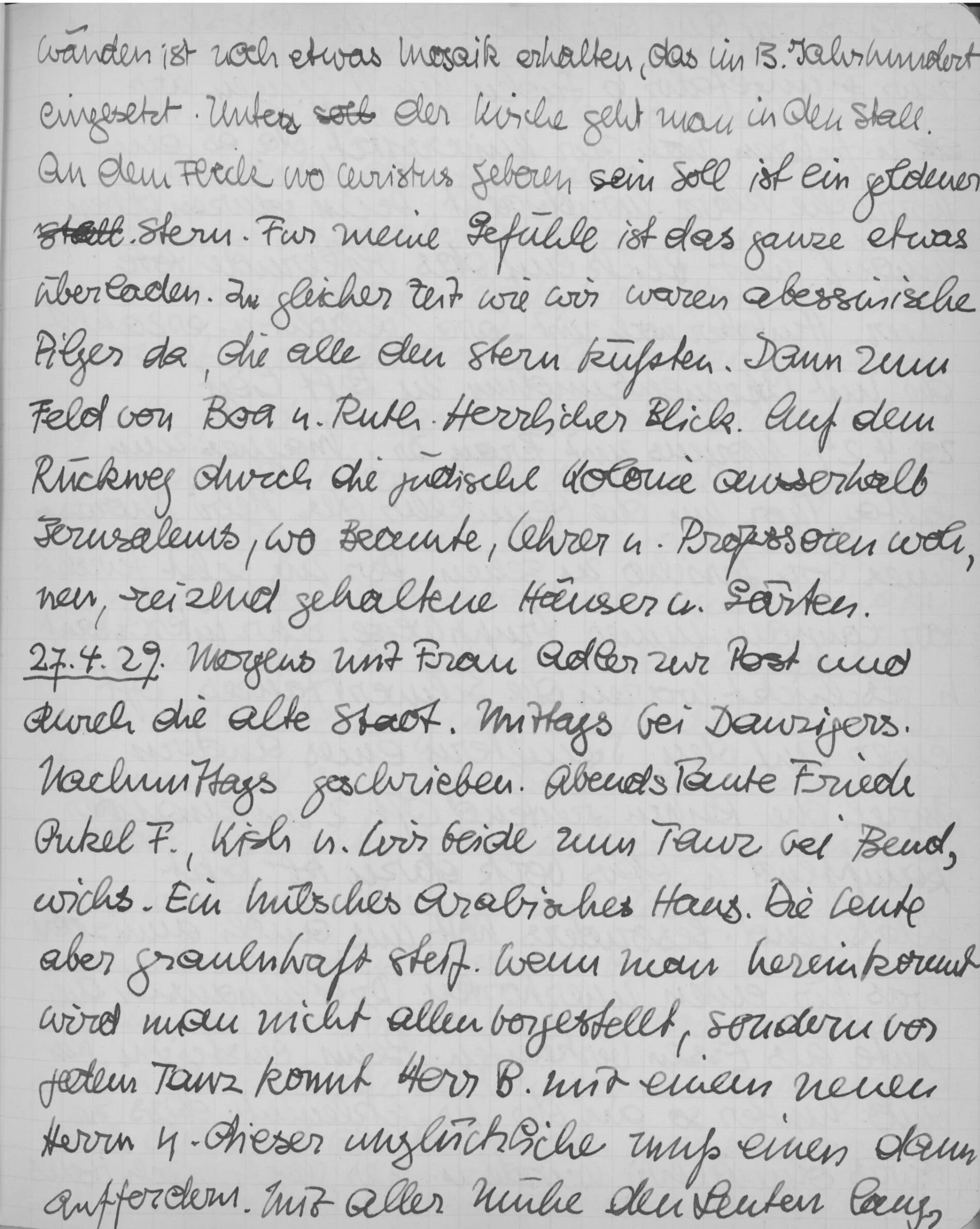
By car to Bethlehem in the morning. Church of the nativity, an old basilica erected during the reign of emperor Constantine. Unostentatious and impressive at the same time. One can still make out some of the 13. Century mosaic on the walls. The area below the church is marked by a golden star, it is believed to be the birthplace of Jesus. The whole thing is a little overloaded for my personal taste. During our visit, a group of Abyssinian pilgrims arrived and proceeded to kiss the golden star. On to the Field of Ruth which gives us a magnificent view of the return route through the Jewish colony outside Jerusalem home to teachers, professors, bureaucrats who live in picturesque little homes with gardens.
-
Accompanying Mrs. Adler to the post office and a stroll through the ancient city in the morning.
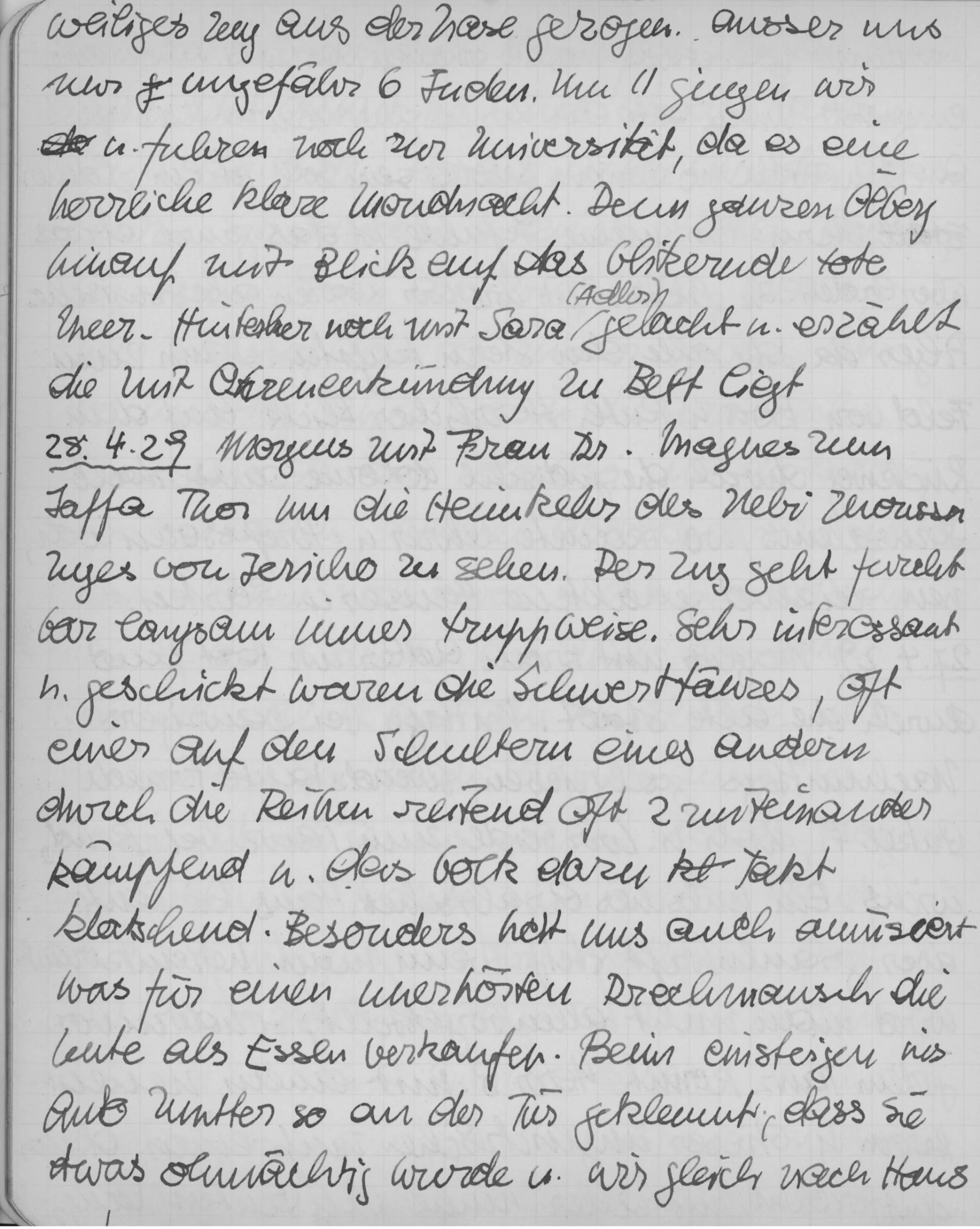
Lunch at Danzigers. Afternoon set aside for writing. Attending a dance at Bendwichs, with aunt Frieda, uncle Felix, Kish and Lori in the evening. A wonderfully charming Arabic home, but the people horribly stiff. Nobody is being introduced upon arrival. Mr. B is walking over a new gentleman before every song; this unfortunate soul is then forced to ask the lady for the next dance. There are only approximately 6 more Jews there besides us. We left at 11pm and headed to the university. It was a bright moon flooded night. All the way up Mount Olive with a breathtaking view of the sparkling Dead Sea in the background. A late-night chat and laugh with Sara Adler, who is bedridden with an ear infection.
-
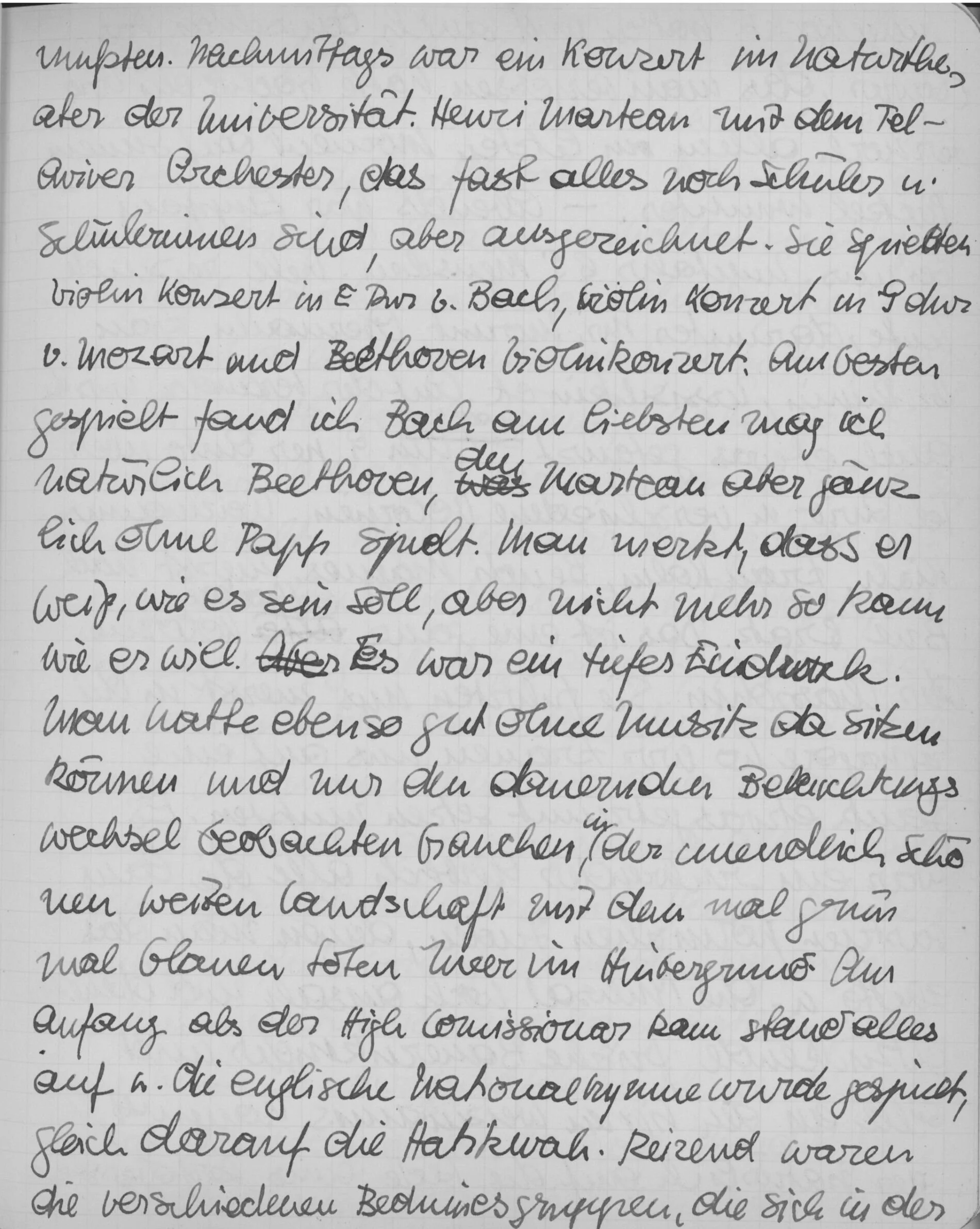
Heading in the morning with Mrs. Magnes to the Jaffa Gate to witness the return of the Nebi Moussa procession from Jericho. Everything goes very slow in stages. The sword dancers were very eye catching, often one riding on the shoulders of another along the rows. Others were pretend fighting, the audience clapping their hands in a rhythmic beat. Mother got stuck in the car door while getting in and passed out, which forced us to head home immediately. We attended a concert at the open-air theatre of the university. The high commissioner arrived and everybody stood up. They played the English national anthem followed by the HaTikvah. Most of the musicians are still students, and exceptionally talented. They performed violin concerto in E major by S. Bach, violin concerto in E flat major by Mozart and Beethoven’s violin concerto. The best piece performed was Bach, although I prefer Beethoven that Martean is not able to bring to its fullness during the concert. I sense that he is aware of it, but not able to step up. You could have just sat there without the music, watching the constant change of lighting. In this infinitely beautiful and vast landscape with the interchanging green sometimes blue Dead Sea in the background. The different charming groups of Bedouins had crouched down and also listened. Toward the end, an Arab man brought down the piano, that had been missing, all by himself on his back. We hosted a reception, with approximately 65 guests at our house in the evening. There was also dancing on the Veranda. A great deal of interesting people attended among them Mr. Mount, Obermann, Mrs. Rupin etc.
-
9am departure with the car to visit various colonies. Weizmanns, Mrs Kahn, Bendi Magnes. First stop is Bnei Brak, which is strictly orthodox and was founded by Hassidic Families. We were brought to the synagogue first and had to sit apart from the men. It was a moving sight to encounter so many long-bearded Polish Jews, who still exhibited the sufferings and the ghetto. The many delightful rosy faced farm children clinging to Weizmann’s side who was responding to a speech given by one of the village elders. Uncle Felix also gave an eloquent address. After the Rabbi followed singing a prayer everybody joined miraculously in singing the HaTikvah.
A visit at the 4-year-old textile factory which under fabulous management. The main room is filled with deafening noise from the machines. The company has already ordered machines from Germany for 20,000 Marks. Somebody is attaching a Jewish flag to our car and gifts us some beach towels, after taking more photographs we are setting out for Kriumietki. Weizmann was officially saluted by a group of young people, wearing white pants and blue striped shirts. They became our escort for the last two miles of the way. Upon arrival we were shown the agricultural school, all structured along communist ideology. From there to Waydil where a white Arabian thoroughbred, with an armed rider greeted us before we even reached the settlement. This magnificent stallion galloped ahead of all the cars until the final destination was reached. The founder of this colony was originally from Russia and appeared very enthusiastic. We were invited to have lunch which was followed by jubilant speeches. First by the restaurant owner, then by Weizmann, who emphasized how honored and happy he was to have uncle Felix and father present and impressed about what they had seen so far. He proceeded to point out that everybody should share that sentiment. Everything that had been created in this country was everlasting and how honored he felt to be a part of this invaluable work. I held back the tears with all the strength I could summon, but when I looked up and saw massive tears running down father’s cheeks I could not keep my composure any longer. Uncle Felix and father shared a wonderful few word, while father went first, and started deliverance with a raspy voice. The heartfelt Weizmann who had offered me a to become his secretary, got up and gave me a kiss. He told me that there was no reason to be ashamed that tears where the most natural thing and that it was because of this that I should definitely accept the job offer. It was in this moment that I especially missed Lola who would have loved nothing more than to keep me company. Anita was saved through an amusing joke by Mrs. Kahn.
We made our way to Tel Aviv to an athletic event. Handball and long distant running, everybody dressed in traditional Palestinian colors.
After freshening up in the hotel we are heading to Tollkewsky, where we meet three of the Habimah people.
Rowinah is exceptionally delightful. The small blond actor is unfortunately not as Interesting. His German is not very fluent which makes it challenging for him to express himself properly. Everybody spoke of “our Lola!”
After a little cat nap, dinner at the hotel Palatin. Later to the theatre -“ The Eternal Jew.” Everybody on stage groups together to form a complete picture. I found the prophet beautiful, the Rowinah touching. The intermittent singing gives the whole performance a solemnly festive touch. We meet the same people everywhere here, Samuels, the brothers Weizmann, Pollack and many others I cannot remember the names. Anita and I brought flowers to the Rowinah, who quickly addressed the audience but especially Weizmann’s attendance concluding that there are not enough words to express how lucky and happy she felt. An overall indescribably beautiful evening. A late-night drive back to Jerusalem. Bendi kept talking in German the entire way back, mostly nonsense, being overly tired made us all giddy and laughing all the way back.
-
Sarah had to get her eardrum punctured yesterday. Her fever broke but she is still very exhausted. We are not sure if Adlers can accompany us. Writing in diary in the morning. Afternoon at the High Commissioner. The violinist Marteau and his wife attended besides us. I sat next to the stupid secretary that I had already met at the dance. Across from us a beautiful and nice friend of the daughter. The High Commissioner and his wife only entered after everybody was present. They are treated like royalty here. In the afternoon 1,5-hour drive to the Dead Sea. An absolute infernal heat. There is no Breeze. We are driving through a bare, sun burned stone desert. A grandiose but melancholy landscape.
At Kish’s in the evening, Sachers and their nephew, Weizmanns, Magnes and his sister. We walked there and back, because it is Saturday. Magnes who I like the best of all the people I have met, promised me to hold my marriage ceremony for me.
-
Sleeping in and writing in the diary. Bendi comes to pick us up. He committed to a violin performance at workers function. We wanted to hear him play. We realized that it was in actuality a farewell party for us. Magnes and sons, Weizmanns, Kisch, Adlers, uncle Felix all spoke with little anecdotes about everybody around the table. This time it was Anita who lost her composure. I also lost a tear during the farewell kiss of Weizmann.
-
8:30 am departing our beloved Jerusalem. Saying good bye was very hard. I have seen, Experienced and met more nice people in these last 2,5 weeks than in my whole entire life. Most of the people we met were at the train station. Mrs. Weizmann, Magnes family, Bernhard Kahns, Mrs. Bentwich, Adlers, Mrs. Pet, Kisch. I know deep inside that I will return. The only question is when.
Arrival in Kantara at 5:30 where the same English officer that had welcomed us. He took us out in in a boat to watch the sun set on the Suez Canal. It was a wonderful and refreshing ride. We spend the night on the train and arrived at 10:30 in Cairo.
-
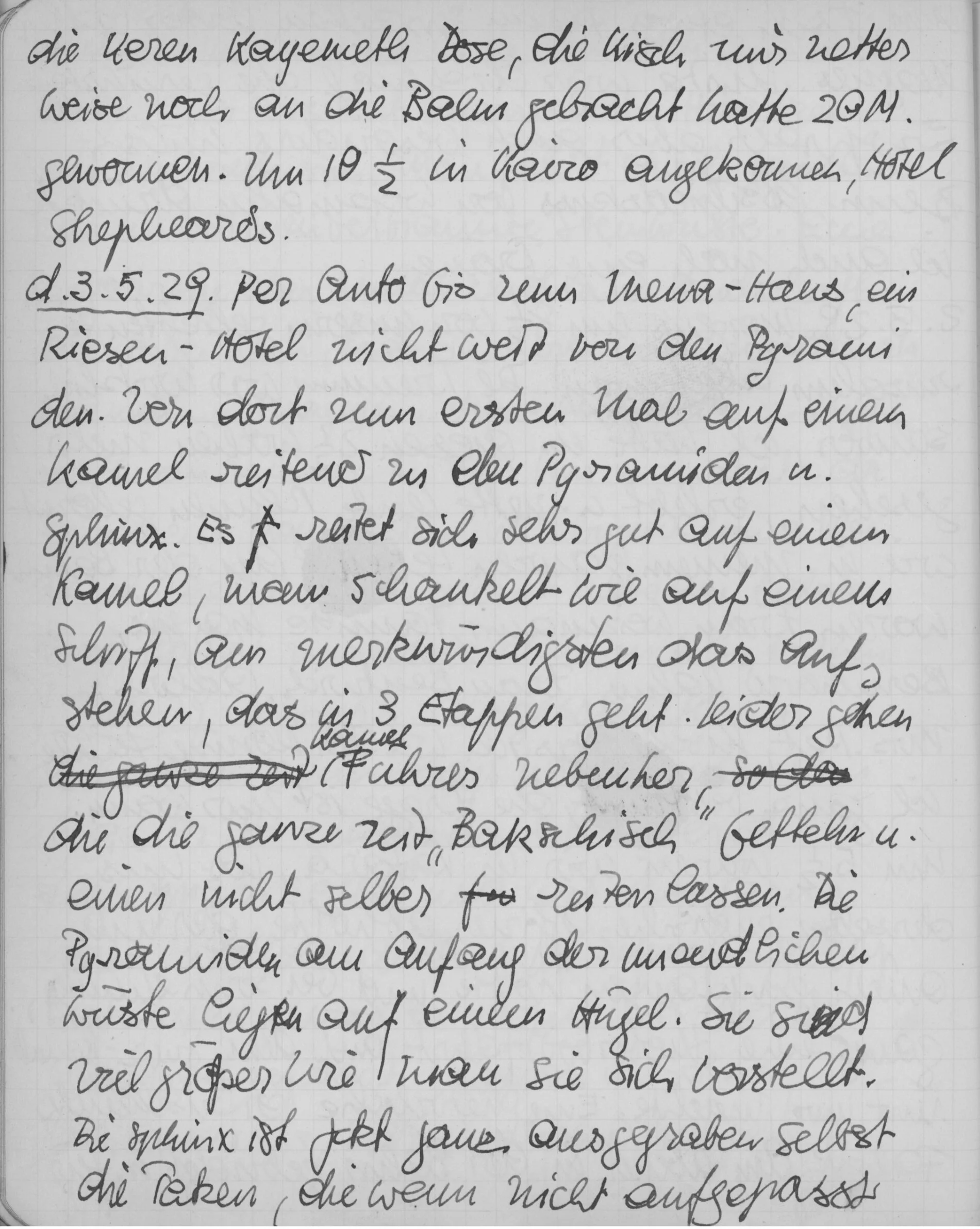
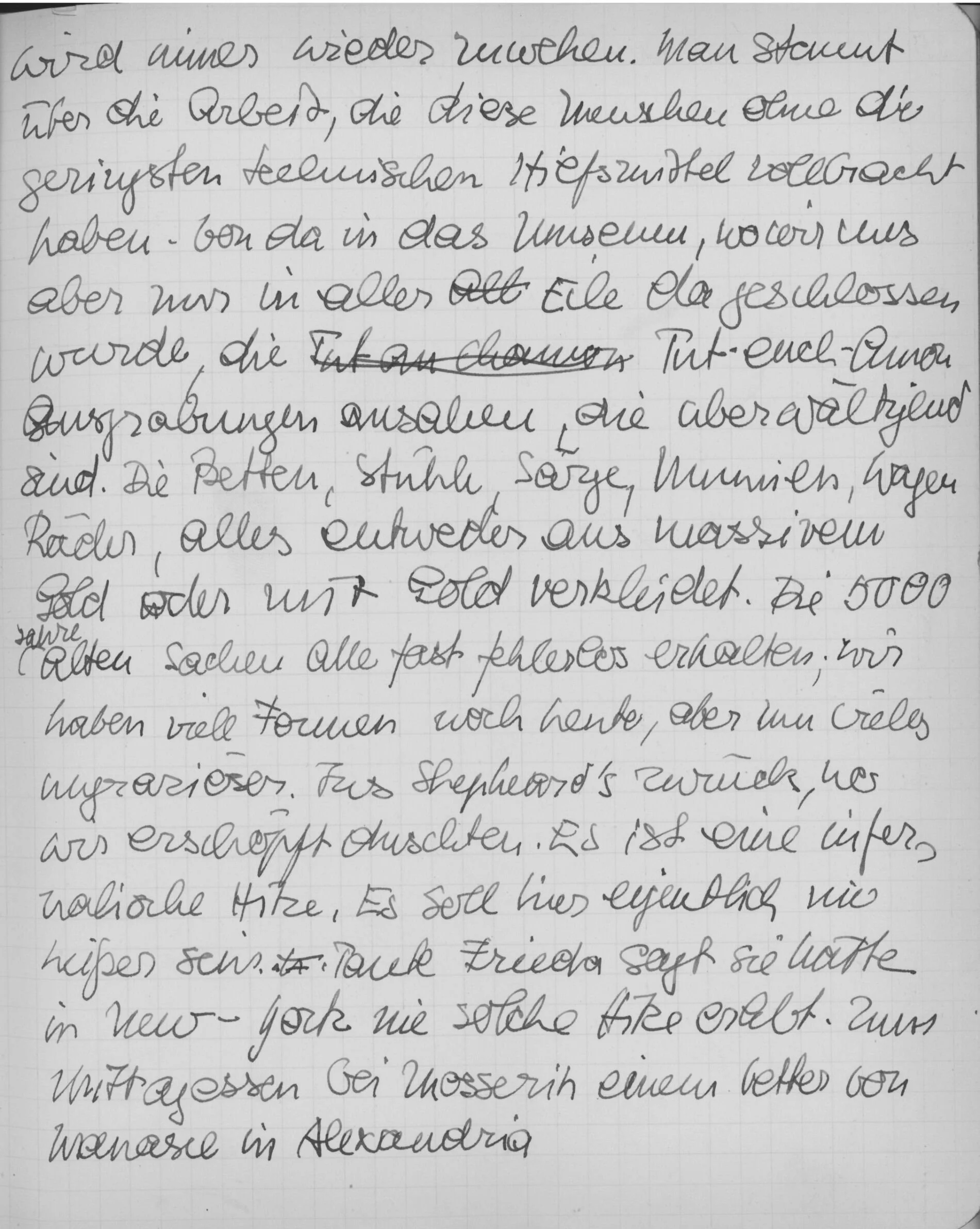
We were picked up by car and brought to the Mena, a gigantic hotel not far from the Pyramids. It was there that I got on top of a camel for the first time. We were riding to the Pyramids and to visit the Sphinx. It was a pleasant experience, one rocks just like on being on a ship. The most peculiar thing is when the animal is getting up, which takes place in 3 stages. Unfortunately, the guides are walking besides the animal and would not allow us to ride alone. Instead they continuously asked for Baksheesh. The Pyramids are located at the beginning of this infinite desert on a hill. They are far more imposing than I had envisioned. The sphinx is now completely unearthed, even the lion’s paws that tend to be blown over if not careful. The craftsmanship amazes the visitor. What these people have accomplished without the slightest technical assistance is truly magnificent. Next visit is the museum and the Tutankhamun excavations, which are to be honest overwhelming. The chairs, beds, coffins, mummies, carriages and their large wheels are all either made from pure gold or are gold plated. The 5000-year-old artifacts are flawlessly preserved. Many of the various styles are still found to this day in society, but far less graceful.
Exhausted, we are all heading back to the hotel to freshen up. The heat is unbearable. Aunt Frieda says she has never experienced such heat in New Work. We have a lunch invitation at Mosserih, a cousin of Manasee in Alexandria.