
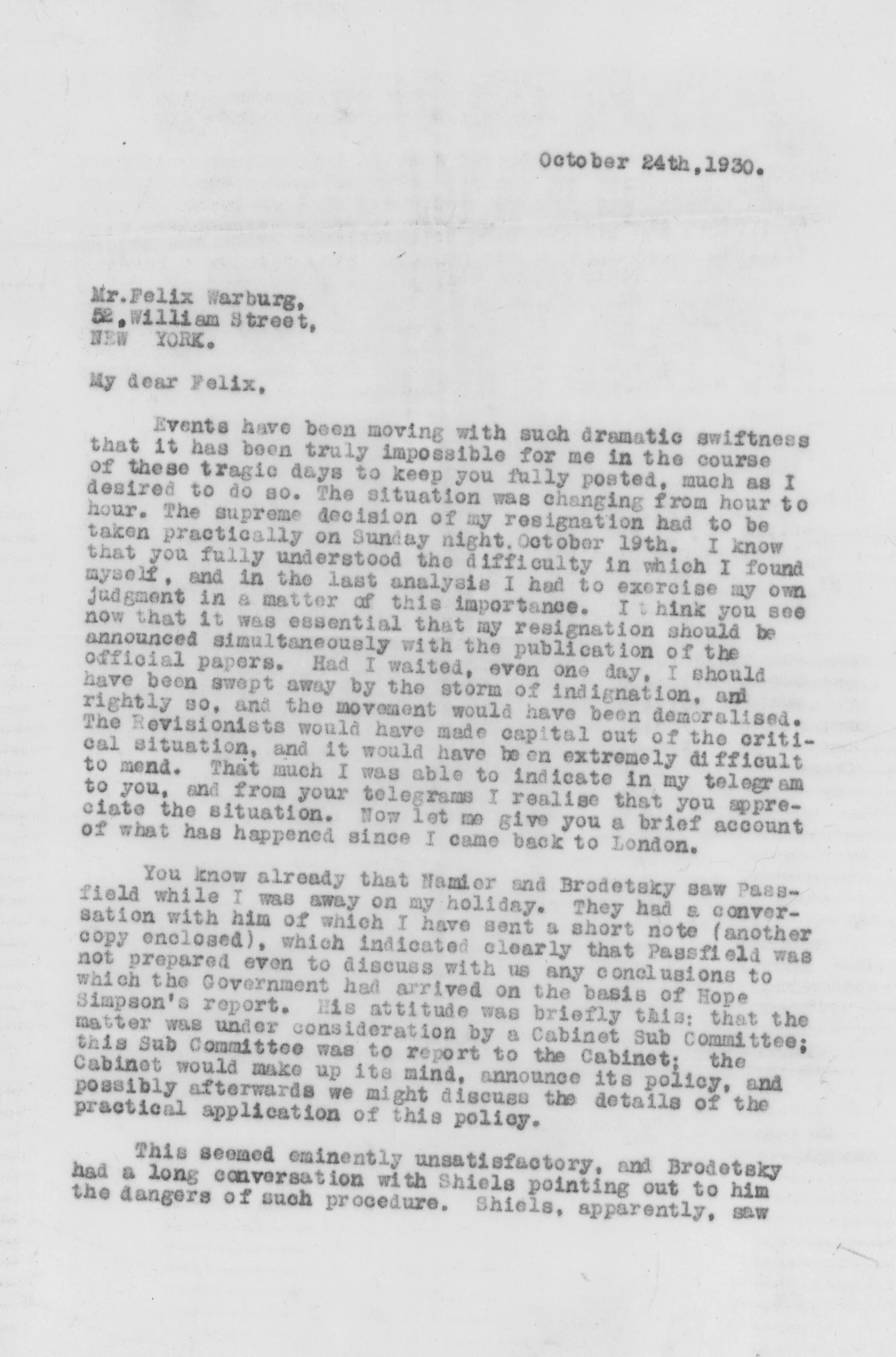
October 24th, 1930 [English]
Mr. Felix Warburg,
52 William Street,
NEW YORK.
My dear Felix,
Events have been moving with such dramatic swiftness that it has been truly impossible for me in the course of these tragic days to keep you fully posted, much as I desired to do so. The situation was changing from hour to hour. The supreme decision of my resignation had to be taken practically on Sunday night. October 19th. I know that you fully understood the difficulty in which I found myself, and in the last analysis I had to exercise my own judgment in a matter of this importance. I think you see now that it was essential that my resignation should be announced simultaneously with the publication of the official papers. Had I waited, even one day, I should have been swept away by the storm of indignation, and rightly so, and the movement would have been demoralized. The revisionists would have made capital out of the critical situation, and it would have been extremely difficult to mend. That much I was able to indicate in my telegram to you, and from your telegram I realize that you appreciate the situation. Now let me give you a brief account of what has happened since I came back to London.
You know already that Namier and Brodetsky saw Passfield while I was away on my holiday. They had a conversation with him of which I have sent a short note (another copy enclosed), which indicate clearly that Passfield was not prepared even to discuss with us any conclusions to which the Government had arrived on the basis of Hope Simpson’s report. His attitude was briefly this: that the matter was under consideration by a Cabinet Sub Committee; this Sub Committee was to report to the Cabinet; the Cabinet would make up its mind, announce its policy, and possibly afterwards we might discuss the details of the practical application of this policy.
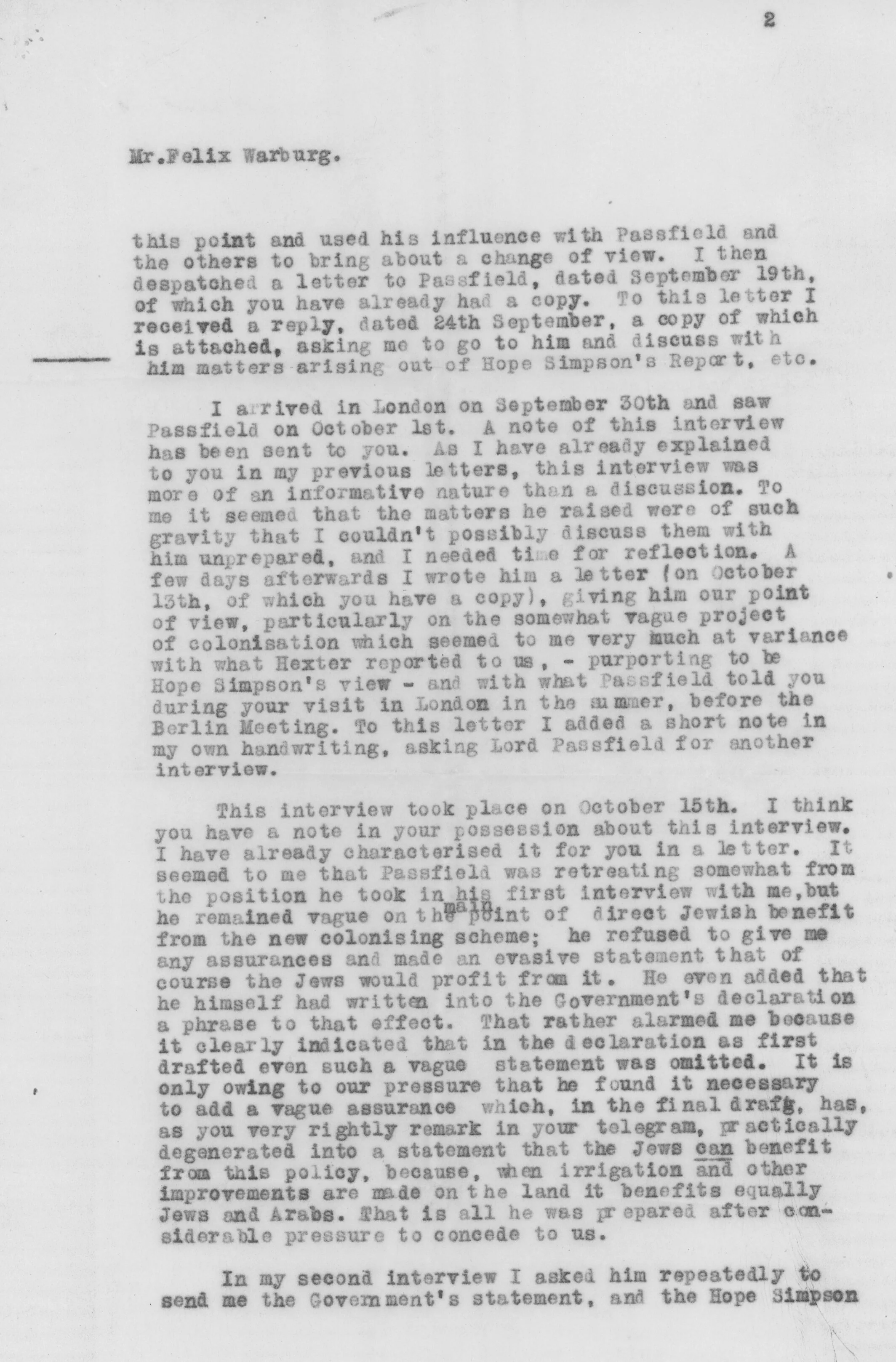
This seemed eminently unsatisfactory, and Brodetsky had a long conversation with Shiels pointing out to him the dangers of such procedure. Shiels, apparently, saw this point and used his influence with Passfield and the others to bring about a change of view. I then despatched a letter to Passfield, dated September 19th, of which you have already had a copy. To this letter I received a reply, dated 24th September, a copy of which is attached, asking me to go to him and discuss with him matters arising out of Hope Simpson’s Report, etc.
I arrived in London on September 30th and saw Passfield on October 1st. A note of this interview has been sent to you. As I have already explained to you in my previous letters, this interview was more of an informative nature than a discussion. To me it seemed that the matters he raised were of such gravity that I couldn’t possibly discuss them with him unprepared, and I needed time for reflection. A few days afterwards I wrote him a letter (on October 13th, of which you have a copy), giving him our point of view, particularly on the somewhat vague project of colonization, which seemed to me very much at variance with what Hexter reported to us, - purporting to be Hope Simpson’s view - and with what Passfield told you during your visit in London in the summer, before the Berlin Meeting. To this letter I added a short note in my own handwriting, asking Lord Passfield for another interview.
This interview took place on October 15th. I think you have a note in your possession about this interview. I have already characterized it for you in a letter. It seemed to me that Passfield was retreating somewhat from the position he took in his first interview with me, but he remained vague on the main point of direct Jewish benefit from the new colonizing scheme; he refused to give me any assurances and made an evasive statement that of course the Jews would profit from it. He even added that he himself had written into the government’s declaration a phrase to that effect. That rather alarmed me because it clearly indicated that in the declaration as first drafted even such a vague statement was omitted. It is only owing to our pressure that he found it necessary to add a vague assurance which, in the final draft, has, as you very rightly remark in your telegram, practically degenerated into a statement that the Jews can benefit from this policy, because, when irrigation and other improvements are made on the land it benefits equally Jews and Arabs. That is all he was prepared after considerable pressure to concede to us.
In my second interview I asked him repeatedly to send me the Government’s statement, and the Hope Simpson.
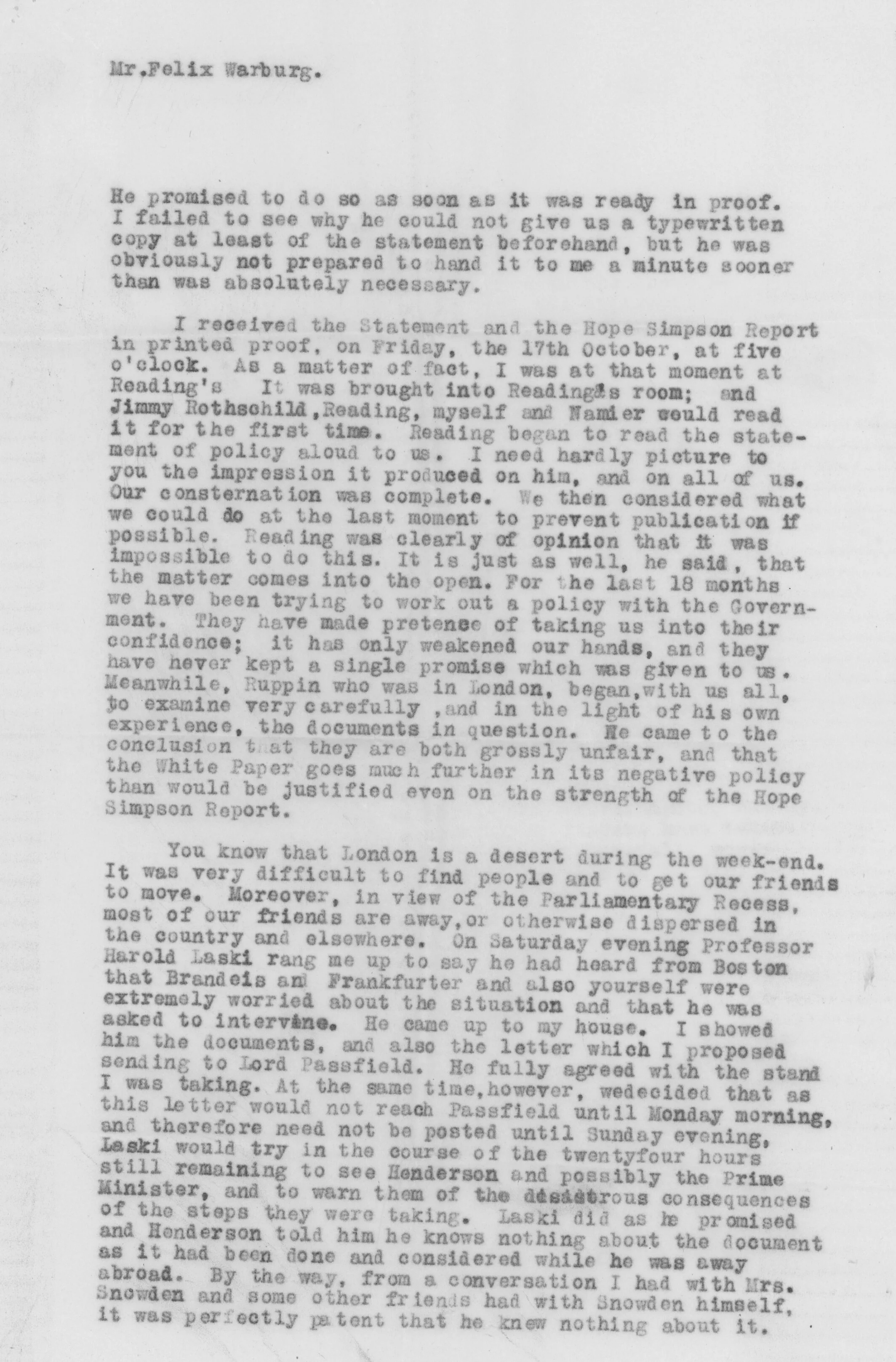
He promised to do so as soon as it was ready in proof. I failed to see why he could not give us a typewritten copy at least of the statement beforehand, but he was obviously not prepared to hand it to me a minute sooner than was absolutely necessary.
I received the statement and the Hope Simpson Report in printed proof, on Friday, the 17th October, at five o’clock. As a matter of fact, I was at that moment at Reading’s. It was brought into Reading’s room; and Jimmy Rothschild, Reading, myself and Namier would read it for the first time. Reading began to read the statement of policy aloud to us. I need hardly picture to you the impression it produced on him, and on all of us. Out consternation was complete. We then considered what we could do at the last moment to prevent the publication if possible. Reading was clearly of opinion that it was impossible to do this. It is just as well, he said, that the matter comes into the open. For the last 18 months we have been trying to work out a policy with the Government. They have made pretense of taking us into their confidence; it has only weakened our hands, and they have never kept a single promise which was given to us. Meanwhile, Ruppin who was in London, began, with us all, to examine very carefully, and in the light of his own experience, the documents in question. He came to the conclusion that they are both grossly unfair, and that the White Paper goes much further in its negative policy than would be justified even on the strength of the Hope Simpson Report.
You know that London is a desert during the weekend. It was very difficult to find people and to get our friends to move. Moreover, in view of the Parliamentary Recess, most of our friends are away, or otherwise dispersed in the country and [corrupted line in scan] Harold Laski rang me up to say he had heard from Boston that Brandeis and Frankfurter and also yourself were extremely worried about the situation and that he was asked to intervene. He came up to my house. I showed him the documents, and also the letter which I proposed sending to Lord Passfield. He fully agreed with the stand I was taking. At the same time, however, we decided that as this letter would not reach Passfield until Monday morning, and therefore need not be posted until Sunday evening, Laski would try in the course of the twenty four hours still remaining to see Henderson and possibly the Prime Minister, and to warn them of the disastrous consequences of the steps they were taking. Laski did as he promised and Henderson told him he knows nothing about the document as it had been done and considered while he was away abroad. By the way, from a conversation I had with Mrs. Snowden and some other friends had with Snowden himself, it was perfectly patent that he knew nothing about it.
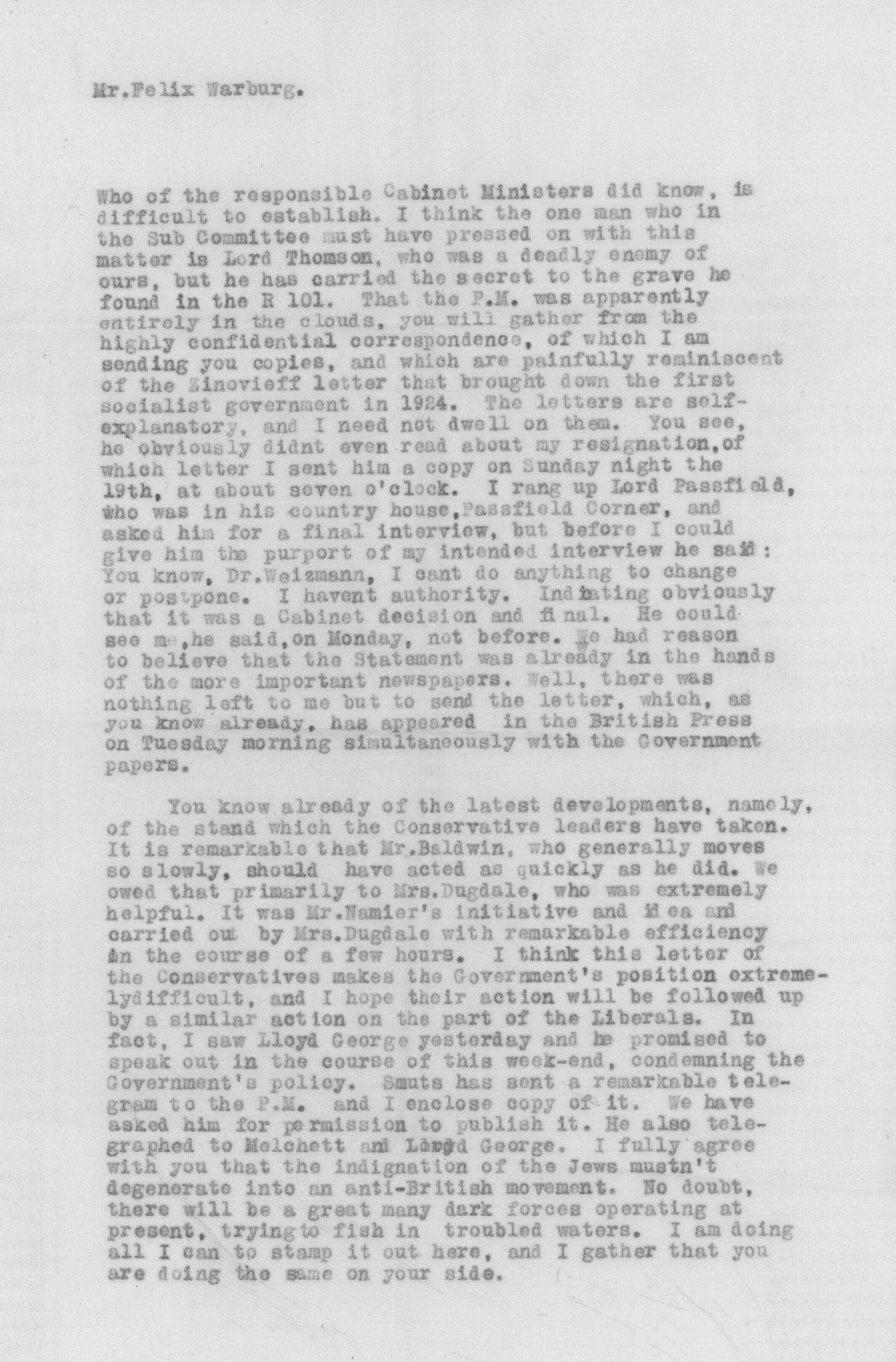
Who of the responsible Cabinet Ministers did know, is difficult to establish. I think the one man who in the Sub Committee must have pressed on with this matter is Lord Thomson, who was a deadly enemy of ours, but he has carried the secret to the grave he found in the R 101. That the P.M. was apparently entirely in the clouds, you will gather from the highly confidential correspondence, of which I am sending you copies, and which are painfully reminiscent of the Zinovleff (English spelling Zinoviev) letter that brought down the first socialist government in 1924. The letters are self-explanatory, and I need not dwell on them. You see, he obviously didn’t even read about my resignation, of which letter I send him a copy on Sunday night the 19th, at about seven o’clock. I rang up Lord Passfield, who was in his country house, Passfield Corner, and asked him for a final interview, but before I could give him the purport of my intended interview he said: You know, Dr. Weizmann, I can’t do anything to change or postpone. I haven’t authority. Indicating obviously that it was a Cabinet decision and final. He could see me, he said, on Monday, not before. We had reason to believe that the Statement was already in the hands of the more important newspapers. Well, there was nothing left of me but to send the letter, which, as you know already, has appeared in the British Press on Tuesday morning simultaneously with the Government papers.
You know already of the latest developments, namely, of the stand which the Conservative leaders have taken. It is remarkable that Mr. Baldwin, who generally moves so slowly, should have acted as quickly as he did. We owed that primarily to Mrs. Dugdale, who was extremely helpful. It was Mr. Namier’s initiative and idea and carried out by Mrs. Dugdale with remarkable efficiency in the course of a few hours. I think this letter of the conservatives makes the Government’s position extremely difficult, and I hope their action will be followed up by a similar action on the part of the Liberals. In fact, I saw Lloyd George yesterday and he promised to speak out in the course of this weekend, condemning the Government’s policy. Smuts has sent a remarkable telegram to the P.M. and I enclose copy of it. We have asked him for permission to publish it. He also telegraphed to Melchett and Lloyd George. I fully agree with you that the indignation of the Jews mustn’t degenerate into an anti-British movement. No doubt, there will be a great many dark forces operating at present, trying to fish in troubled waters. I am doing all I can to stamp it out here, and I gather that you are doing the same on your side.
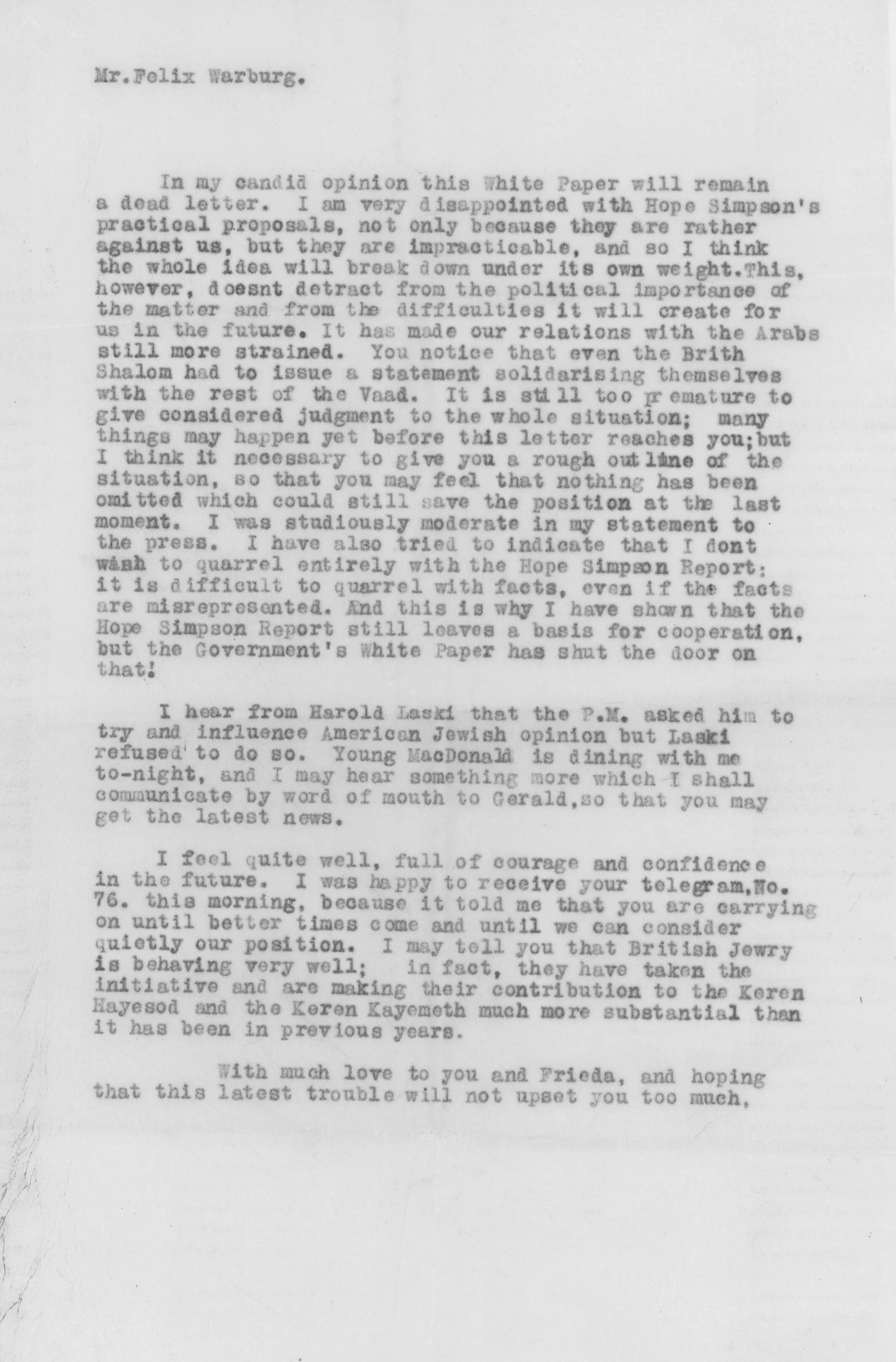
In my candid opinion this White Paper will remain a dead letter. I am very disappointed with Hope Simpson’s practical proposals, not only because they are rather against us, but they are impracticable, and so I think the whole idea will break down under its own weight. This, however, doesn’t detract from the political importance of the matter and from the difficulties it will create for us in the future. It has made our relations with the Arabs still more strained. You notice that even the Brith Shalom had to issue a statement solid arising themselves with the rest of the Vaad. It is still too premature to give considered judgement to the whole situation; many things may happen yet before this letter reaches you; but I think it necessary to give you a rough outline of the situation, so that you may feel that nothing has been omitted which could still save the position at the last moment. I was studiously moderate in my statement to the press. I have also tried to indicate that I don’t wish to quarrel entirely with the Hope Simpson Report: it is difficult to quarrel with facts, even if the facts are misrepresented. And this is why I have shown that the Hope Simpson Report still leaves a basis for cooperation, but the Government’s White Paper has shut the door on that!
I hear from Harold Laski that the P.M. asked him to try and influence American Jewish opinion but Laski refused to do so. Young Macdonald is dining with me to-night, and I may hear something more which I shall communicate by word of mouth to Gerald, so that you may get the latest news.
I feel quite well, full of courage and confidence in the future. I was happy to receive your telegram, No. 76, this morning, because it told me that you are carrying on until better times come and until we can consider quietly our position. I may tell you that British Jewry is behaving very well; in fact, they have taken the initiative and are making their contribution to the Keren Hayesod and the Keren Kayemeth much more substantial than it has been in previous years.
With much love to you and Frieda, and hoping that this latest trouble will not upset you too much.